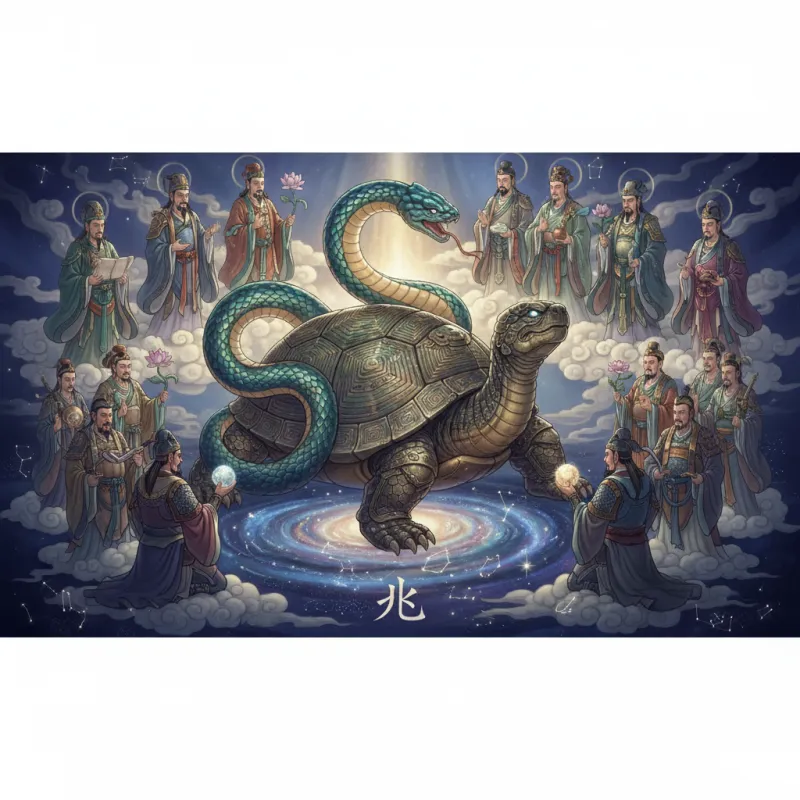
Xuanwu: The Turtle-Snake Deity of the North
⏱️ 24 min read⏱️ 24 min read⏱️ 23 min readXuanwu: The Turtle-Snake Deity of the North
Introduction: Guardian of the Northern Heavens
In the vast pantheon of Chinese deities, few figures embody the profound synthesis of martial power, cosmic balance, and spiritual transformation quite like Xuanwu (玄武, Xuánwǔ), the Dark Warrior of the North. This enigmatic deity, depicted as a turtle entwined with a snake, stands as one of the Four Symbols (四象, Sì Xiàng) that govern the cardinal directions in Chinese cosmology. While the Azure Dragon guards the East, the Vermilion Bird protects the South, and the White Tiger watches over the West, Xuanwu reigns supreme over the northern quadrant, embodying the elemental forces of water and the season of winter.
The very name "Xuanwu" carries layers of meaning that reveal the deity's essential nature. The character 玄 (xuán) signifies "dark," "mysterious," or "profound," evoking the deep, unknowable waters and the midnight sky of the north. The character 武 (wǔ) means "martial" or "military," establishing this deity as a warrior god of formidable power. Yet Xuanwu transcends simple martial prowess—this deity represents the ultimate fusion of yin and yang energies, the harmonious union of opposites, and the transformative journey from mortal to immortal.
The Iconography: Turtle and Snake as Cosmic Unity
The most distinctive feature of Xuanwu is the composite form of a black turtle (龟, guī) with a snake (蛇, shé) coiled around its body or emerging from its shell. This unusual pairing is far from arbitrary; it represents one of the most sophisticated symbolic constructs in Chinese religious thought.
The turtle, with its hard shell and long lifespan, has been revered in Chinese culture since ancient times as a symbol of longevity, stability, and cosmic endurance. Oracle bones from the Shang Dynasty (商朝, Shāng Cháo, c. 1600-1046 BCE) were often made from turtle plastrons, establishing the creature as a mediator between heaven and earth. The turtle's ability to withdraw into its shell represents the Daoist principle of self-preservation through strategic retreat—a form of martial wisdom that values survival over reckless aggression.
The snake, conversely, embodies flexibility, transformation, and the vital energy of renewal. Snakes shed their skin, symbolizing rebirth and the cyclical nature of existence. In Chinese cosmology, the snake is associated with the earth element and represents the yin principle—receptive, adaptive, and deeply connected to the hidden currents of qi (气, qì) that flow through the natural world.
Together, the turtle and snake form a perfect mandala of complementary forces. The turtle represents yang within yin—the hard within the soft, the stable within the fluid. The snake represents yin within yang—the flexible within the rigid, the transformative within the enduring. This intertwining symbolizes the fundamental Daoist teaching that all things contain their opposite, and that true power emerges from the balance and integration of seemingly contradictory forces.
Historical Evolution: From Stellar Constellation to Martial Deity
Xuanwu's origins can be traced to ancient Chinese astronomy and the observation of the northern night sky. The deity began as a constellation grouping in the northern quadrant, one of the Twenty-Eight Mansions (二十八宿, Èrshíbā Xiù) that divided the celestial sphere. These seven northern mansions—Dipper (斗, Dǒu), Ox (牛, Niú), Girl (女, Nǚ), Emptiness (虚, Xū), Rooftop (危, Wēi), Encampment (室, Shì), and Wall (壁, Bì)—were collectively visualized as forming the shape of a turtle-snake creature.
During the Han Dynasty (汉朝, Hàn Cháo, 206 BCE-220 CE), Xuanwu became firmly established as one of the Four Symbols, appearing in tomb murals, bronze mirrors, and architectural decorations. Archaeological discoveries from this period show Xuanwu depicted on the northern walls of burial chambers, serving as a guardian against malevolent spirits and a guide for the deceased soul's journey through the afterlife.
The transformation of Xuanwu from astronomical symbol to personified deity accelerated during the Tang Dynasty (唐朝, Táng Cháo, 618-907 CE), when Daoist theology systematized the celestial bureaucracy. However, the most dramatic evolution occurred during the Song Dynasty (宋朝, Sòng Cháo, 960-1279 CE), when Emperor Zhenzong (真宗, Zhēnzōng) claimed to have received a divine revelation from Xuanwu, elevating the deity to unprecedented prominence.
The Ming Dynasty (明朝, Míng Cháo, 1368-1644 CE) witnessed Xuanwu's apotheosis as a supreme deity. The Yongle Emperor (永乐帝, Yǒnglè Dì), who had launched his successful rebellion from the north, attributed his victory to Xuanwu's divine protection. He commissioned the construction of the magnificent Wudang Mountains (武当山, Wǔdāng Shān) temple complex in Hubei Province, which became—and remains—the primary cult center for Xuanwu worship. The emperor bestowed upon the deity the exalted title Zhenwu Dadi (真武大帝, Zhēnwǔ Dàdì), the "Perfect Warrior Great Emperor" or "Perfected Martial Emperor."
The Legend of Prince Jingye: From Mortal to Immortal
The most popular hagiography of Xuanwu tells the story of his mortal incarnation as Prince Jingye (净乐太子, Jìnglè Tàizǐ), the son of a virtuous king and queen who ruled the kingdom of Jingle. According to this narrative, the queen dreamed of swallowing the sun and subsequently became pregnant. The prince was born with extraordinary qualities—intelligent, compassionate, and utterly disinterested in worldly pleasures or political power.
Despite his parents' wishes that he inherit the throne, Prince Jingye felt a profound calling toward spiritual cultivation. At the age of fifteen, he renounced his royal status and retreated to the remote Wudang Mountains to pursue Daoist practices. For forty-two years, he engaged in rigorous self-cultivation, meditation, and martial training, subsisting on minimal food and enduring extreme hardships.
The most dramatic episode in his transformation involves the purification of his internal organs. According to legend, after decades of cultivation, the prince realized that his stomach and intestines—having consumed worldly food for his first fifteen years—remained impure and prevented his final transcendence. In an act of extreme asceticism, he cut open his own abdomen, removed his stomach and intestines, and washed them in a river. These organs, imbued with residual consciousness, transformed into a demon turtle and a demon snake that terrorized the local population.
The prince, now purified, had to subdue these manifestations of his former self. After an epic battle demonstrating his mastery of martial arts and spiritual power, he defeated and tamed the turtle and snake, which became his loyal servants and the symbols of his complete integration of all aspects of his being—pure and impure, celestial and earthly, spiritual and physical. This victory marked his final transformation into the immortal deity Xuanwu.
The Jade Emperor (玉皇大帝, Yùhuáng Dàdì), impressed by this achievement, appointed him Guardian of the North and bestowed upon him command over the northern heavens, with authority over water, winter, and the element of darkness.
Xuanwu in Daoist Practice and Cosmology
Within Daoist religious practice, Xuanwu occupies a position of supreme importance, particularly in the Zhengyi (正一, Zhèngyī) and Quanzhen (全真, Quánzhēn) traditions. The deity serves multiple functions across different contexts of worship and spiritual cultivation.
As a protective deity, Xuanwu guards against evil spirits, demons, and misfortune. Daoist priests invoke Xuanwu in exorcism rituals (驱邪, qūxié) and protective ceremonies. Talismans (符, fú) bearing Xuanwu's image or seal are used to ward off negative energies and ensure safety during travel, particularly journeys to the north or across water.
In internal alchemy (内丹, nèidān) practices, Xuanwu represents the kidneys and the water element within the human body. The turtle symbolizes the jing (精, jīng)—the essential life force stored in the kidneys—while the snake represents the movement of qi through the body's meridians. Practitioners visualize Xuanwu during meditation to strengthen kidney energy, enhance vitality, and achieve the harmonious circulation of internal energies necessary for spiritual transformation.
The deity also plays a crucial role in fengshui (风水, fēngshuǐ) and directional symbolism. The northern sector of any space—whether a home, temple, or city—falls under Xuanwu's protection. Proper alignment with Xuanwu's energy ensures stability, security, and the accumulation of wealth. The ideal fengshui configuration places a mountain or elevated terrain to the north (the Xuanwu position), providing solid backing and protection.
Temples and Sacred Sites
The Wudang Mountains remain the most sacred site associated with Xuanwu worship. This UNESCO World Heritage Site contains dozens of temples, monasteries, and shrines built into the dramatic mountain landscape. The Golden Hall (金殿, Jīn Diàn) at the summit of Tianzhu Peak houses a magnificent bronze statue of Zhenwu Dadi, while the complex's architecture demonstrates sophisticated integration of religious symbolism with natural topography.
The Purple Cloud Palace (紫霄宫, Zǐxiāo Gōng), constructed during the Ming Dynasty, serves as the primary ceremonial center for Xuanwu worship. Its main hall contains elaborate murals depicting the deity's life story and spiritual achievements. Daoist priests continue to perform daily rituals and seasonal ceremonies honoring Xuanwu, maintaining traditions that stretch back centuries.
Beyond Wudang, Xuanwu temples can be found throughout China, particularly in coastal regions where the deity's association with water makes him a patron of sailors, fishermen, and merchants engaged in maritime trade. In Beijing, the Temple of True Martial Peak (真武庙, Zhēnwǔ Miào) served as an important site for imperial worship during the Ming and Qing dynasties.
Cultural Influence and Modern Relevance
Xuanwu's influence extends far beyond religious contexts into Chinese martial arts, literature, and popular culture. The deity is considered a patron of martial artists, particularly those practicing internal martial arts (内家拳, nèijiāquán) such as Taijiquan (太极拳, Tàijíquán) and Baguazhang (八卦掌, Bāguàzhǎng). These arts emphasize the same principles embodied by Xuanwu—the integration of hard and soft, the strategic use of yielding to overcome force, and the cultivation of internal power through patient practice.
In classical Chinese literature, Xuanwu appears in the Ming Dynasty novel "Journey to the North" (北游记, Běi Yóu Jì), which recounts the deity's adventures and spiritual achievements. The novel, while less famous than "Journey to the West," provides rich detail about Xuanwu's mythology and his role in the celestial hierarchy.
Contemporary Chinese culture continues to reference Xuanwu in various media. The deity appears in films, television series, video games, and graphic novels, often depicted as a powerful guardian or wise mentor figure. The symbolism of the turtle-snake combination resonates with modern audiences as a representation of balance, wisdom, and the integration of opposing forces.
Conclusion: The Enduring Mystery of the Dark Warrior
Xuanwu stands as one of Chinese religion's most complex and multifaceted deities—simultaneously a cosmic force, a historical figure, a martial protector, and a symbol of spiritual transformation. The image of the turtle and snake, locked in eternal embrace, continues to captivate imagination and inspire contemplation about the nature of duality, balance, and transcendence.
In an age of rapid change and uncertainty, Xuanwu's teachings remain profoundly relevant. The deity reminds us that true strength comes not from rigid force but from flexible adaptation, that protection requires both defensive stability and offensive capability, and that spiritual achievement demands the integration of all aspects of our being—light and dark, pure and impure, celestial and earthly.
The Dark Warrior of the North continues to watch over his domain, a timeless guardian whose mysterious depths invite endless exploration and whose martial prowess inspires courage in the face of life's challenges. In temples across China and in the hearts of devotees worldwide, Xuanwu remains a living presence, a bridge between the ancient wisdom of the past and the spiritual needs of the present.
About the Author
Immortal Scholar — A specialist in animal spirits and Chinese cultural studies.
Related Articles
The Four Dragon Kings: Rulers of the Seas
Rulers of the Seas...
Fox Immortals in Daoism: When Animal Spirits Achieve Divinity
When Animal Spirits Achieve Divinity...
Sun Wukong Origins: The Monkey King Before Journey to the West
The Monkey King Before Journey to the West...
Unveiling the Mystique of Chinese Animal Spirits in Daoist and Buddhist Beliefs
Discover the significance of animal spirits in Daoist and Buddhist Chinese mythology....