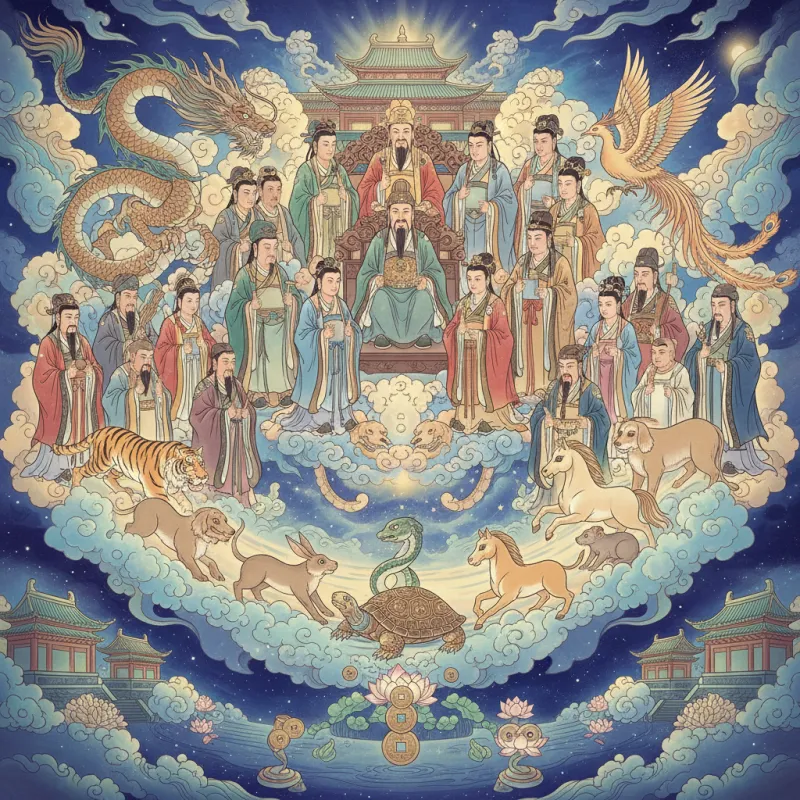
A fox spirit materializes in the moonlight, her nine tails shimmering as she transforms from beast to beautiful woman. In the next village over, a turtle who has lived for three centuries finally achieves enlightenment, ascending to become a minor deity. These aren't fairy tales—they're the lived spiritual reality of millions who have practiced Daoism and Buddhism across two millennia of Chinese history. Animal spirits occupy a peculiar space in the Chinese religious imagination: neither fully divine nor entirely mortal, they exist in the liminal zones where cultivation, karma, and transformation intersect.
The Cultivation Paradigm: Why Animals Can Become Gods
The fundamental difference between Chinese animal spirits and their Western counterparts lies in one revolutionary concept: xiūliàn (修炼), or spiritual cultivation. In the Daoist and Buddhist worldview, divinity isn't a fixed category—it's an achievement. A human can become an immortal through decades of meditation and alchemical practice. So why not a fox? Why not a snake?
The Fengshen Yanyi (封神演义, Investiture of the Gods), that sprawling 16th-century novel, makes this explicit. Among the 365 deities officially canonized after the Shang-Zhou war, several began as animals. The most famous is probably Huang Feihu's mount, a mystical bovine that achieves divine status alongside its master. But the novel treats this as unremarkable—of course animals can cultivate. They have hun and po souls just like humans, merely configured differently.
Buddhist texts take this further. The Lotus Sutra explicitly states that all sentient beings possess Buddha-nature, including animals. The dragon king's daughter achieves Buddhahood instantly in one famous passage, confounding the male disciples who insist enlightenment requires countless lifetimes. If a dragon—traditionally associated with storms and chaos—can become a Buddha, the path is open to any creature with sufficient determination.
The Fox Spirit Hierarchy: From Trickster to Celestial Official
No animal spirit has captured Chinese imagination quite like the húxiān (狐仙, fox immortal). But "fox spirit" is far too crude a translation for the complex taxonomy that developed over centuries. The Taiping Guangji (太平广记), that massive 10th-century compendium of supernatural tales, distinguishes at least five categories of fox spirits based on their cultivation level and moral alignment.
At the bottom are the yěhú (野狐, wild foxes)—tricksters and seducers who drain human life force through sexual encounters. These are the foxes of cautionary tales, the ones who lead scholars astray and cause family ruin. The Liaozhai Zhiyi (聊斋志异) by Pu Songling is packed with these stories, though Pu's sympathies often lie with the foxes rather than their victims.
Mid-tier fox spirits have achieved partial transformation abilities and some magical powers, but haven't yet transcended their animal nature. They might serve as familiars to Daoist priests or Buddhist monks, trading their services for guidance in cultivation. The Yuewei Caotang Biji (阅微草堂笔记) by Ji Yun describes several such arrangements, treating them as perfectly normal spiritual contracts.
At the apex are the húxiān proper—fox spirits who have cultivated for 500 or 1,000 years, achieved full transformation, and earned recognition from the Celestial Bureaucracy. These beings often serve as local tutelary deities, with their own temples and worship cults. In northeastern China, particularly Manchuria, the húxiān are venerated alongside the weasel, hedgehog, snake, and mouse spirits as the "Five Great Immortals," protectors of households and granters of fortune.
Snake and Dragon: The Slithering Path to Divinity
The line between snake (shé, 蛇) and dragon (lóng, 龙) in Chinese cosmology is permeable, even fluid. A snake that cultivates for centuries can develop horns, grow legs, and eventually transform into a dragon. This isn't metaphor—it's spiritual biology as understood in traditional Chinese thought.
The Baishe Zhuan (白蛇传, Legend of the White Snake) dramatizes this transformation process. Bai Suzhen, the white snake spirit, has cultivated for 1,000 years when the story begins. She's achieved human form, mastered magical arts, and even married a mortal man. Her companion Xiaoqing, the green snake, is several centuries younger and correspondingly less powerful. The story's tragedy stems from Bai Suzhen's position in the liminal zone—powerful enough to love a human, not yet transcendent enough to escape karmic consequences.
Buddhist temples often feature snake spirits as dharma protectors. The Yongzheng Emperor (r. 1722-1735) was particularly devoted to a snake spirit he believed protected the Forbidden City. He commissioned paintings of this being, depicting it as a massive serpent coiled around palace pillars, its eyes gleaming with wisdom rather than menace. The emperor's personal writings describe the snake as a nāga (那伽), those semi-divine serpent beings from Indian Buddhist cosmology who had been thoroughly sinicized by the Qing dynasty.
The Turtle-Crane Axis: Longevity and Transcendence
If foxes represent cunning and snakes represent transformation, turtles (guī, 龟) embody the slow, patient accumulation of spiritual power through sheer longevity. The Zhuangzi mentions 1,000-year-old turtles as beings of profound wisdom, and this association only deepened over subsequent centuries.
The Xiyou Ji (西游记, Journey to the West) features a turtle who has cultivated for centuries in the River of Flowing Sands. This turtle aids the pilgrims' journey, carrying them across treacherous waters. But the novel's genius lies in showing that even after such long cultivation, the turtle still harbors attachments—he asks Tripitaka to inquire with the Buddha about when he'll achieve full enlightenment. When Tripitaka forgets to ask, the turtle dumps the pilgrims in the river, a moment of very human pettiness from a supposedly transcendent being.
Cranes (hè, 鹤) occupy the opposite end of the longevity spectrum. While turtles achieve immortality through earthbound patience, cranes soar toward the heavens. Daoist immortals ride cranes, and the birds themselves are often depicted as having achieved immortality through association with enlightened masters. The Baopuzi (抱朴子) by Ge Hong describes techniques for "crane breathing"—respiratory practices meant to help cultivators achieve the lightness and longevity of these birds.
Tiger Spirits: The Dangerous Path of Martial Cultivation
Tiger spirits (hǔjīng, 虎精) represent a darker, more dangerous form of animal cultivation. Unlike foxes who seduce or snakes who transform, tigers cultivate through consuming human essence—sometimes literally. The Soushen Ji (搜神记), that 4th-century collection of supernatural tales, describes tigers who eat exactly 1,000 humans to achieve transformation and immortality.
Yet even tiger spirits can achieve redemption through Buddhist conversion. The Gaoseng Zhuan (高僧传, Biographies of Eminent Monks) records multiple instances of tiger spirits who, after encountering truly enlightened masters, abandon their predatory ways and become dharma protectors. One famous story involves a tiger spirit who had terrorized a region for decades, devouring travelers. After hearing a single sermon from the monk Huiyuan, the tiger wept, vowed to cease killing, and spent its remaining years guarding the monastery.
This redemption arc reflects a core Buddhist principle: no being is beyond salvation. The tiger generals who serve various deities in the Celestial Bureaucracy often began as predatory spirits who were converted and elevated through their service to higher powers.
The Celestial Bureaucracy's Animal Officials
By the Ming and Qing dynasties, the Chinese spiritual imagination had developed an elaborate bureaucracy in the heavens that mirrored the earthly imperial administration. And just as talented commoners could pass the civil service examinations to become officials, cultivated animal spirits could earn positions in this celestial government.
The Fengshen Yanyi codifies this system. After the great war between Shang and Zhou, the victor Jiang Ziya performs the Investiture of the Gods, assigning divine positions to the war's casualties and various spirits. Several animal spirits receive official appointments: the Golden-Haired Hou becomes a constellation deity, various bird spirits become stellar officials, and even some insect spirits achieve minor bureaucratic positions.
This bureaucratization of animal spirits reflects a distinctly Chinese approach to the supernatural. Rather than existing in chaotic opposition to divine order, animal spirits are integrated into the system. They have ranks, responsibilities, and superiors. A fox spirit might serve as a local earth god, reporting to the City God, who reports to regional deities, who ultimately answer to the Jade Emperor. It's spirituality as administrative hierarchy.
Modern Persistence: Why Animal Spirits Still Matter
Walk through any traditional Chinese neighborhood today, and you'll still find shrines to fox spirits, offerings left for snake guardians, turtle figurines positioned for feng shui. The Communist Party's decades-long campaign against "feudal superstition" failed to eradicate these beliefs, which persist in both rural villages and urban apartments.
Why? Because animal spirit veneration addresses something fundamental in human religious experience: the recognition that consciousness and spiritual potential exist beyond human boundaries. In an era of ecological crisis, there's something almost prophetic about a religious tradition that insists animals can achieve enlightenment, that the natural world contains beings worthy of respect and even worship.
The fox spirit temples of northeastern China see steady streams of worshippers seeking help with business ventures, romantic troubles, and family conflicts. These aren't museum pieces or tourist attractions—they're living religious sites where people maintain relationships with spiritual beings who began as animals. The household protection spirits that families venerate often include animal spirits alongside human ancestors and formal deities.
Contemporary Chinese fantasy literature and film have embraced animal spirits with renewed enthusiasm. The Painted Skin films, the Legend of the White Snake television adaptations, and countless web novels explore animal spirit cultivation with special effects budgets and narrative complexity that would astound Pu Songling. These aren't just entertainment—they're theological speculation, asking the same questions that Daoist and Buddhist thinkers have pondered for millennia: What makes a being worthy of divinity? Can love transcend species boundaries? Is enlightenment a destination or a journey?
The mystique of Chinese animal spirits endures because it offers something rare in religious traditions: a path to transcendence that's theoretically open to all sentient beings. In a cosmos where a fox can become a god through patient cultivation, where a snake can transform into a dragon through moral refinement, the boundaries between human and animal, mortal and divine, become permeable. That permeability—that insistence on transformation as the fundamental spiritual reality—remains as radical and compelling today as it was when the first Daoist hermit befriended a fox in the mountains two thousand years ago.
Related Reading
- The Heavenly Court: China's Divine Bureaucracy
- Guanyin: The Goddess of Mercy
- Dragon Boat Festival: The Poet, the River, and the Race