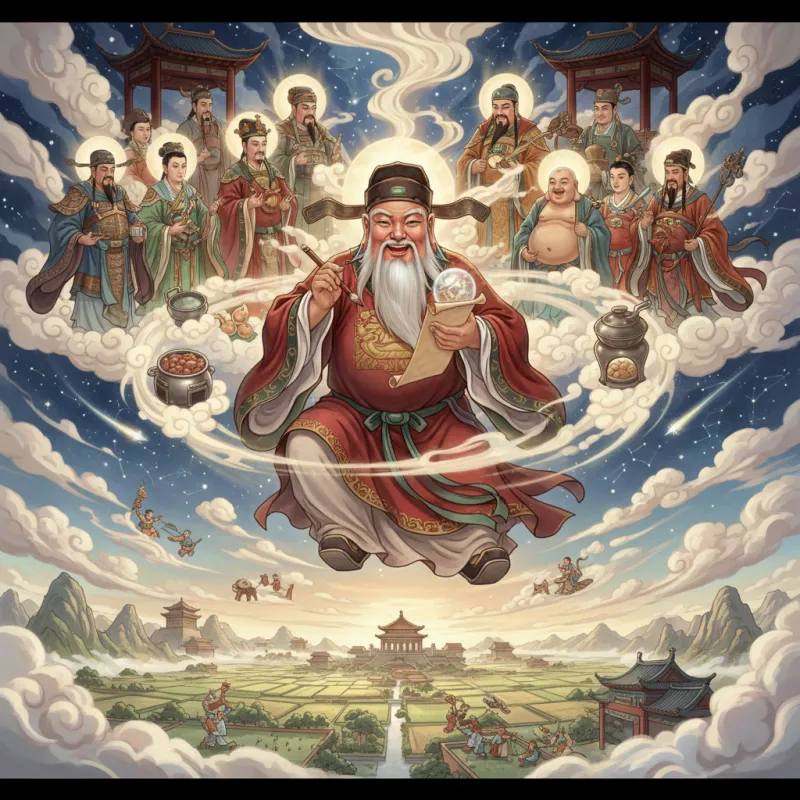
The Kitchen God: The Deity Who Reports to Heaven
⏱️ 28 min read⏱️ 27 min read⏱️ 26 min readThe Kitchen God: The Deity Who Reports to Heaven
Introduction: The Divine Bureaucrat in Every Home
In the intricate hierarchy of Chinese folk religion, few deities occupy a position as intimate and influential as the Kitchen God, known as Zao Jun (灶君) or Zao Shen (灶神). Unlike the distant celestial emperors or mountain-dwelling immortals, this deity resides in the most mundane yet essential space of every household—the kitchen. His presence transforms the hearth from a mere cooking area into a sacred site where the mortal and divine worlds intersect daily.
The Kitchen God serves as heaven's surveillance officer, a divine bureaucrat who meticulously observes family conduct throughout the year before ascending to the celestial realm to file his annual report. This unique role makes him simultaneously one of the most beloved and most feared deities in Chinese folk religion, embodying the Daoist principle that spiritual cultivation begins not in remote monasteries but within the everyday rhythms of domestic life.
Origins and Mythological Identity
The Many Faces of Zao Jun
The Kitchen God's origins are as layered as Chinese civilization itself, with multiple mythological narratives competing and coexisting across different regions and time periods. The most widely accepted version identifies him as Zhang Lang (张郎) or Zhang Dan (张单), a man whose transformation into a deity serves as a cautionary tale about marriage, fortune, and redemption.
According to this legend, Zhang Lang was once a prosperous man married to a virtuous woman. However, he abandoned his faithful wife for a younger woman, only to lose his wealth and be abandoned in turn. Reduced to begging, he unknowingly arrived at his former wife's door. Overcome with shame upon recognizing her, he attempted to hide in the kitchen stove, where he perished in the flames. The Jade Emperor (玉皇大帝, Yù Huáng Dàdì), moved by his remorse, appointed him as the Kitchen God—a position where his past mistakes would inform his judgment of others.
Alternative traditions identify the Kitchen God with different historical or mythological figures. Some texts name him as Su Jili (苏吉利), a fire official from the Yan Emperor's (炎帝, Yán Dì) court in ancient mythology. Others associate him with Yan Di himself, the legendary ruler credited with teaching humanity agriculture and the use of fire. This multiplicity of identities reflects the Kitchen God's evolution from ancient fire worship into a complex deity embodying domestic harmony, moral surveillance, and bureaucratic order.
Historical Development
The worship of kitchen deities dates back to the Han Dynasty (汉朝, Hàn Cháo, 206 BCE–220 CE), with references appearing in texts like the "Records of the Grand Historian" (史记, Shǐjì) by Sima Qian. However, the Kitchen God's role as a moral reporter to heaven crystallized during the Song Dynasty (宋朝, Sòng Cháo, 960–1279 CE), when the systematization of Chinese folk religion reached new heights.
By the Ming (明朝, Míng Cháo, 1368–1644) and Qing (清朝, Qīng Cháo, 1644–1912) dynasties, the Kitchen God had become ubiquitous in Chinese households, with his image displayed above or beside the stove in virtually every home. This widespread adoption reflected the increasing importance of domestic morality in Confucian social philosophy and the integration of bureaucratic concepts into religious practice.
The Divine Bureaucracy: Zao Jun's Celestial Role
The Annual Report
The Kitchen God's primary function centers on his annual journey to heaven, which occurs on the 23rd day of the 12th lunar month (腊月二十三, làyuè èrshísān), just before the Spring Festival (春节, Chūnjié). This date, known as "Little New Year" (小年, Xiǎonián), marks one of the most significant ritual occasions in the Chinese calendar.
Throughout the year, Zao Jun observes every action, conversation, and moral choice made by household members. He notes acts of filial piety, marital harmony, honesty in business, and charitable deeds. Conversely, he records quarrels, wasteful behavior, disrespect toward elders, and moral transgressions. His observations are comprehensive—nothing escapes his divine scrutiny.
On the appointed day, the Kitchen God's spirit departs from his earthly post to ascend to the Heavenly Court (天庭, Tiāntíng), where he presents his findings to the Jade Emperor. Based on this report, the celestial administration determines the household's fortune for the coming year: prosperity or poverty, health or illness, harmony or discord. This mechanism transforms domestic behavior into a matter of cosmic consequence, making every family meal and household interaction a potential entry in a divine ledger.
The Celestial Bureaucracy
The Kitchen God's role exemplifies the remarkable fusion of religious belief and administrative structure in Chinese cosmology. The heavenly realm mirrors the earthly imperial bureaucracy, complete with departments, officials, and hierarchical reporting structures. Zao Jun functions as a local magistrate of sorts, gathering intelligence from the grassroots level and forwarding it up the chain of command.
This bureaucratic conception of the divine reflects core Chinese philosophical assumptions about order, hierarchy, and the continuity between human and cosmic governance. Just as earthly officials reported to the emperor, celestial deities reported to the Jade Emperor. Just as local magistrates monitored their jurisdictions, household gods monitored their domains. The Kitchen God thus represents the ultimate penetration of state-like authority into private life—but with a spiritual rather than political mandate.
Ritual Practices and Domestic Worship
The Farewell Ceremony
The ritual sending-off of the Kitchen God on the 23rd of the 12th lunar month involves elaborate preparations designed to ensure a favorable report. Families perform the "Sending Off the Kitchen God" (送灶神, sòng Zào Shén) ceremony with a mixture of reverence, strategic flattery, and practical magic.
The most famous element involves offering sweet foods—particularly maltose candy (麦芽糖, màiyátáng), sticky rice cakes (年糕, niángāo), or honey (蜂蜜, fēngmì)—to the deity. The symbolism operates on multiple levels. First, the sweetness is meant to "sweeten" the god's words, encouraging him to emphasize positive aspects of the household's behavior. Second, the sticky quality is believed to either seal his lips or make his speech unclear, preventing him from articulating criticisms too clearly. Some families even smear honey directly on the Kitchen God's paper image's mouth, a charmingly literal interpretation of the practice.
Families also burn incense, offer wine, and present vegetarian dishes or meat, depending on regional customs. The ritual culminates in burning the Kitchen God's paper image, releasing his spirit to ascend to heaven on the smoke. Some traditions include burning paper horses or sedan chairs to provide transportation for his celestial journey.
The Welcome Back
On New Year's Eve (除夕, Chúxì), families perform the "Welcoming the Kitchen God" (迎灶神, yíng Zào Shén) ceremony to receive him back from heaven. A new paper image is installed above the stove, often depicting Zao Jun alongside his wife, Zao Jun Nainai (灶君奶奶), who in some traditions accompanies him or serves as a separate deity of domestic harmony.
The new image typically shows the Kitchen God in official robes, emphasizing his bureaucratic status. The iconography often includes auspicious phrases like "Heaven speaks good things, the lower realm receives peace" (上天言好事,下界保平安, shàngtiān yán hǎoshì, xiàjiè bǎo píng'ān), making explicit the transactional nature of the relationship between worshippers and deity.
Daily Veneration
Beyond these annual ceremonies, the Kitchen God receives daily acknowledgment. Traditional families maintain a small altar or shrine space near the stove, where they might place offerings of tea, rice, or the first portion of cooked meals. Before major family decisions or events, household heads might report to Zao Jun, seeking his blessing or at least his favorable notation.
The kitchen itself becomes a sacred space requiring respectful behavior. Sitting on the stove, pointing at it disrespectfully, or using foul language near it are considered offenses against the deity. This sanctification of domestic space reinforces moral behavior through constant awareness of divine presence—an internalized form of social control more effective than external enforcement.
Regional Variations and Cultural Adaptations
Northern and Southern Traditions
The Kitchen God's worship exhibits significant regional variation across China's vast geography. In northern China, the sending-off ceremony typically occurs on the 23rd of the 12th lunar month, while southern regions often observe it on the 24th. This difference reflects historical distinctions between official and folk calendars, with northern practices following imperial court traditions and southern customs maintaining older folk patterns.
Northern offerings tend to emphasize wheat-based foods like steamed buns (馒头, mántou) and dumplings, while southern regions favor rice-based preparations. The specific types of sweets also vary: northern families prefer guandong candy (关东糖, Guāndōng táng), a hard maltose confection, while southern households might offer tangyuan (汤圆), sweet rice balls, or sugarcane.
Diaspora Communities
Chinese diaspora communities throughout Southeast Asia, North America, and beyond have maintained Kitchen God worship with varying degrees of adaptation. In Malaysia and Singapore, where large Chinese populations preserve traditional practices, the Kitchen God's festival remains a significant occasion, though often simplified for urban apartment living where traditional stoves have been replaced by modern appliances.
Some families adapt by placing the Kitchen God's image near the rice cooker or refrigerator—the contemporary equivalents of the hearth as the source of family sustenance. This flexibility demonstrates the tradition's resilience and its practitioners' ability to maintain spiritual continuity despite material changes.
Theological and Philosophical Significance
Moral Surveillance and Self-Cultivation
The Kitchen God embodies a sophisticated approach to moral development that combines external surveillance with internal cultivation. His constant presence serves as a reminder that ethical behavior matters not only in public but in the private sphere where social reputation cannot enforce conformity. This aligns with Confucian emphasis on "sincerity" (诚, chéng) and "self-examination" (自省, zìxǐng)—the cultivation of virtue even when unobserved by human eyes.
Yet the tradition also reveals a pragmatic understanding of human nature. The sweet offerings acknowledge that even divine judgment might be influenced, introducing an element of negotiation into the cosmic order. This reflects the transactional nature of much Chinese folk religion, where relationships with deities mirror human social relationships involving reciprocity, gift-giving, and mutual obligation.
The Domestic as Sacred
By placing a major deity in the kitchen rather than a temple, this tradition sanctifies ordinary life. The message is clear: spiritual cultivation occurs not through withdrawal from the world but through ethical engagement with daily responsibilities. Cooking meals, managing household resources, treating family members with respect—these mundane activities become religious practices when performed under the Kitchen God's watchful gaze.
This domestication of the sacred particularly elevated women's religious roles, as they typically managed kitchen affairs and led household rituals. While formal religious institutions often excluded or marginalized women, the Kitchen God's worship created a space where female family members exercised spiritual authority and maintained crucial connections between the household and the divine realm.
Contemporary Relevance and Transformation
Modern Practice
In contemporary China and Chinese communities worldwide, Kitchen God worship has declined significantly, particularly in urban areas where modernization, political campaigns against "superstition," and changing lifestyles have eroded traditional practices. The Cultural Revolution (文化大革命, Wénhuà Dàgémìng, 1966–1976) particularly targeted folk religious practices, including Kitchen God worship, as feudal remnants.
However, recent decades have seen a revival of interest, driven by cultural nostalgia, tourism promotion, and a broader renaissance of traditional culture. Some families maintain the practice as a cultural tradition rather than a religious belief, viewing it as a way to connect with heritage and mark the lunar calendar's rhythm. The Little New Year festival, even when stripped of its religious content, remains an occasion for family gatherings and special foods.
Cultural Symbolism
Beyond religious practice, the Kitchen God has entered broader cultural consciousness as a symbol of domestic life, traditional values, and the integration of spiritual and material concerns. His image appears in art, literature, and popular culture as a shorthand for traditional Chinese household culture. The phrase "reporting to the Kitchen God" (向灶神汇报, xiàng Zào Shén huìbào) has entered colloquial language, sometimes used humorously to describe tattling or reporting on others' behavior.
Conclusion: The Enduring Legacy of Domestic Divinity
The Kitchen God represents a remarkable synthesis of religious belief, social control, and domestic culture that has shaped Chinese family life for over two millennia. His annual journey to heaven transforms the mundane space of the kitchen into a site of cosmic significance, where daily actions accumulate moral weight and family harmony becomes a matter of divine concern.
Whether understood as literal belief, cultural metaphor, or ancestral tradition, Zao Jun's worship reveals profound insights into Chinese conceptions of morality, authority, and the relationship between human and divine realms. His presence in the home—simultaneously comforting and constraining, protective and judgmental—embodies the complex negotiations between individual behavior and social expectations that characterize Chinese ethical thought.
In an era of rapid modernization and cultural change, the Kitchen God endures as a reminder that the sacred need not be distant or abstract. Sometimes divinity resides not in mountain temples or celestial palaces, but in the warm, fragrant space where families gather to share meals and build the small, essential bonds that sustain human life. And perhaps that is the Kitchen God's most important lesson: that heaven's judgment ultimately rests not on grand gestures but on the daily practice of kindness, honesty, and care within the intimate circle of home.
About the Author
Immortal Scholar — A specialist in regional gods and Chinese cultural studies.
Related Articles
Chenghuang: The City Gods Who Govern the Spiritual Realm
The City Gods Who Govern the Spiritual Realm...
Mazu: The Sea Goddess Who Protects Sailors
The Sea Goddess Who Protects Sailors...
Tudi Gong: The Earth God in Every Chinese Village
The Earth God in Every Chinese Village...
Exploring the Rich Pantheon of Chinese Deities and Immortals in Daoism and Buddhism
Discover the historical and cultural significance of Chinese deities and immortals in Daoist and Buddhist traditions....