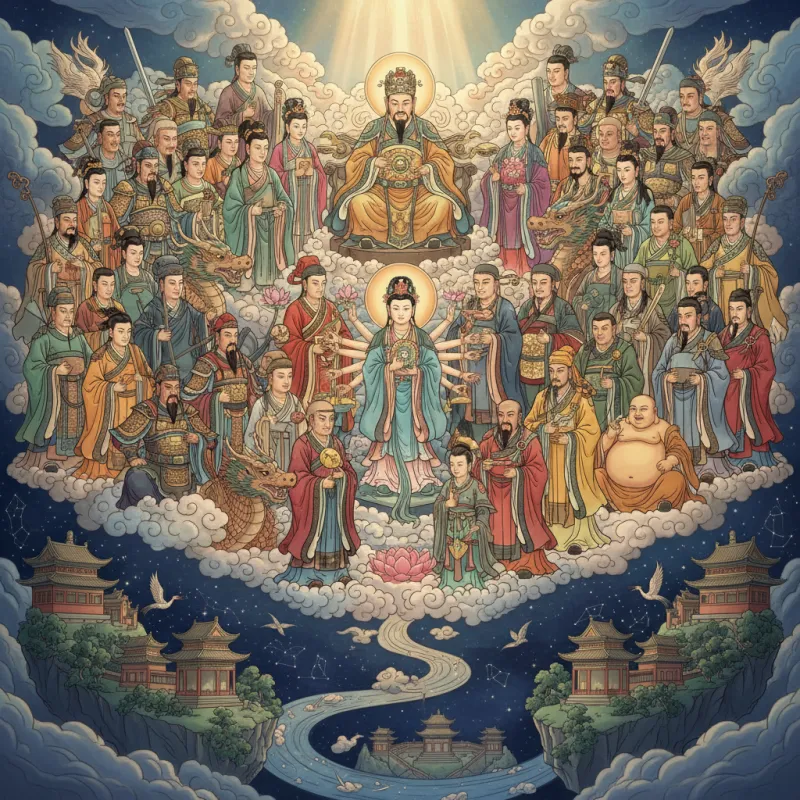
Picture this: A celestial bureaucrat stamps your petition for rain while a peach-eating immortal lounges in the clouds above, and somewhere in the underworld, ten judges are reviewing your moral ledger. Welcome to the Chinese pantheon, where the divine realm mirrors earthly government so precisely that even the gods file paperwork.
The sheer scale of Chinese religious cosmology can overwhelm newcomers. We're not talking about a tidy dozen Olympians here—Chinese tradition has cultivated thousands of deities, immortals, and spiritual beings across more than two millennia. What makes this pantheon fascinating isn't just its size, but how it functions as a living, breathing system that absorbed Buddhist imports, elevated historical figures to godhood, and created job descriptions for celestial administrators that would make any HR department weep.
The Daoist Hierarchy: Heaven's Corporate Structure
Daoism gave China its most elaborate divine bureaucracy, and at the top sits the Jade Emperor (玉皇大帝, Yùhuáng Dàdì). Don't let the title fool you—he's not the creator god. That role belongs to more abstract figures like the Three Pure Ones (三清, Sānqīng), who represent different aspects of the Dao itself. The Jade Emperor is essentially heaven's CEO, managing the celestial administration while the Three Pure Ones remain in philosophical retirement.
The Three Pure Ones deserve special attention. The Celestial Worthy of Primordial Beginning (元始天尊, Yuánshǐ Tiānzūn) represents the Dao before creation. The Celestial Worthy of Numinous Treasure (灵宝天尊, Língbǎo Tiānzūn) governs the unfolding of cosmic time. The Celestial Worthy of the Way and its Virtue (道德天尊, Dàodé Tiānzūn)—often identified with Laozi himself—brings the Dao into the human realm. This trinity emerged during the Tang Dynasty (618-907 CE) as Daoism formalized its theology to compete with Buddhism's sophisticated cosmology.
Below this upper management, you'll find specialized departments. The Queen Mother of the West (西王母, Xīwángmǔ) tends the peaches of immortality in her garden—those famous fruits that ripen once every three thousand years. The Eight Immortals (八仙, Bāxiān) represent different social classes and life paths, proving that enlightenment isn't reserved for monks and emperors. My favorite is Lü Dongbin (吕洞宾), the scholarly immortal who failed the imperial examinations but achieved something better: eternal life and mastery over sword techniques that could slay demons.
Buddhist Additions: When India Met China
Buddhism arrived in China during the Han Dynasty (206 BCE - 220 CE), and what followed was one of history's most successful religious mergers. Chinese Buddhism didn't just translate Sanskrit texts—it transformed the entire pantheon, creating hybrid deities that would have puzzled monks in India.
Take Guanyin (观音, Guānyīn), the Goddess of Mercy. Originally Avalokiteśvara, a male bodhisattva in Indian Buddhism, Guanyin underwent a remarkable gender transformation in China. By the Song Dynasty (960-1279 CE), she had become definitively female, absorbing characteristics from indigenous Chinese goddesses and the compassionate mother archetype. The story of Miaoshan (妙善), a princess who became Guanyin through extreme filial piety and self-sacrifice, gave her a Chinese origin story that resonated deeply with Confucian values.
The Four Heavenly Kings (四大天王, Sì Dà Tiānwáng) guard the cardinal directions in Buddhist temples, but their Chinese incarnations carry distinctly local weapons and symbolism. The Southern King holds a sword representing wisdom that cuts through ignorance—but also wind and smooth weather, concerns very relevant to Chinese agricultural society. These adaptations show how Buddhism bent to accommodate Chinese cosmological concerns.
Dizang (地藏, Dìzàng), known as Kṣitigarbha in Sanskrit, vowed not to achieve Buddhahood until all hells are emptied. His cult became enormously popular in China, where he's depicted as a monk with a staff that opens hell's gates. The Chinese added a backstory about him being a filial daughter in a previous life who descended to hell to save her mother—again, that Confucian filial piety sneaking in.
The Immortals: Humanity's Upgrade Path
Chinese immortals (仙, xiān) occupy a unique category—they're not quite gods, but they've transcended human limitations through cultivation practices, moral virtue, or sheer luck. The concept emerged from Daoist alchemy and meditation traditions, promising that humans could achieve physical immortality and supernatural powers.
The hierarchy of immortals is surprisingly specific. Celestial Immortals (天仙, tiānxiān) dwell in heaven. Earthly Immortals (地仙, dìxiān) remain on earth but possess extraordinary abilities. Ghost Immortals (鬼仙, guǐxiān) achieved only spiritual immortality—their bodies died, but their consciousness persists. This classification system, detailed in texts like the Baopuzi (抱朴子) by Ge Hong (283-343 CE), shows how Daoism systematized what began as scattered folk beliefs.
Historical figures regularly joined the immortal ranks. Guan Yu (关羽), the Three Kingdoms general who died in 220 CE, became Guan Di (关帝), the God of War and patron of business. His temples outnumber those of almost any other deity in China. Zhang Sanfeng (张三丰), the possibly-legendary Daoist credited with creating Tai Chi, supposedly achieved immortality in the 14th century and still wanders the mountains, occasionally teaching worthy students.
The process of becoming an immortal involved internal alchemy (内丹, nèidān)—circulating qi through energy channels, refining essence into spirit, and ultimately forming an immortal embryo within the body. External alchemy (外丹, wàidān) sought immortality through consuming elixirs, often containing mercury and lead. This killed more practitioners than it saved, leading to internal alchemy's dominance by the Song Dynasty.
Folk Religion: Where Everyone Gets a Vote
Chinese folk religion operates on democratic principles—if enough people worship something, it becomes divine. This bottom-up approach created deities for every conceivable need and profession. The Kitchen God (灶神, Zàoshén) reports your family's behavior to the Jade Emperor annually. Mazu (妈祖), a Song Dynasty girl who saved sailors, became the goddess of the sea. Caishen (财神), the God of Wealth, has multiple incarnations because different regions and professions needed their own financial patron.
This folk layer explains why Chinese temples often house multiple religious traditions simultaneously. A single temple might contain Buddhist bodhisattvas, Daoist immortals, and local spirits, all receiving offerings from the same worshippers. The Chinese approach to religion is pragmatic—why limit yourself to one divine connection when you can hedge your bets?
The City God (城隍, Chénghuáng) system perfectly illustrates this pragmatism. Every Chinese city had its own City God, usually a virtuous historical figure from that locality, who governed the spiritual realm as the earthly magistrate governed the physical. When you died, you reported to your City God for initial judgment before proceeding to the Ten Courts of Hell. This mirroring of earthly bureaucracy in the afterlife made the cosmic order comprehensible and, oddly, comforting.
The Underworld: Hell's Ten Departments
Chinese hell (地狱, dìyù) isn't eternal damnation—it's more like a cosmic correctional facility with a release date. The Ten Courts of Hell, each presided over by a Yama King (阎罗王, Yánluówáng), process souls through increasingly specific punishments matched to their earthly crimes. Liars get their tongues pulled out. Corrupt officials are frozen in ice. Tax evaders are crushed by stones.
This system emerged from Buddhist concepts of karma and rebirth filtered through Chinese legal sensibilities. The Jade Record (玉历宝钞, Yùlì Bǎochāo), a popular religious text from the Qing Dynasty, details each court's jurisdiction with the precision of a legal code. After completing your sentence—which might take centuries—you drink Mengpo's (孟婆) amnesia soup and reincarnate, hopefully having learned your lesson.
The underworld bureaucracy extends beyond punishment. The Department of Wandering Ghosts handles souls who died without proper burial. The Registry of Life and Death tracks everyone's allotted lifespan, though exceptional virtue or wickedness can earn you extensions or deductions. Even in death, the Chinese cosmos maintains meticulous records.
Syncretism: The Art of Religious Fusion
What makes the Chinese pantheon truly remarkable is its absorptive capacity. Rather than religious wars, China experienced religious synthesis. The Three Teachings (三教, Sānjiào)—Confucianism, Daoism, and Buddhism—coexisted and cross-pollinated for centuries. Scholars might be Confucian in public life, Daoist in their private cultivation, and Buddhist when contemplating death.
This syncretism created hybrid deities and practices that would horrify religious purists but worked beautifully in practice. The concept of regional protective deities shows how local spirits were incorporated into broader religious frameworks. Even mountain gods and nature spirits found places in both Daoist and Buddhist hierarchies, their worship continuing uninterrupted through theological shifts.
The Ming Dynasty novel Journey to the West (西游记) perfectly captures this religious mixing. The Monkey King Sun Wukong battles Daoist immortals, serves a Buddhist monk, and encounters folk deities, all within a cosmology that treats these different traditions as parts of one vast spiritual ecosystem. This wasn't confusion—it was sophisticated religious pluralism.
Living Traditions in Modern Context
These aren't museum pieces. Millions still worship at temples dedicated to these deities across China, Taiwan, Singapore, and Chinese diaspora communities worldwide. During Chinese New Year, families still paste images of door gods on their entrances. Pregnant women still pray to Songzi Guanyin (送子观音), the child-giving form of Guanyin. Business owners still burn incense to Guan Di before major deals.
The pantheon continues evolving. Some temples now include deities for modern concerns—there are reports of shrines to gods of examinations being repurposed for students taking college entrance exams, and Caishen worship has adapted to stock market speculation. The system's flexibility, its willingness to add new deities and retire obsolete ones, explains its longevity.
Understanding this pantheon means recognizing that Chinese religious culture never demanded exclusive loyalty to one divine figure or tradition. Instead, it built a vast, interconnected system where deities specialized, collaborated, and occasionally competed, much like the human society they served. The result is a religious landscape as complex and diverse as China itself—bureaucratic yet mystical, ancient yet adaptive, otherworldly yet deeply concerned with everyday human needs.
Related Reading
- Discovering Nature Spirits in Chinese Mythology: Guardians of the Earth and Sky
- Ancient Chinese Underworld Deities: Guardians of Death and Afterlife Realms
- The Dragon Kings of the Four Seas