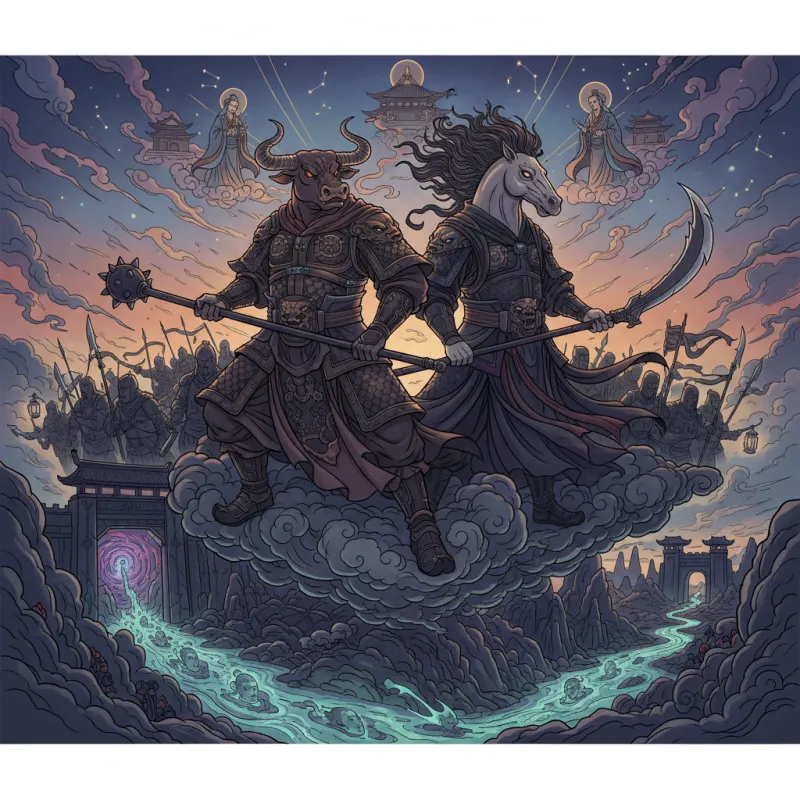
Ox-Head and Horse-Face: The Underworld Famous Guards
⏱️ 26 min read⏱️ 26 min read⏱️ 24 min readOx-Head and Horse-Face: The Underworld's Famous Guards
Introduction: The Fearsome Gatekeepers of the Dead
In the shadowy realm of Chinese underworld mythology, few figures inspire as much dread and fascination as Niútóu (牛頭, Ox-Head) and Mǎmiàn (馬面, Horse-Face). These two supernatural beings serve as the primary enforcers and guards of Diyu (地獄, the Chinese underworld), tasked with escorting the souls of the deceased from the mortal realm to face judgment before the Shí Diàn Yánwáng (十殿閻王, Ten Courts of Hell). Their grotesque appearance—human bodies topped with the heads of an ox and horse respectively—has made them instantly recognizable icons in Chinese religious art, literature, and popular culture for over a millennium.
Unlike the solitary psychopomps found in other mythological traditions, Niútóu and Mǎmiàn work as an inseparable pair, embodying the bureaucratic efficiency that characterizes the Chinese conception of the afterlife. They are not demons in the Western sense, nor are they evil; rather, they are dutiful civil servants of the underworld administration, carrying out their responsibilities with unwavering dedication. Their presence in Chinese culture extends far beyond religious texts, permeating folk beliefs, theatrical performances, temple art, and even modern media.
Origins and Textual Sources
Buddhist Foundations
The earliest references to Ox-Head and Horse-Face appear in Buddhist texts that were translated into Chinese during the Nán-Běi Cháo (南北朝, Northern and Southern Dynasties, 420-589 CE). The concept likely originated from Indian Buddhist mythology, where similar guardian figures existed, but underwent significant sinicization as Buddhism merged with indigenous Chinese beliefs about death and the afterlife.
The Tiělóng Shān (鐵籠山, Iron Cage Mountain) scriptures and various biànwén (變文, transformation texts) from the Tang Dynasty (618-907 CE) contain some of the earliest detailed descriptions of these underworld guards. In the Yùlán Pén Jīng (盂蘭盆經, Ullambana Sutra) and its associated commentaries, Ox-Head and Horse-Face are described as yèchā (夜叉, yaksha) or fierce protective spirits who serve Yánluówáng (閻羅王, Yama Raja), the king of hell.
Daoist Adaptations
As Daoism developed its own elaborate underworld cosmology during the Tang and Song dynasties, Niútóu and Mǎmiàn were incorporated into Daoist texts as well. The Yùshū Qībù (玉樞七部, Seven Sections of the Jade Pivot) and other Daoist scriptures describe them as subordinates to the Dōngyuè Dàdì (東嶽大帝, Great Emperor of the Eastern Peak), who oversees the registers of life and death.
In Daoist tradition, these guards are sometimes given more elaborate backstories. One account suggests that Niútóu was originally a butcher who killed countless oxen, while Mǎmiàn was a horse trader who mistreated animals. Upon their deaths, they were condemned to serve in the underworld with the heads of the creatures they had wronged, transforming their karmic debt into eternal service.
Physical Appearance and Iconography
Traditional Depictions
The visual representation of Ox-Head and Horse-Face follows remarkably consistent patterns across centuries of Chinese art. Niútóu typically appears with the head of a water buffalo or ox, complete with curved horns, a broad snout, and fierce eyes. His body is muscular and humanoid, often depicted wearing the armor or robes of an underworld official. In his hands, he commonly carries a chāgān (叉杆, trident or pitchfork), symbolizing his role in capturing and controlling wayward souls.
Mǎmiàn features an elongated horse's head with prominent teeth, flared nostrils, and a wild mane. His expression is typically one of stern determination rather than outright malevolence. He is often shown wielding a pòhún biān (破魂鞭, soul-breaking whip) or chains used to bind spirits. Some depictions show him holding a gōumíng bù (勾命簿, life-summoning register), a ledger containing the names of those whose time has come.
Color Symbolism
In temple murals and religious paintings, Niútóu is frequently rendered with dark blue or black skin, representing the yin energy of death and the underworld. Mǎmiàn often appears in shades of white, gray, or pale green, colors associated with corpses and ghostly apparitions. Their garments typically feature the colors of underworld officials: dark robes with red or gold trim, sometimes adorned with symbols of their rank within the infernal bureaucracy.
The contrast between the two figures—one bovine and dark, the other equine and pale—creates a visual balance that reflects the dualistic nature of Chinese cosmology. Together, they represent the inescapable nature of death, approaching from different directions but working toward the same inevitable end.
Roles and Responsibilities
Soul Escorts and Enforcers
The primary duty of Niútóu and Mǎmiàn is to serve as gōuhún shǐzhě (勾魂使者, soul-summoning messengers). When a person's allotted lifespan expires, as recorded in the Shēngsǐ Bù (生死簿, Register of Life and Death), these two guards are dispatched to the mortal realm to collect the deceased's húnpò (魂魄, soul-spirit). They appear at the moment of death or shortly thereafter, making themselves visible only to the dying person and other spirits.
Unlike the gentle guidance offered by some psychopomps in other traditions, Niútóu and Mǎmiàn are known for their forceful methods. They use chains, ropes, or their signature weapons to bind the soul and prevent it from fleeing or lingering in the mortal world. This harsh treatment serves a purpose: it ensures that souls do not become gūhún yěguǐ (孤魂野鬼, lonely souls and wild ghosts) who wander the earth causing mischief or harm.
Guardians of the Underworld Gates
Beyond their role as escorts, Ox-Head and Horse-Face also serve as sentinels at various checkpoints throughout Diyu. The Chinese underworld is conceived as a vast bureaucratic structure with multiple levels, courts, and stations. Niútóu and Mǎmiàn are often stationed at the Guǐmén Guān (鬼門關, Ghost Gate Pass), the primary entrance to the underworld, where they verify the identity of incoming souls and prevent unauthorized departures.
In this capacity, they work alongside other underworld officials such as the Hēi Bái Wúcháng (黑白無常, Black and White Impermanence), though Niútóu and Mǎmiàn are generally considered to have higher rank and authority. They report directly to the Yánwáng and are empowered to use force against souls who resist judgment or attempt to escape their fate.
Enforcers of Karmic Justice
In some traditions, Ox-Head and Horse-Face also participate in the punishment of souls who have committed grave sins. They may assist in administering tortures in the various hells, particularly in cases involving cruelty to animals, given their own animal-headed forms. The Shíbā Céng Dìyù (十八層地獄, Eighteen Levels of Hell) each have specific punishments, and Niútóu and Mǎmiàn ensure that sentences are carried out according to the karmic debts accumulated during life.
Cultural Significance and Folk Beliefs
Protection Against Evil Spirits
Paradoxically, despite their fearsome appearance and association with death, images of Niútóu and Mǎmiàn are sometimes used as protective talismans. The logic follows that if these guards are powerful enough to control the dead and maintain order in the underworld, their images can frighten away malevolent spirits and èguǐ (惡鬼, evil ghosts) in the mortal realm.
During the Zhōngyuán Jié (中元節, Ghost Festival) on the 15th day of the seventh lunar month, when the gates of the underworld open and spirits roam freely, some households display pictures of Ox-Head and Horse-Face to remind wandering ghosts that they must return to the underworld when the festival ends. Temples dedicated to Chénghuáng (城隍, City God) often feature statues or paintings of these guards flanking the main deity, emphasizing the god's authority over life and death.
Theatrical and Literary Representations
Chinese opera, particularly dìfāng xì (地方戲, regional opera forms), frequently features Niútóu and Mǎmiàn as characters. In performances of stories like Mùlián Jiù Mǔ (目連救母, Mulian Rescues His Mother), these guards appear as both antagonists and comic relief. Their distinctive makeup and costumes—elaborate masks or face paint depicting their animal features—make them instantly recognizable to audiences.
In classical literature, they appear in works such as Xīyóu Jì (西遊記, Journey to the West), where they attempt to capture Sun Wukong (孫悟空, the Monkey King) when he storms the underworld to erase his name from the Register of Death. Their failure to contain the rebellious monkey demonstrates both their dedication to duty and the limitations of their power when confronted with beings of exceptional spiritual cultivation.
The Ming Dynasty novel Fēngshén Yǎnyì (封神演義, Investiture of the Gods) and various gōng'àn (公案, court case) stories also feature these underworld guards, often highlighting the bureaucratic nature of the afterlife and the importance of proper procedure even in matters of death and judgment.
Regional Variations and Worship
Temple Representations
Major temples dedicated to underworld deities throughout China, Taiwan, and Southeast Asian Chinese communities feature prominent representations of Ox-Head and Horse-Face. The Fēngdū Guǐchéng (豐都鬼城, Fengdu Ghost City) in Chongqing, considered one of the earthly representations of the Chinese underworld, contains numerous statues and reliefs depicting these guards in various scenes of soul collection and judgment.
In Taiwan, temples dedicated to the Dìzàng Wáng Púsà (地藏王菩薩, Ksitigarbha Bodhisattva), who vowed to save all beings from hell, often include Niútóu and Mǎmiàn in their iconographic programs. These representations serve as reminders of the consequences of evil deeds and the importance of accumulating merit during one's lifetime.
Syncretism with Local Beliefs
In different regions of China, Ox-Head and Horse-Face have been syncretized with local deities and spirits. In some areas of southern China, they are associated with water buffalo spirits and horse deities that protect livestock. In other regions, they have been conflated with door gods (ménshén 門神) or protective spirits specific to local traditions.
The Hakka (客家) people of southern China and Taiwan have particularly elaborate traditions involving these figures, incorporating them into funeral rites and ancestral worship practices. During funeral processions, paper effigies of Niútóu and Mǎmiàn may be carried or burned to ensure the deceased's safe passage to the underworld.
Modern Interpretations and Popular Culture
Contemporary Media
In modern Chinese popular culture, Ox-Head and Horse-Face have experienced a renaissance. They appear in films, television series, comics, and video games, often with updated characterizations that make them more sympathetic or even heroic. The 2017 film Zhāo Yáo (招摇) and various animated series have reimagined these traditional figures for contemporary audiences while maintaining their essential characteristics.
Video games such as Yīnyáng Shī (陰陽師, Onmyoji) and Wángzhě Róngyào (王者榮耀, Honor of Kings) feature Niútóu and Mǎmiàn as playable characters or opponents, introducing these mythological figures to younger generations who might not encounter them through traditional religious contexts.
Philosophical Reflections
Beyond their role in religious belief and entertainment, Ox-Head and Horse-Face serve as powerful symbols in Chinese philosophical thought about death, duty, and cosmic order. They represent the impersonal nature of death—it comes for everyone regardless of status, wealth, or desire. Their animal heads suggest that death operates according to natural law rather than human sentiment.
The partnership between Niútóu and Mǎmiàn also reflects Chinese values of cooperation and complementarity. Like yin and yang, they are different but work together harmoniously toward a common purpose. Their unwavering dedication to duty, even in the grim work of collecting souls, exemplifies the Confucian virtue of zhōng (忠, loyalty) and the importance of fulfilling one's role in the cosmic order.
Conclusion: Eternal Guardians of the Threshold
Ox-Head and Horse-Face occupy a unique position in Chinese mythology as figures who are simultaneously feared and respected, grotesque yet necessary. They embody the Chinese cultural understanding that death is not an end but a transition, and that the afterlife operates according to the same principles of order, hierarchy, and justice that govern the mortal world.
For over a thousand years, these underworld guards have served as reminders of mortality and the importance of living ethically. Whether depicted in temple murals, theatrical performances, or modern media, Niútóu and Mǎmiàn continue to capture the imagination and convey profound truths about the human condition. They stand at the threshold between life and death, ensuring that the cosmic order is maintained and that every soul faces the judgment it has earned through its actions in life.
In understanding these figures, we gain insight not only into Chinese religious beliefs but also into the cultural values that have shaped Chinese civilization for millennia: the importance of duty, the inevitability of consequences, and the belief that even in death, there is order, purpose, and ultimately, justice.
About the Author
Immortal Scholar — A specialist in underworld and Chinese cultural studies.
Related Articles
The Bridge of Helplessness: Crossing Between Life and Death
Crossing Between Life and Death...
Meng Po Soup of Forgetting: The Drink Before Reincarnation
The Drink Before Reincarnation...
Yanluo Wang: The King of Hell in Chinese Mythology
The King of Hell in Chinese Mythology...
Ancient Chinese Underworld Deities: Guardians of Death and Afterlife Realms
Explore the fascinating pantheon of Chinese underworld deities shaping death, judgment, and the afterlife in Daoist and ...