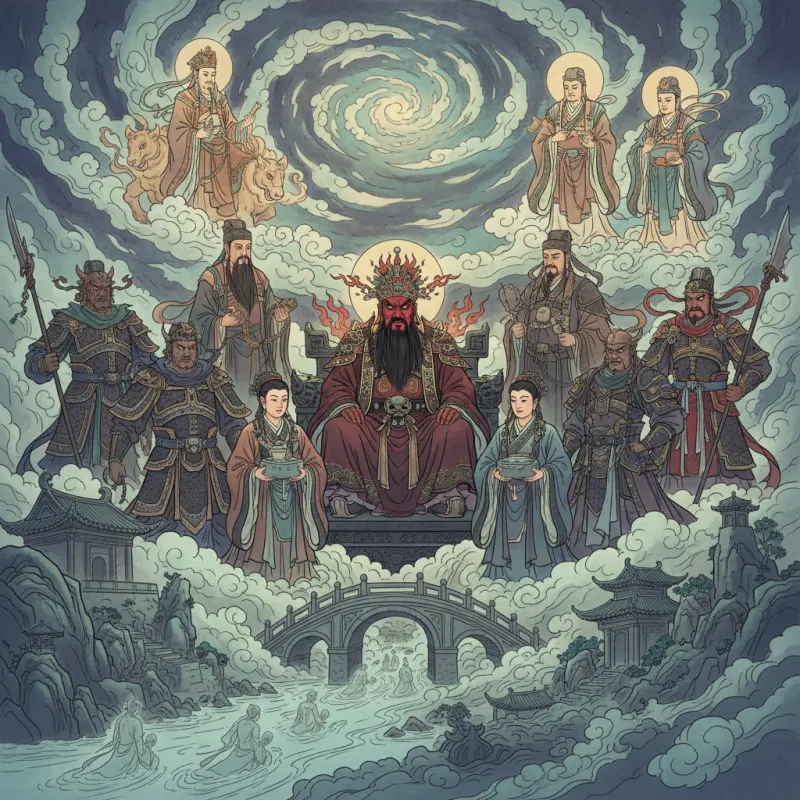
The screams echo through ten courts of judgment, each more terrifying than the last. Sinners hang from iron hooks, boil in cauldrons of oil, or face mountains of knives—all while celestial bureaucrats meticulously record every transgression. This isn't medieval European imagination run wild. This is Diyu (地狱, Dìyù)—the Chinese underworld—a realm where death isn't an ending but the beginning of an elaborate judicial process that would make any modern court system look simple by comparison.
The Bureaucracy of the Dead: Why Chinese Hell Has Paperwork
Here's what makes the Chinese underworld fundamentally different from Western hell: it's temporary, it's fair (theoretically), and it runs on paperwork. The concept emerged from a fascinating collision between indigenous Chinese ancestor worship, Daoist cosmology, and Buddhist karma imported from India around the 1st century CE. By the Tang Dynasty (618-907 CE), these traditions had fused into something uniquely Chinese—a underworld that mirrors the imperial bureaucracy above ground, complete with judges, clerks, and endless administrative procedures.
Yanluo Wang (閻羅王, Yánluó Wáng)—known in Sanskrit as Yama—presides over this realm as its supreme magistrate. But unlike the Christian Satan, Yanluo Wang isn't evil. He's a civil servant. A terrifying one, sure, with his red face, bulging eyes, and official robes, but ultimately he's just doing his job: processing souls according to their karmic ledger. The Jade Record (玉曆, Yùlì), a Ming Dynasty text that became wildly popular in the 17th century, describes him sitting in judgment with the Book of Life and Death open before him, cross-referencing every deed against cosmic law.
What's brilliant about this system is its underlying assumption: punishment fits the crime with almost mathematical precision. Lied in life? Your tongue gets pulled out in death. Wasted food? You'll eat molten iron. It's karmic accounting taken to its logical extreme.
The Ten Courts: A Guided Tour Through Torment
The structure of Diyu evolved significantly between the Tang and Ming dynasties, eventually settling on the famous Ten Courts of Hell (十殿閻羅, Shí Diàn Yánluó). Each court specializes in particular sins, presided over by its own king. This isn't just religious imagination—it's social engineering. These courts reflect what Chinese society feared and valued across different eras.
The First Court, ruled by Qinguang Wang (秦廣王, Qínguǎng Wáng), serves as intake and initial judgment. Think of it as the underworld's reception desk, where souls first learn their fate. The relatively virtuous might pass through quickly, while serious offenders get routed to the appropriate specialized court.
By the Fifth Court, under Yanluo Wang himself, we're dealing with the worst offenders—murderers, arsonists, those who committed suicide (considered a serious offense because it disrupts cosmic order). The punishments here make Dante look tame. The Jade Record describes the Mountain of Knives, where souls must climb a peak made entirely of blades, and the Forest of Swords, where trees bear razor-sharp leaves that slice anyone passing beneath.
The Tenth Court, governed by Zhuanlun Wang (轉輪王, Zhuànlún Wáng), handles reincarnation. After serving their sentences—which could last thousands of years—souls drink the Potion of Oblivion (孟婆湯, Mèngpó Tāng) from the goddess Meng Po (孟婆, Mèngpó) and forget their past lives before being reborn. Even hell has an exit strategy.
The Support Staff: Ox-Head, Horse-Face, and Other Underworld Employees
No bureaucracy functions without its enforcers and administrators. The Chinese underworld employs a colorful cast of supernatural beings who handle the day-to-day operations of soul management.
Ox-Head (牛頭, Niútóu) and Horse-Face (馬面, Mǎmiàn) are the underworld's most famous duo—demonic guards who escort souls from the mortal world to judgment. Their appearance in Chinese opera and folk art is instantly recognizable: literally the heads of an ox and horse on humanoid bodies, wielding weapons and chains. They're not subtle. According to the Journey to the West (西遊記, Xīyóu Jì), even the Monkey King Sun Wukong couldn't escape their initial summons, though he later trashed the underworld's bureaucracy and crossed out his name from the Book of Death—a scene that perfectly captures Chinese ambivalence toward authority, even cosmic authority.
Then there's Heibai Wuchang (黑白無常, Hēibái Wúcháng)—the Black and White Guards of Impermanence. These two appear at the moment of death: Bai Wuchang (White Guard) is tall, pale, and wears a hat reading "You're coming with me," while Hei Wuchang (Black Guard) is short, dark, and his hat says "Exactly as ordered." They're the underworld's repo men, and they always collect.
What's fascinating is how these figures evolved from Buddhist and Daoist texts into folk religion. By the Qing Dynasty (1644-1912), ordinary people were making offerings to these underworld officials, hoping for favorable treatment when their time came. It's very Chinese: if you can't avoid the bureaucracy, try to bribe it.
The City God: Local Government Extends Beyond Death
Here's where Chinese underworld cosmology gets really interesting: it's localized. Every city has a Chenghuang (城隍, Chénghuáng)—a City God who serves as the local magistrate for both living and dead. These deities report to Yanluo Wang but handle regional cases, maintaining order in their jurisdictions and escorting local souls to judgment.
City God temples were once as common as post offices, and for good reason. The Chenghuang wasn't some distant cosmic force—he was your neighbor's problem too. He knew your business. During the Ming Dynasty, it was common practice for magistrates to report to the City God temple before taking office, essentially checking in with their supernatural counterpart. Some City Gods were historical figures who'd been deified for their virtuous governance, creating a direct link between earthly and underworld administration.
This system reveals something profound about Chinese religious thought: the cosmos operates on the same principles as human society, just on a grander scale. Justice, hierarchy, and proper procedure matter as much in death as in life. For more on how these local deities interact with the broader pantheon, see Chinese Folk Deities and Local Gods.
Dizang Wang: The Bodhisattva Who Refuses to Leave Hell
Not everyone in the underworld is there to punish. Dizang Wang Pusa (地藏王菩薩, Dìzàng Wáng Púsà)—known in Sanskrit as Ksitigarbha—is the bodhisattva who made an impossible vow: "Not until hell is empty will I become a Buddha." He's essentially volunteered for eternal overtime in the worst possible workplace.
Dizang Wang appears throughout Chinese Buddhist texts as a monk with a shaved head, holding a staff with six rings (representing the six realms of rebirth) and a wish-fulfilling jewel. His job is to comfort souls in torment, reduce sentences when possible, and guide the dead toward better rebirths. He's particularly associated with helping children who died young and soldiers who fell in battle—souls who might not have had time to accumulate good karma.
The cult of Dizang Wang became enormously popular during the Tang Dynasty, particularly at Mount Jiuhua (九華山, Jiǔhuá Shān) in Anhui Province, where a Korean monk named Kim Gyo-gak was believed to be his incarnation. Today, Jiuhua remains one of China's four sacred Buddhist mountains, and pilgrims still climb its peaks seeking Dizang Wang's intercession for deceased relatives.
What makes Dizang Wang compelling is his compassion in a system otherwise focused on retribution. He represents the Buddhist principle that even in hell, enlightenment remains possible. Mercy exists alongside justice. For more on Buddhist figures in Chinese cosmology, explore Buddhist Deities in Chinese Tradition.
The Underworld in Literature: When Fiction Shapes Belief
Chinese underworld mythology didn't just exist in religious texts—it exploded into popular literature, which in turn shaped how ordinary people understood death and judgment. The Journey to the West, written by Wu Cheng'en in the 16th century, features multiple underworld scenes that became more influential than any scripture. Sun Wukong's rampage through hell, where he literally erases his name and those of his monkey subjects from the Book of Life and Death, became the template for how Chinese audiences imagined the underworld: bureaucratic, corruptible, and ultimately subject to disruption by sufficiently powerful beings.
The Jade Record, compiled during the Ming Dynasty, took a different approach. It's essentially an illustrated guidebook to hell, describing each court's punishments in graphic detail. This text was explicitly designed to scare people into moral behavior, and it worked. For centuries, temple murals depicted these torments, ensuring that even illiterate peasants understood exactly what awaited sinners.
By the Qing Dynasty, underworld journey narratives became a popular literary genre. Stories like Yue Fei's Journey to the Underworld allowed authors to comment on contemporary politics by showing historical figures being judged in death—a safe way to criticize the powerful by imagining their posthumous punishment.
Modern Echoes: The Underworld That Won't Die
You might think modernization would have killed belief in these underworld deities, but you'd be wrong. During Qingming Festival (清明節, Qīngmíng Jié) and Ghost Month, Chinese communities worldwide still burn paper money, paper houses, even paper smartphones for deceased relatives—offerings meant to ease their time in the underworld or provide comfort in the afterlife. The bureaucracy of death apparently accepts electronic transfers now.
Contemporary Chinese cinema and television continue mining underworld mythology. Films like Painted Skin (2008) and The Monkey King series feature underworld scenes that draw directly from classical sources while updating the special effects. Video games like Black Myth: Wukong (2024) include elaborate underworld levels where players navigate the Ten Courts.
What persists isn't necessarily literal belief in Ox-Head and Horse-Face waiting to escort souls to judgment. Rather, it's the underlying framework: actions have consequences, justice exists beyond death, and the cosmos maintains moral order even when earthly systems fail. In a culture that experienced massive disruption throughout the 20th century, these ancient certainties offer psychological comfort.
The Chinese underworld, with its judges and courts and carefully calibrated punishments, reflects a civilization's attempt to impose order on the ultimate chaos—death itself. It's bureaucracy as theology, punishment as pedagogy, and hell as a temporary correctional facility rather than eternal damnation. Whether you find that comforting or terrifying probably depends on how you feel about paperwork.
Related Reading
- A Practical Guide to Visiting Chinese Temples: What to Do and What Not to Do
- Symbols of the Eight Immortals: Hidden Meanings in Chinese Art
- Chinese Gods in Anime and Manga: Eastern Mythology Goes Global