Maitreya and the Laughing Buddha: Future Buddha in Chinese Culture
Introduction: Two Faces of the Future Buddha
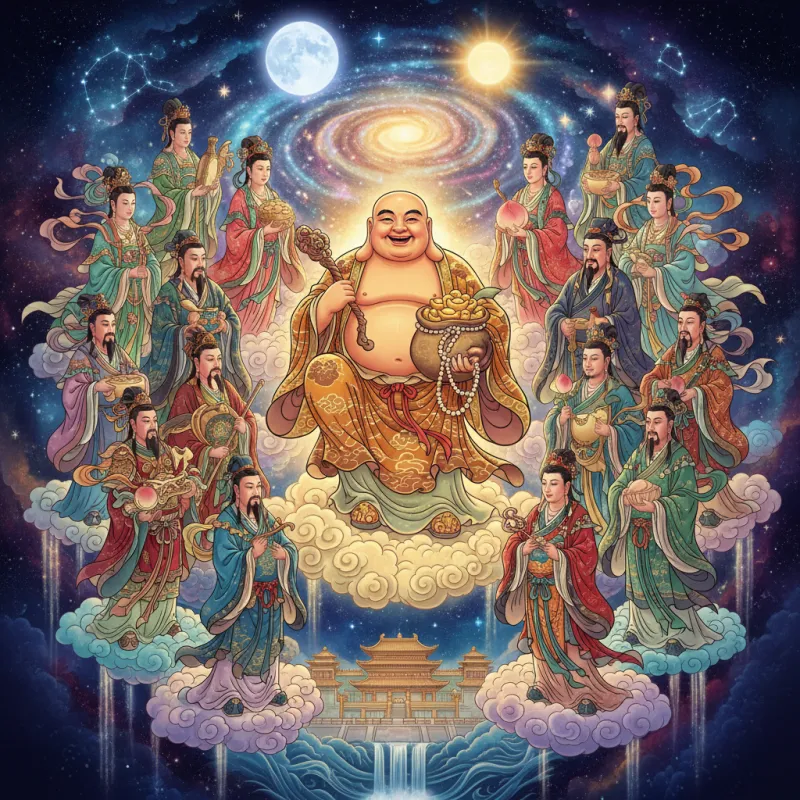
In temples across China, visitors encounter a paradox. Buddhist scriptures describe Maitreya (彌勒佛, Mílè Fó), the Future Buddha, as a majestic bodhisattva dwelling in the Tuṣita Heaven, waiting to descend to Earth in a distant age. Yet the first figure greeting worshippers at temple gates is often a rotund, laughing monk with an exposed belly, cloth sack, and infectious grin. This jolly figure—known as the Laughing Buddha (笑佛, Xiào Fó) or Budai (布袋, Bùdài, "Cloth Sack")—represents one of Chinese Buddhism's most fascinating transformations: the sinicization of an Indian bodhisattva into a distinctly Chinese folk deity.
This article explores how Maitreya evolved from an austere figure of Buddhist eschatology into the beloved, corpulent monk who embodies prosperity, contentment, and the promise of a better world to come.
The Indian Maitreya: Bodhisattva of the Future
Origins in Buddhist Scripture
Maitreya's story begins in early Buddhist texts, where he appears as the successor to Gautama Buddha. According to the Maitreya-vyākaraṇa (彌勒下生經, Mílè Xiàshēng Jīng, "Sutra on Maitreya's Descent"), this bodhisattva currently resides in Tuṣita Heaven (兜率天, Dōushuài Tiān), the fourth of the six desire realms. There he preaches the Dharma to celestial beings, awaiting the proper time to be reborn on Earth.
Buddhist cosmology teaches that Maitreya will descend 5,670 million years after Gautama Buddha's parinirvana, when the Dharma has been completely forgotten and human lifespans have increased to 80,000 years. He will be born under a Dragon Flower Tree (龍華樹, Lónghuá Shù), achieve enlightenment, and hold three great assemblies (三會, sān huì) where countless beings will attain liberation.
Early Chinese Reception
When Buddhism entered China during the Han Dynasty (206 BCE–220 CE), Maitreya worship quickly gained prominence. The earliest Chinese Buddhist translations, including works by Dharmarakṣa (竺法護, Zhú Fǎhù) in the 3rd century, introduced Maitreya as 彌勒 (Mílè), a phonetic rendering of his Sanskrit name.
During the Northern and Southern Dynasties (420–589 CE), Maitreya devotion flourished among both monastics and laity. Cave temples at Dunhuang (敦煌), Yungang (雲岡), and Longmen (龍門) feature magnificent sculptures depicting Maitreya in his traditional form: a princely bodhisattva adorned with jewels, seated in the "pensive pose" (思惟像, sīwéi xiàng) with one leg crossed and hand touching his cheek, contemplating the suffering world below.
The Maitreya Sutra (彌勒經, Mílè Jīng) became immensely popular, offering hope for a utopian future. It describes a world where the earth will be flat and fertile, cities prosperous, and people virtuous. This vision resonated deeply during periods of warfare and social upheaval, spawning numerous millenarian movements throughout Chinese history.
The Transformation: Enter Budai
The Historical Monk
The dramatic shift in Maitreya's iconography traces to a semi-legendary Chan Buddhist monk named Qici (契此) or Budai (布袋), who lived during the late Tang and Five Dynasties period (late 9th–early 10th century CE). According to the Jingde Chuandeng Lu (景德傳燈錄, "Record of the Transmission of the Lamp"), compiled in 1004 CE, Budai was an eccentric monk from Fenghua (奉化) in present-day Zhejiang Province.
Historical accounts describe Budai as corpulent and cheerful, always carrying a cloth sack (hence his name) filled with random objects—candy for children, food scraps, or mysterious items. He wandered from village to village, begging for food and sleeping wherever he found shelter. Unlike conventional monks, he showed no concern for monastic discipline, ate meat, and behaved in ways that scandalized the orthodox.
The Deathbed Revelation
The crucial moment came at Budai's death around 916 CE. According to legend, as he lay dying at Yuelin Temple (岳林寺), he composed a verse:
"Maitreya, true Maitreya,
Reborn countless times.
From time to time manifested to people,
But people of the age do not recognize him."
This cryptic poem was interpreted as Budai revealing himself as an incarnation of Maitreya. The claim gained credibility through numerous miracle stories: Budai allegedly predicted weather with perfect accuracy, appeared in multiple places simultaneously, and remained dry during rainstorms. His unconventional behavior was reinterpreted as "crazy wisdom" (狂慧, kuáng huì)—the enlightened transcendence of conventional morality.
Iconographic Evolution
By the Song Dynasty (960–1279), Budai's image began appearing in temples. Artists depicted him with distinctive features:
- Rotund belly (大肚, dà dù): symbolizing abundance, contentment, and the capacity to "contain" all things
- Broad smile (笑容, xiàoróng): representing joy and the transcendence of worldly concerns
- Cloth sack (布袋, bùdài): containing treasures and symbolizing generosity
- Exposed chest and belly: showing freedom from shame and social convention
- Children surrounding him: indicating his affinity with innocence and play
- Prayer beads or gold ingots: sometimes included to emphasize prosperity
This transformation was complete by the Ming Dynasty (1368–1644), when Budai's image became standard in Chinese Buddhist temples, typically placed in the entrance hall (天王殿, Tiānwáng Diàn) facing the main gate.
Cultural Significance and Symbolism
The Sinicization of Buddhism
Budai's identification with Maitreya represents a masterful example of Buddhism's adaptation to Chinese culture. Several factors enabled this transformation:
Daoist Influence: The figure of the wandering immortal (遊仙, yóu xiān) or eccentric sage was deeply rooted in Chinese tradition. Budai's unconventional behavior echoed Daoist figures like the Eight Immortals (八仙, Bā Xiān), making him more accessible to Chinese sensibilities than the austere Indian bodhisattva.
Folk Religion Integration: Chinese folk religion emphasized tangible benefits—prosperity, health, and happiness. Budai's jolly appearance and association with wealth aligned perfectly with these concerns, transforming the abstract promise of future enlightenment into immediate blessings.
Chan Buddhist Philosophy: Chan (禪, Chán; Japanese: Zen) Buddhism emphasized sudden enlightenment and the transcendence of scriptural learning. Budai embodied these ideals through his spontaneous, unconventional behavior and rejection of formal practice.
Symbolic Meanings
The Laughing Buddha carries multiple layers of meaning in Chinese culture:
Contentment and Joy (知足常樂, zhīzú cháng lè): His perpetual smile teaches that happiness comes from inner peace rather than external circumstances. The saying "大肚能容,容天下難容之事;開口便笑,笑世間可笑之人" (Dà dù néng róng, róng tiānxià nán róng zhī shì; kāikǒu biàn xiào, xiào shìjiān kě xiào zhī rén) translates as "A big belly can contain what is difficult to contain in the world; an open mouth laughs at those who are laughable in the world."
Prosperity and Abundance (財富, cáifù): His rotund form suggests well-being and plenty. In Chinese culture, a full belly signifies not just physical nourishment but economic security and social success.
Tolerance and Acceptance (包容, bāoróng): His large belly metaphorically "contains" all things—good and bad, pleasant and unpleasant—without discrimination. This represents the Buddhist ideal of equanimity (平等心, píngděng xīn).
Future Hope (未來希望, wèilái xīwàng): Despite his folk deity status, Budai retains his connection to Maitreya's promise of a better age. He represents both present contentment and future salvation.
Maitreya in Chinese Religious Movements
Millenarian Rebellions
The belief in Maitreya's imminent descent inspired numerous rebellions throughout Chinese history. The White Lotus Society (白蓮教, Báilián Jiào), active from the Song Dynasty onward, combined Maitreya worship with political resistance. Leaders claimed to be Maitreya incarnate or his heralds, promising to overthrow corrupt dynasties and establish a utopian kingdom.
The Red Turban Rebellion (紅巾起義, Hóngjīn Qǐyì) of the 1350s, which helped topple the Yuan Dynasty, was led by Han Shantong (韓山童), who claimed Maitreya would soon descend. Even Zhu Yuanzhang (朱元璋), founder of the Ming Dynasty, had connections to White Lotus groups before establishing orthodox rule.
These movements troubled imperial authorities, who periodically banned Maitreya worship and persecuted associated groups. The tension between Maitreya as a symbol of hope and as a catalyst for rebellion shaped Chinese religious policy for centuries.
Modern Syncretism
In contemporary Chinese religion, Maitreya/Budai appears in various syncretic contexts:
Yiguandao (一貫道, Yīguàn Dào): This modern religious movement, founded in the early 20th century, teaches that Maitreya has already descended and that humanity is entering the final age of salvation.
Popular Temples: Many temples dedicated to the Laughing Buddha function more as folk shrines than orthodox Buddhist institutions, with devotees seeking worldly benefits rather than spiritual liberation.
New Age Interpretations: Some contemporary spiritual movements reinterpret Maitreya as a cosmic teacher or ascended master, blending Buddhist, Daoist, and Western esoteric concepts.
Worship Practices and Customs
Temple Placement and Rituals
In traditional Chinese Buddhist temples, Budai occupies a specific architectural position. He sits in the entrance hall (山門, shānmén or 天王殿, Tiānwáng Diàn), facing the main gate with his back to the main shrine hall. This placement symbolizes his role as the welcoming host who greets visitors with joy and abundance.
Devotees perform several practices before Budai's image:
Rubbing the Belly (摸肚子, mō dùzi): Many believe that rubbing the Laughing Buddha's belly brings good luck, wealth, and happiness. This practice, though not traditionally Buddhist, has become widespread in temples and homes.
Offering Incense (上香, shàng xiāng): Worshippers burn incense and make prostrations, praying for prosperity, health, and family harmony.
Placing Coins (放錢幣, fàng qiánbì): Some statues feature a cloth sack or bowl where devotees place coins, symbolizing both offering and the hope for financial return.
Popular Sayings and Proverbs
Chinese culture has generated numerous sayings associated with the Laughing Buddha:
- "笑口常開,好運自然來" (Xiào kǒu cháng kāi, hǎo yùn zìrán lái): "Keep smiling, and good fortune will naturally come"
- "大肚能容天下事" (Dà dù néng róng tiānxià shì): "A big belly can contain all matters under heaven"
- "彌勒佛笑天下可笑之人" (Mílè Fó xiào tiānxià kě xiào zhī rén): "Maitreya Buddha laughs at the laughable people of the world"
Global Spread and Misconceptions
The "Laughing Buddha" in the West
As Chinese immigrants established communities worldwide, they brought Budai's image with them. In Western contexts, he became known simply as the "Laughing Buddha" or "Fat Buddha," often confused with Gautama Buddha himself. Chinese restaurants, gift shops, and homes display his image as a symbol of good luck and prosperity.
This popularization has led to several misconceptions:
Identity Confusion: Many Westerners don't realize that the jolly figure differs from the historical Buddha (Siddhārtha Gautama), who is typically depicted as slim and serene.
Commercialization: Budai has become a kitsch symbol, appearing on everything from keychains to garden ornaments, often stripped of religious context.
Cultural Appropriation Debates: Some question whether displaying Budai's image without understanding its religious significance constitutes disrespect, while others see it as harmless cultural exchange.
Feng Shui and Popular Culture
In feng shui (風水, fēngshuǐ) practice, Laughing Buddha statues are believed to attract positive energy (氣, qì). Practitioners recommend specific placements:
- Facing the main door: To welcome wealth and good fortune
- In the living room: To promote family harmony and happiness
- On a high shelf: Never on the floor, as this shows disrespect
- Facing east: The direction of sunrise and new beginnings
Contemporary Chinese popular culture continues to reference Budai. He appears in films, television shows, and literature as a symbol of wisdom disguised in foolishness, contentment amid chaos, and the subversion of conventional expectations.
Conclusion: The Enduring Appeal of the Laughing Buddha
The transformation of Maitreya from an austere Indian bodhisattva into the jolly Chinese Laughing Buddha represents more than mere iconographic change. It demonstrates Buddhism's remarkable adaptability and Chinese culture's genius for synthesis. By identifying the eccentric monk Budai with the cosmic figure of Maitreya, Chinese Buddhism created a deity who speaks to both spiritual aspirations and worldly concerns.
The Laughing Buddha's enduring popularity—from medieval temple halls to modern living rooms—testifies to the universal appeal of his message. In a world often characterized by stress, competition, and dissatisfaction, Budai's broad smile and ample belly remind us that contentment, generosity, and joy are not distant goals but present possibilities. His laughter echoes across centuries, inviting us to embrace life's absurdities, cultivate inner peace, and trust in the promise of better times ahead.
Whether understood as Maitreya's incarnation, a folk deity, or simply a symbol of happiness, the Laughing Buddha continues to greet temple visitors and home dwellers alike with the same timeless message: open your heart, lighten your burden, and remember that enlightenment might arrive wearing the most unexpected face—perhaps even one creased with laughter and crowned with a bald, shining head.