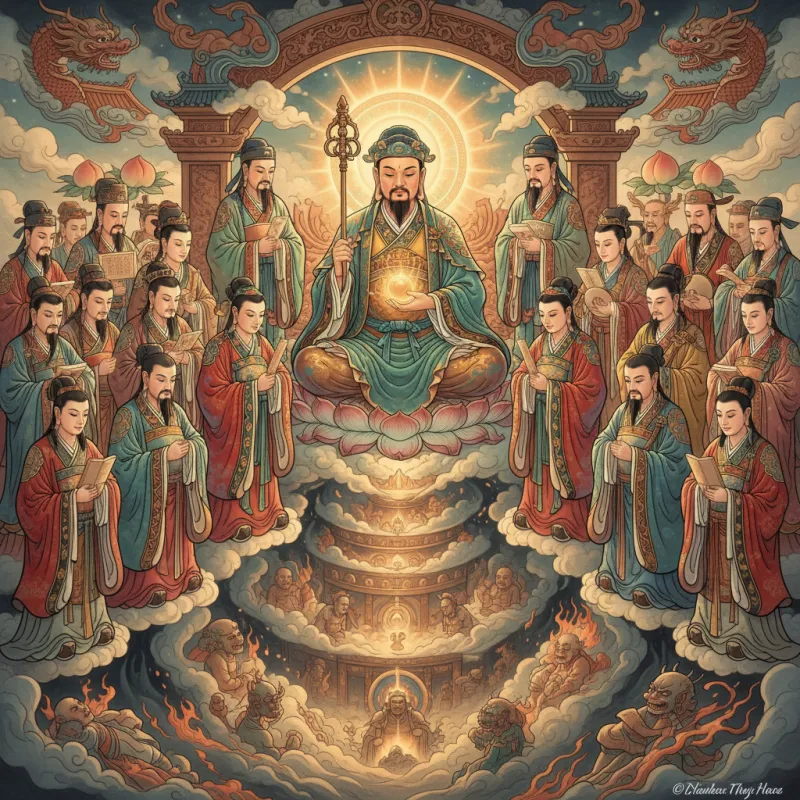
Picture a monk standing at the gates of hell, refusing to leave. Not because he's trapped, but because he made a vow: "Until the hells are empty, I will not become a Buddha." This is Dizang (地藏, Dìzàng), known in Sanskrit as Kṣitigarbha, the bodhisattva who turned down enlightenment to rescue souls from the darkest corners of existence. While other Buddhist figures ascended to paradise, Dizang descended into the underworld—and he's still there.
The Monk Who Chose Hell Over Heaven
Dizang's defining characteristic isn't his power—it's his stubbornness. According to the Kṣitigarbha Bodhisattva Pūrvapraṇidhāna Sūtra (地藏菩薩本願經, Dìzàng Púsà Běnyuàn Jīng), translated into Chinese during the Tang Dynasty, Dizang made his famous vow before the Buddha himself. The text describes how, in a previous life as a young woman, he witnessed his mother's suffering in hell and vowed to save all beings from such torment. This wasn't a one-time promise—the sutra records that Dizang made similar vows across multiple lifetimes, each time choosing compassion over personal liberation.
What makes this remarkable is the Buddhist context. In Mahayana Buddhism, becoming a Buddha represents the ultimate achievement, the end of suffering and rebirth. Dizang essentially said "no thanks" to this cosmic promotion. He's like someone who refuses a corner office because there's still work to do in the basement. This decision resonates deeply in Chinese religious culture, where filial piety and self-sacrifice are paramount virtues. Dizang embodies both: he saves his mother and extends that familial devotion to all beings.
The Iconography of the Underworld Guardian
You can spot Dizang in any temple by his distinctive appearance. He's always depicted as a monk with a shaved head, wearing simple robes—no elaborate crowns or jewelry like Guanyin. In his right hand, he holds a khakkhara (錫杖, xīzhàng), a ringed staff that jingles to alert insects and small creatures to move out of his way (preventing accidental killing, a Buddhist precept). His left hand typically holds a wish-fulfilling jewel (如意寶珠, rúyì bǎozhū) that illuminates the darkness of hell.
But here's what's interesting: Dizang often appears with a companion animal—a creature called Diting (諦聽, Dìtīng), which translates roughly as "Truth Listener." This mythical beast has the head of a lion, the horns of a deer, and the body of a dog, and it can distinguish truth from lies and good from evil. During the Tang Dynasty, artists began including Diting in Dizang iconography, suggesting the bodhisattva's role as a judge who sees through deception. The animal doesn't just look fierce—it represents Dizang's ability to perceive the true nature of karma and determine who deserves salvation.
Dizang's Domain: The Ten Courts of Hell
Chinese Buddhist cosmology describes hell not as a single pit but as a bureaucratic nightmare—literally. The underworld consists of ten courts (十殿閻羅, shí diàn Yánluó), each presided over by a different king who judges specific sins. Dizang doesn't rule these courts; instead, he moves through them as an advocate for the damned. Think of him as a defense attorney who never loses hope in his clients, no matter how guilty they are.
The Dizang Sutra describes how he manifests in different forms to reach souls in various hells. In the Hell of Tongue-Ripping (拔舌地獄, báshé dìyù), where liars are punished, he appears to teach the value of truthful speech. In the Hell of Ice (寒冰地獄, hánbīng dìyù), he brings warmth through dharma teachings. This isn't passive compassion—Dizang actively intervenes in the karmic process, something that troubled some Buddhist philosophers. If karma is supposed to be automatic, how can a bodhisattva interfere? The answer lies in the concept of merit transfer: Dizang uses his accumulated spiritual merit to offset the negative karma of others, essentially paying their karmic debts.
The Festival of Hungry Ghosts and Dizang's Birthday
On the first day of the seventh lunar month, Chinese Buddhists begin preparing for Ghost Month (鬼月, guǐ yuè), when the gates of hell open and spirits roam the earth. This period culminates on the fifteenth day with the Zhongyuan Festival (中元節, Zhōngyuán Jié), which coincides with Dizang's birthday. Temples hold elaborate ceremonies where monks chant the Dizang Sutra for hours, and families make offerings to wandering spirits who have no descendants to care for them.
I've attended these ceremonies at temples in Taiwan and mainland China, and the atmosphere is striking. Unlike the joyful celebrations for Mazu or other protective deities, Dizang's birthday carries a somber, almost gothic quality. The chanting is deep and repetitive, designed to reach souls in the deepest hells. Devotees burn elaborate paper offerings—not just money, but paper houses, cars, and even smartphones for the dead to use in the afterlife. The implicit message: even in death, even in hell, you're not forgotten.
Dizang in Popular Culture and Folk Religion
While Dizang originated in Buddhist scripture, he's been thoroughly absorbed into Chinese folk religion, where boundaries between Buddhist, Daoist, and local traditions blur. In many temples, you'll find Dizang statues alongside Daoist underworld officials like the City God (城隍, Chénghuáng) and the Ten Kings of Hell. This syncretism reflects how ordinary Chinese people approach the afterlife—they're not concerned with doctrinal purity but with covering all their bases.
The Ming Dynasty novel Journey to the West (西遊記, Xīyóu Jì) features Dizang in a memorable scene where Sun Wukong, the Monkey King, causes havoc in the underworld. Dizang appears as a calming presence, negotiating between the angry hell kings and the unrepentant monkey. This portrayal—Dizang as mediator and peacemaker—reflects his popular image. He's not a warrior bodhisattva like Weituo; he's a diplomat who resolves conflicts through compassion rather than force.
In contemporary Taiwan and Hong Kong, Dizang worship has experienced a revival, particularly among people dealing with grief. Temples dedicated to Dizang offer services for communicating with deceased relatives, and some have become pilgrimage sites for those seeking closure after losing loved ones. This modern adaptation shows how ancient religious figures evolve to meet contemporary emotional needs.
The Philosophical Problem of Infinite Compassion
Here's the uncomfortable question that Dizang's vow raises: Can hell actually be emptied? Buddhist cosmology suggests that as long as beings create negative karma, hell will have occupants. Dizang's mission might be literally impossible—an eternal task with no completion. Some scholars argue this is precisely the point. The vow isn't meant to succeed; it's meant to demonstrate the boundless nature of bodhisattva compassion.
But there's another interpretation. The Dizang Sutra contains a curious passage where the Buddha predicts that Dizang will eventually become a Buddha named "Profound Enlightenment King" (深覺王, Shēnjué Wáng). This suggests that Dizang's vow has an endpoint, that hell can be emptied—or at least that his work will eventually be complete. The tension between these interpretations has fueled centuries of Buddhist philosophical debate.
Why Dizang Matters Today
In an age of climate anxiety, political despair, and existential dread, Dizang offers an unusual form of hope. He doesn't promise that suffering will end or that justice will prevail. Instead, he demonstrates that someone will be there in the worst moments, that no one is beyond redemption, and that compassion doesn't require optimism about outcomes. His vow to stay in hell until it's empty is either foolish or heroic, depending on your perspective—but it's undeniably committed.
The bodhisattva who refuses paradise reminds us that spiritual advancement isn't always upward. Sometimes the most enlightened choice is to descend, to stay with those who suffer, to refuse the exit when others remain trapped. Dizang doesn't empty hell through miracles or divine intervention—he does it one soul at a time, with infinite patience and unwavering presence. That's not just mythology; it's a template for how to live in a world that often feels like hell itself.
Related Reading
- Unveiling Chinese Deities and Immortals in Daoist and Buddhist Traditions
- Maitreya: The Laughing Buddha
- Exploring the Rich Tapestry of Chinese Deities and Immortals in Buddhism and Daoism
- Guanyin: The Goddess of Mercy
- Fuxi: The God-Emperor Who Gave Humanity Civilization
- The Eight Immortals: A Complete Guide
- Unraveling the Mystique of Chinese War Gods in the Daoist and Buddhist Pantheon