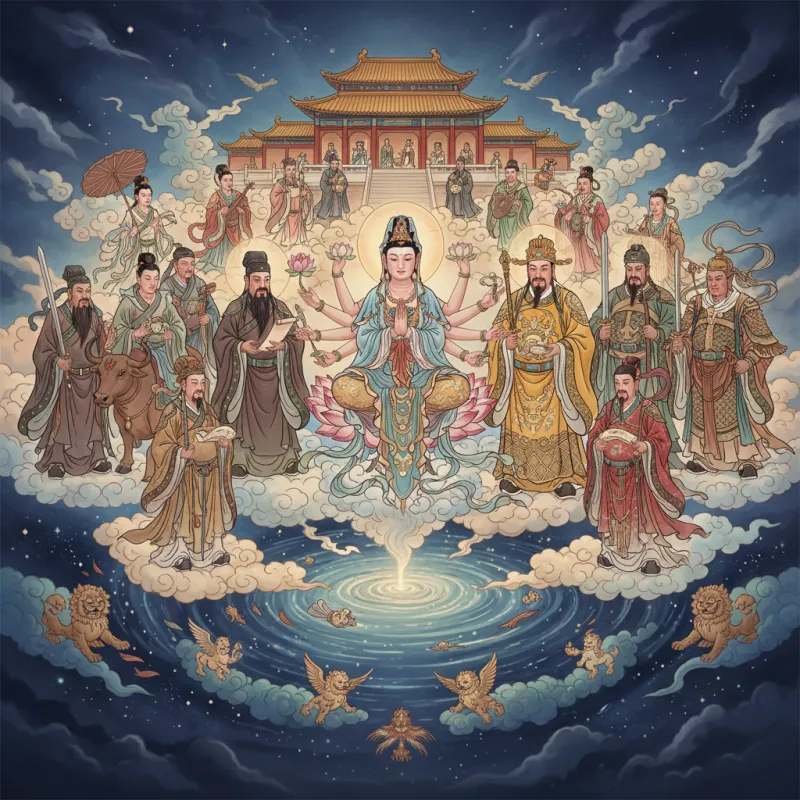
Picture this: a celestial bureaucrat stamps your afterlife paperwork while a peach-eating immortal lounges in the clouds above, and somewhere between them, a compassionate bodhisattva postpones enlightenment to save your soul. Welcome to the organized chaos of Chinese religious cosmology, where Buddhist compassion meets Daoist transcendence in a pantheon so vast it makes the Greek gods look understaffed.
The interweaving of Buddhism and Daoism in China created something unprecedented in religious history—not a merger, but a conversation spanning fifteen centuries. These traditions didn't replace each other; they borrowed, competed, and ultimately enriched one another, producing a spiritual landscape where Guanyin (觀音, Guānyīn) might share temple space with the Eight Immortals, and where a single person could pray to both without cognitive dissonance.
The Buddhist Migration: How Indian Deities Became Chinese
When Buddhism arrived via the Silk Road during the Han Dynasty (206 BCE–220 CE), it faced a translation problem that went far beyond language. How do you explain the concept of nirvana to a culture obsessed with longevity? The solution was brilliant: Buddhist missionaries and Chinese converts didn't just translate texts—they transformed the entire presentation.
Take Avalokiteśvara, the bodhisattva of compassion. In India, this figure was decidedly masculine. But by the Song Dynasty (960–1279 CE), Guanyin had become predominantly female in Chinese imagination, absorbing characteristics from indigenous mother goddesses and the Daoist Queen Mother of the West. This wasn't corruption of the dharma—it was adaptation, and it worked spectacularly. Today, Guanyin remains one of the most beloved figures in Chinese Buddhism, her thousand arms representing infinite compassion in a way that resonates with Chinese aesthetic sensibilities.
The transformation of Ksitigarbha into Dizang (地藏, Dìzàng) tells another story. This bodhisattva who vowed not to achieve Buddhahood until all hells are empty found particular resonance in Chinese ancestor worship. His promise to save souls from the underworld aligned perfectly with filial piety, making him essential to Chinese Buddhist practice in ways his Indian origins never anticipated.
The Daoist Counter-Pantheon: Bureaucracy Meets Mysticism
While Buddhism was adapting to China, Daoism was building its own elaborate hierarchy of deities, and here's where things get deliciously complex. The Daoist pantheon wasn't just spiritual—it was administrative. The Jade Emperor (玉皇大帝, Yùhuáng Dàdì) presides over a celestial bureaucracy that mirrors earthly government, complete with departments, reports, and performance reviews for local gods.
This bureaucratic structure reveals something profound about Chinese religious psychology: the divine realm should operate with the same order and hierarchy as the human world. When you pray to the Kitchen God (灶神, Zàoshén), you're essentially filing a report that will work its way up the celestial chain of command. He monitors your household behavior all year, then ascends to heaven during Chinese New Year to deliver his annual assessment. Smart families traditionally smeared honey on his lips before his departure—a bit of divine bribery to sweeten his report.
The Eight Immortals (八仙, Bāxiān) represent Daoism's more anarchic side. Unlike the rigid celestial bureaucracy, these figures achieved immortality through various means—some through alchemy, others through moral cultivation, one allegedly by getting drunk on divine wine. They're beloved precisely because they're flawed, relatable, and often irreverent. Lü Dongbin (呂洞賓, Lǚ Dòngbīn), the most famous of the eight, is simultaneously a scholarly gentleman and a trickster who tests mortals' virtue, sometimes through seduction. This complexity makes him far more interesting than a simple saint.
The Syncretic Sweet Spot: Where Traditions Blur
By the Ming Dynasty (1368–1644 CE), the boundaries between Buddhist and Daoist figures had become wonderfully porous. The novel Journey to the West (西遊記, Xīyóujì), written around 1592, perfectly captures this syncretism. The Monkey King Sun Wukong (孫悟空, Sūn Wùkōng) battles both Buddhist and Daoist deities, steals peaches from the Daoist Queen Mother's garden, and ultimately finds redemption through Buddhist pilgrimage. The story doesn't treat this mixing as problematic—it's simply how the cosmos works.
Consider Mazu (媽祖, Māzǔ), the goddess of the sea. Historically a Song Dynasty woman named Lin Moniang who died saving sailors, she was deified through popular worship, officially recognized by the imperial court, and eventually absorbed into both Buddhist and Daoist frameworks. Temples to Mazu might feature Buddhist sutras, Daoist rituals, and Confucian moral teachings—all in the same ceremony. This isn't confusion; it's sophisticated religious pluralism.
The concept of the Three Teachings (三教, Sānjiào)—Buddhism, Daoism, and Confucianism—as complementary rather than contradictory became orthodox thinking. A Ming Dynasty saying captured it perfectly: "The three teachings are one family" (三教一家, Sānjiào yījiā). You could be a Confucian in the office, a Daoist in the mountains, and a Buddhist facing death, without anyone questioning your consistency.
Immortality vs. Enlightenment: Competing Visions of Transcendence
Here's where Buddhism and Daoism fundamentally diverge, despite their surface similarities. Daoist immortals (仙, xiān) seek to transcend death itself, preserving and perfecting the physical body through alchemy, meditation, and esoteric practices. The goal is literal immortality—living forever in a transformed, imperishable body.
Buddhist enlightenment, by contrast, aims to escape the cycle of rebirth entirely. The body is temporary, death inevitable, and attachment to physical existence is precisely the problem. Bodhisattvas like Guanyin achieve liberation but choose to remain in the cycle of rebirth to help others—a fundamentally different kind of transcendence than Daoist immortality.
Yet in practice, these distinctions blurred. Daoist immortals were sometimes described as achieving a state suspiciously similar to Buddhist nirvana. Buddhist arhats were depicted with supernatural longevity that looked a lot like Daoist immortality. The folk religion that most Chinese actually practiced borrowed freely from both traditions, creating a practical spirituality focused on this-worldly benefits: health, prosperity, protection, and yes, longevity.
The Underworld: Where Buddhist Hells Meet Daoist Bureaucracy
Nowhere is the Buddhist-Daoist synthesis more evident than in Chinese conceptions of the afterlife. The Ten Courts of Hell, presided over by the Ten Yama Kings (十殿閻羅, Shí Diàn Yánluó), combine Buddhist karma with Daoist administrative structure. Each court specializes in punishing specific sins, with tortures meticulously matched to crimes in a system that would make Dante jealous.
But here's the twist: this isn't permanent damnation. Souls work through their karma, serve their sentences, and eventually reincarnate. The system is harsh but ultimately just, reflecting both Buddhist causality and Chinese legal philosophy. And crucially, the living can help the dead through offerings, prayers, and merit transfer—a practice that owes more to Chinese ancestor worship than to either Buddhism or Daoism in their pure forms.
Dizang Bodhisattva oversees this realm, but he shares authority with Daoist deities like the City God (城隍, Chénghuáng), who acts as a kind of underworld magistrate. In popular religion, people prayed to both, hedging their bets across traditions. This wasn't theological confusion—it was practical spirituality.
Modern Resonance: Ancient Deities in Contemporary Life
Walk through any Chinese community today, from Beijing to San Francisco, and you'll find these ancient figures still commanding devotion. Guanyin statues grace Buddhist temples and taxi dashboards alike. The Jade Emperor receives offerings during Chinese New Year. Mazu temples dot coastal regions, still protecting fishermen and sailors.
What's remarkable isn't that these traditions survived—it's how they've adapted. Modern worshippers might not know the intricate theological distinctions between Buddhist and Daoist cosmology, but they understand the practical benefits: Guanyin for compassion and help in crisis, Guan Yu (關羽, Guān Yǔ) for business success and loyalty, Wenchang (文昌, Wénchāng) for academic achievement. The pantheon functions as a spiritual toolkit, with different deities for different needs.
The syncretic tradition also offers something increasingly valuable: religious flexibility without relativism. These traditions maintain distinct identities and practices while acknowledging multiple paths to transcendence. In an era of religious polarization, the Chinese model of "three teachings, one family" suggests alternatives to both rigid fundamentalism and vague spirituality.
The Living Tradition: Continuity and Change
The story of Chinese deities and immortals isn't ancient history—it's ongoing evolution. New deities continue to emerge through popular devotion, while ancient figures acquire new attributes and responsibilities. The tradition's genius lies in its flexibility, its willingness to absorb new influences while maintaining core principles.
Understanding this pantheon requires abandoning Western categories of "pure" versus "syncretic" religion. The mixing of Buddhist and Daoist elements isn't corruption—it's the tradition working as designed, adapting to Chinese cultural values while preserving essential teachings. The result is a religious landscape of remarkable depth, where celestial bureaucrats and enlightened bodhisattvas, immortal tricksters and compassionate goddesses, all have their place in a cosmos that's simultaneously orderly and wild, ancient and ever-renewing.
Related Reading
- Maitreya: The Laughing Buddha
- Dizang: The Bodhisattva Who Empties Hell
- Guanyin: The Goddess of Mercy
- Unveiling Chinese Deities and Immortals in Daoist and Buddhist Traditions
- Ancient Chinese Underworld Deities: Guardians of Death and Afterlife Realms
- Daoist Temples: Where to Go, What to Expect, and How Not to Embarrass Yourself
- A Practical Guide to Visiting Chinese Temples: What to Do and What Not to Do