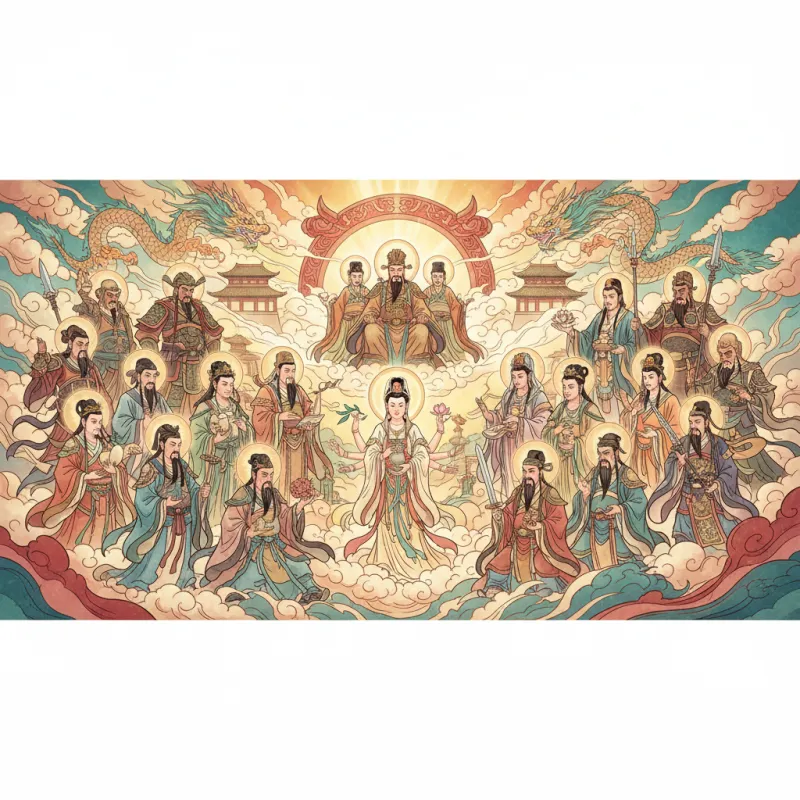
The Monkey King just punched through another dimension—this time in a Japanese high school uniform. Somewhere between the Tang Dynasty pilgrimage and today's streaming platforms, Chinese gods learned to speak Japanese, gained spiky anime hair, and conquered a global audience that's never read the original texts. This isn't cultural appropriation—it's cultural alchemy, and the results are spectacular.
The Monkey King's Infinite Transformations
Sun Wukong (孙悟空 Sūn Wùkōng) doesn't just appear in anime and manga—he dominates it. The Great Sage Equal to Heaven has been reincarnated more times in Japanese media than he ever was in Buddhist cosmology. Akira Toriyama's Dragon Ball (1984) kicked off the modern era by transforming the rebellious stone monkey into Son Goku, a Saiyan warrior who kept the tail, the staff, and the flying cloud but traded Buddhist enlightenment for increasingly absurd power levels. The genius move? Toriyama stripped away the religious framework while preserving the core appeal: an underdog trickster who refuses to bow to authority.
But Dragon Ball is just the most famous example. Saiyuki (1997) by Kazuya Minekura reimagines the Journey to the West (西游记 Xīyóu Jì) pilgrims as gun-toting, chain-smoking pretty boys in a post-apocalyptic fantasy world. Hoshin Engi (1996) adapts Investiture of the Gods (封神演义 Fēngshén Yǎnyì), turning Jiang Ziya into a lazy teenage strategist. Even Naruto borrows heavily—the Third Hokage's summoning jutsu directly references Sun Wukong's Ruyi Jingu Bang (如意金箍棒 Rúyì Jīngū Bàng), and the transformation techniques echo the Monkey King's 72 transformations.
The pattern is clear: Japanese creators don't just adapt Chinese mythology—they remix it, stripping away cultural context while amplifying the visual spectacle and character archetypes. Sun Wukong becomes a template for the shonen protagonist: powerful, rebellious, loyal to friends, and always hungry.
The Jade Emperor's Bureaucracy Meets Shonen Logic
Chinese mythology's elaborate celestial hierarchy—with the Jade Emperor (玉皇大帝 Yùhuáng Dàdì) at the top and countless departments managing everything from weather to reincarnation—translates surprisingly well to anime's love of complex power systems. Bleach essentially recreates the Chinese underworld bureaucracy with its Soul Society, complete with different divisions, ranked officers, and a spirit king who barely appears. The Ten Kings of Hell (十殿阎王 Shí Diàn Yánwáng) become the Gotei 13 captains.
Noragami (2011) takes this further, presenting a modern Japan where countless minor gods struggle for recognition and survival, dependent on human worship—a concept lifted directly from Chinese folk religion where deities' power correlates with their cult following. The protagonist Yato is essentially a Chinese wandering deity (游神 yóushén) transplanted into contemporary Tokyo, complete with the need to perform odd jobs for offerings.
What's fascinating is how Japanese adaptations often preserve the bureaucratic absurdity of Chinese divine administration while making it more accessible. The Jade Emperor's court, with its endless protocols and political maneuvering, becomes the backdrop for action sequences and character drama. The gods stop being distant, inscrutable beings and become characters with motivations, flaws, and character arcs—very un-Daoist, but very entertaining.
Nezha: From Child God to Anime Archetype
Nezha (哪吒 Nézhā), the lotus-born child deity who killed a dragon prince and committed suicide before being reborn, is tailor-made for anime adaptation. His story has everything: family trauma, body horror, divine weapons, and a protagonist who looks like a teenager but fights like a god. Hoshin Engi features Nataku (the Japanese reading of Nezha) as a tragic artificial human created for war. Saiyuki reimagines him as a stoic, emotionally stunted warrior. Even Fate/Grand Order includes him as a summonable servant.
The Japanese versions consistently emphasize Nezha's youth and his complicated relationship with authority—particularly his father Li Jing (李靖 Lǐ Jìng). The original Investiture of the Gods presents Nezha's suicide and resurrection as a Buddhist parable about filial piety and karmic debt. Anime adaptations transform it into a story about child soldiers, parental abuse, and the cost of being a weapon. It's darker, more psychological, and arguably more relevant to modern audiences than the original morality tale.
The Eight Immortals Walk Into an Anime
The Eight Immortals (八仙 Bāxiān)—that eclectic group of Daoist immortals who achieved enlightenment through various means—appear less frequently than Sun Wukong or Nezha, but their influence is everywhere. Each immortal represents a different path to transcendence and carries a unique magical implement, making them perfect for ensemble cast stories and power system mechanics.
Naruto's Akatsuki organization mirrors the Eight Immortals' structure: a group of powerful individuals, each with distinct abilities and backstories, united by a common goal. One Piece's emphasis on each crew member having a specialized role and unique fighting style echoes the Eight Immortals' dynamic. Even My Hero Academia's diverse quirk system owes something to the idea that power can manifest in radically different forms depending on the individual's nature.
The immortal Lü Dongbin (吕洞宾 Lǚ Dòngbīn), the scholarly swordsman, becomes the template for countless "genius swordsman" characters. He Xiangu (何仙姑 Hé Xiāngū), the only female immortal, influences the "mysterious woman with healing/nature powers" archetype. The adaptations are rarely direct—Japanese creators absorb the archetypes and redistribute them across multiple characters and series.
Why Japanese Adaptations Work (And Sometimes Don't)
The success of Chinese mythology in Japanese media comes down to aesthetic compatibility and narrative flexibility. Chinese myths are episodic, filled with transformations and battles, and feature protagonists who challenge cosmic order—perfect for serialized manga and anime. The visual language translates well: flowing robes become dramatic capes, celestial palaces become floating fortresses, and magical implements become signature weapons.
But something gets lost in translation. The philosophical underpinnings—Daoist concepts of wu wei (无为 wúwéi, effortless action), Buddhist ideas about karma and reincarnation, Confucian values about social harmony—often get stripped away or simplified. Sun Wukong's journey in Journey to the West is fundamentally about spiritual cultivation and overcoming ego. Son Goku's journey is about getting stronger to protect his friends. Both are valid stories, but they're not the same story.
The most successful adaptations—like The Ravages of Time, a manga reimagining of Romance of the Three Kingdoms (三国演义 Sānguó Yǎnyì)—preserve the complexity while making it accessible. The weakest ones treat Chinese mythology as a costume box, grabbing cool-looking gods and weapons without understanding what made them resonate for centuries.
The Reverse Flow: Chinese Creators Reclaim Their Gods
Here's where it gets interesting: Chinese creators are now adapting their own mythology with techniques learned from Japanese anime and manga. The 2019 animated film Ne Zha broke Chinese box office records by presenting Nezha as a punk rock rebel with eyeliner, clearly influenced by decades of anime aesthetics. The Legend of Hei (2019) features a cat demon protagonist in a story that feels like a Studio Ghibli film directed by someone who grew up on Chinese folklore.
This reverse flow creates a fascinating cultural loop. Chinese gods go to Japan, get the anime treatment, become globally popular, and return home transformed. Young Chinese audiences now encounter their own mythology filtered through Japanese visual language, which itself was influenced by Chinese art centuries ago. It's cultural exchange as a Möbius strip.
The question isn't whether this is "authentic"—mythology has always evolved through retelling. The question is whether these adaptations preserve something essential about the original stories while making them relevant to new audiences. When Sun Wukong appears in a Japanese manga, does he still embody the rebellious spirit that made him beloved in the Ming Dynasty? When Nezha shows up in an anime, does his story still resonate with the same emotional truth?
The Global Mythology Marketplace
Chinese gods in anime and manga represent something larger: the globalization of mythology itself. These aren't just Chinese stories anymore—they're part of a shared global pop culture vocabulary. A teenager in Brazil might know Sun Wukong primarily through Dragon Ball, not Journey to the West. An American gamer might encounter the Jade Emperor through Smite or League of Legends before learning about Chinese cosmology.
This democratization of mythology has costs and benefits. On one hand, these ancient stories reach audiences who would never read classical Chinese literature. On the other hand, the stories get simplified, commercialized, and sometimes misrepresented. But mythology has always worked this way—Greek gods became Roman gods became Renaissance allegories became Marvel superheroes. The stories that survive are the ones that keep getting retold, even if each retelling changes them.
The real magic is that Chinese mythology proves endlessly adaptable. Whether it's Sun Wukong fighting Frieza, Nezha piloting a mecha, or the Eight Immortals inspiring a superhero team, these gods keep finding new forms. They've survived thousands of years of dynastic changes, religious reforms, and cultural revolutions. A little anime hair and some power level inflation isn't going to stop them now.
For more on how Chinese deities appear in modern media, check out Chinese Gods in Video Games. And if you're curious about the original stories behind these adaptations, explore Journey to the West Characters.
Related Reading
- Nezha: From Ancient Deity to Box Office Hit
- Chinese Gods in Marvel and DC Comics
- Nezha: From Rebellious Child God to China's Biggest Animated Film
- Journey to the West: From Novel to Netflix — Every Major Adaptation
- Unraveling the Mystique of Chinese War Gods in the Daoist and Buddhist Pantheon
- How to Pray at a Chinese Temple: A Respectful Visitor's Guide
- The Eight Immortals: China's Most Beloved Supernatural Team