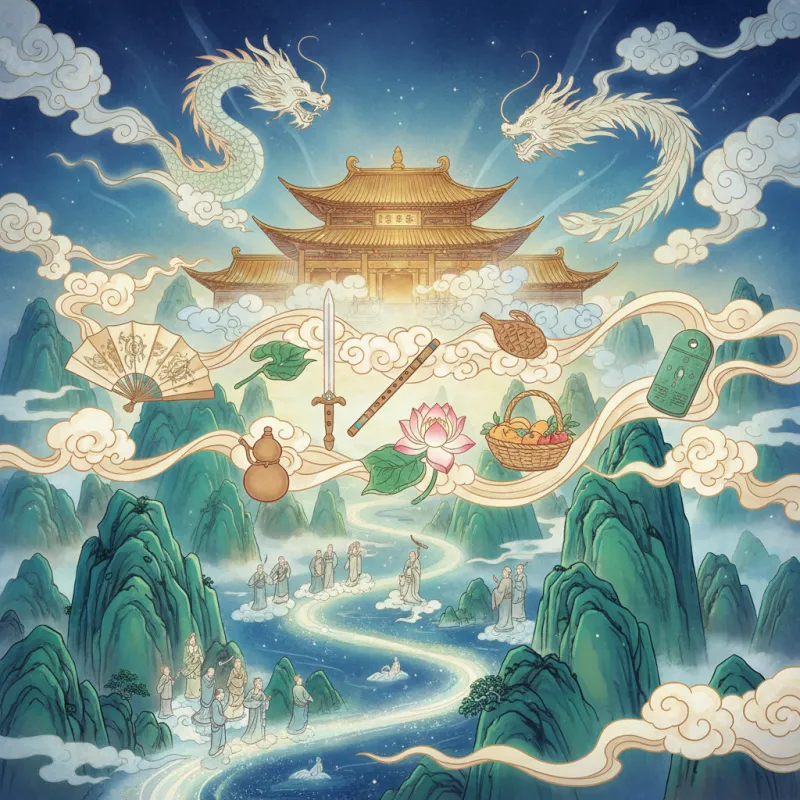
A porcelain vase sits in a museum case, its surface decorated with what looks like a random assortment of objects: a fan, a sword, a gourd, a pair of castanets. The label reads "Qing Dynasty, decorative motifs." But to anyone who knows the visual language of Chinese art, this isn't decoration—it's a coded message, a blessing, a complete spiritual narrative told through eight objects that represent eight legendary figures who achieved immortality.
The Language of Objects
The Eight Immortals (八仙 Bāxiān) are among the most recognizable figures in Chinese popular religion, but their symbols—known as the àn bā xiān (暗八仙), literally "hidden Eight Immortals"—operate on a different level entirely. When you see these objects floating on a piece of porcelain, carved into furniture, or embroidered on silk, you're looking at a sophisticated visual shorthand that developed during the Ming Dynasty (1368-1644) and reached its peak during the Qing (1644-1912).
This wasn't just artistic convenience. In a culture where direct representation could sometimes be considered presumptuous or where space was limited, the symbols allowed artisans to invoke the immortals' blessings without depicting the sacred figures themselves. It's the difference between writing someone's name and drawing their portrait—both refer to the same person, but the approach changes the relationship between viewer and subject.
Decoding the Eight Emblems
Zhongli Quan's fan (扇子 shànzi) looks innocent enough—a simple palm-leaf fan of the type used throughout Asia. But this particular fan carries the power to revive the dead and calm the seas. In art, it often appears with a slight curve, sometimes with visible ribs, and its presence signals authority over life and death. Zhongli Quan, the corpulent, bare-bellied leader of the Eight, used this fan to bring souls back from the underworld. When you see it on a wedding gift or birthday present, you're looking at a wish for longevity and protection from premature death.
Lü Dongbin's sword (剑 jiàn) is never just a weapon. This is the demon-slaying blade that cuts through illusion, ignorance, and evil spirits. In the visual language of the symbols, it's usually depicted as a straight double-edged sword, sometimes with a tassel hanging from the pommel. Lü Dongbin, the scholar-immortal who appears frequently in Chinese immortal legends, wielded this sword not primarily in physical combat but in spiritual warfare. The sword on a scholar's desk accessory isn't advocating violence—it's invoking the clarity of mind that cuts through confusion.
He Xiangu's lotus (莲花 liánhuā) carries layers of meaning that go beyond the Buddhist associations most people know. Yes, the lotus represents purity rising from mud, but in He Xiangu's hands, it specifically symbolizes female spiritual achievement and the possibility of transcendence regardless of gender. In a society that often limited women's religious roles, He Xiangu's lotus was a quiet but powerful statement. The flower appears in art either as a full bloom, a bud, or sometimes as a lotus pod, each stage carrying slightly different connotations about spiritual development.
Zhang Guolao's fish drum (鱼鼓 yúgǔ) is probably the most puzzling symbol to modern viewers. This isn't a drum made from a fish—it's a bamboo tube covered with fish skin, struck with a small rod. Zhang Guolao, the eccentric immortal who rode his donkey backward, used this instrument in his Daoist rituals and performances. The fish drum represents the ability to predict the future and communicate with the spiritual realm through rhythm and sound. When it appears in art, it's often shown as a cylindrical tube with two small rods crossed over it.
Lan Caihe's flower basket (花篮 huālán) overflows with peonies, chrysanthemums, and other blooms that never wilt. Lan Caihe—whose gender remains ambiguous in most texts—carried this basket while wandering as a street performer, singing songs about the brevity of life and the foolishness of attachment. The basket in art symbolizes the ability to gather life's pleasures without being trapped by them. It's a more complex message than simple abundance: it's about holding beauty lightly.
Han Xiangzi's flute (笛子 dízi) produces music that makes flowers bloom and brings enlightenment to listeners. This transverse bamboo flute appears in art as a simple tube with finger holes, sometimes with a tassel attached. Han Xiangzi, nephew of the famous Tang Dynasty scholar Han Yu, used music as his path to immortality. The flute represents harmony, the arts, and the idea that beauty itself can be a spiritual practice. You'll often see it paired with other scholarly symbols on objects meant for educated audiences.
Cao Guojiu's castanets (玉板 yùbǎn) or jade tablets mark him as the only immortal with imperial connections—he was supposedly the brother of an empress. These percussion instruments, held in both hands and clapped together, represent his ability to purify and his connection to official rank. In art, they appear as a pair of rectangular tablets, sometimes with visible decorative patterns. Their presence invokes both nobility and the idea that even those born to privilege must cultivate virtue to achieve transcendence.
Li Tieguai's gourd (葫芦 húlu) contains medicine, magic, and sometimes his own soul. Li Tieguai, the beggar immortal with the iron crutch, used this gourd to store healing elixirs and to house his spirit when he traveled in astral form. The gourd in art is usually depicted as a double-bulbed bottle gourd, sometimes with a stopper, sometimes with vapor emerging from the top. It represents healing, transformation, and the alchemical arts. On medicine shops and pharmacies throughout Chinese communities, you'll still see the gourd as a sign of the healing profession.
Reading Combinations and Contexts
The real sophistication appears when you start noticing how these symbols combine and where they appear. A vase with all eight symbols scattered across its surface is offering a complete blessing—longevity, wisdom, purity, prosperity, harmony, nobility, healing, and spiritual protection all at once. But artisans often selected specific combinations for specific purposes.
Wedding gifts frequently featured He Xiangu's lotus paired with other symbols of harmony and fertility. Scholar's objects emphasized Lü Dongbin's sword and Han Xiangzi's flute—wisdom and artistic cultivation. Birthday presents for elderly relatives would prominently display Zhang Guolao's fish drum and Li Tieguai's gourd, both associated with longevity and health.
The arrangement matters too. Symbols floating freely suggest the immortals wandering the world, bringing blessings wherever they drift. Symbols arranged in a formal pattern indicate more structured, ceremonial wishes. Symbols partially hidden among clouds or waves reference the immortals' ability to move between the mortal and spiritual realms.
From Ming Refinement to Qing Exuberance
The visual treatment of these symbols evolved significantly across dynasties. Ming Dynasty (1368-1644) artisans tended toward restraint—the symbols appeared as elegant line drawings or subtle relief carvings, often in monochrome. The message was there for those who could read it, but it didn't shout.
Qing Dynasty (1644-1912) taste ran toward abundance. The same symbols became more elaborate, more colorful, more three-dimensional. Porcelain from the Kangxi period (1662-1722) shows the symbols rendered in brilliant enamels, sometimes with additional decorative elements like ribbons, clouds, or auspicious characters. By the late Qing, you might see the symbols embedded in complex scenes with landscapes, architecture, and other symbolic elements, creating visual puzzles that reward careful examination.
This shift reflects broader changes in Chinese aesthetic preferences and manufacturing capabilities, but it also shows how the symbols remained relevant across changing times. The same visual vocabulary served both the refined taste of Ming literati and the more exuberant sensibilities of Qing merchants and officials.
Beyond Decoration: Symbols in Daily Life
Walk through any traditional Chinese home, and you'd encounter these symbols constantly. They appeared on the bed frame (blessing the marriage and hoping for children), on storage chests (protecting valuable contents), on room dividers (marking boundaries between spaces), on clothing (especially for children, offering protection), and on practically every piece of porcelain used for serving food and tea.
This wasn't superstition in the dismissive sense—it was a way of surrounding yourself with positive intentions and spiritual protection. The symbols functioned like prayers made visible, like blessings you could touch. A mother embroidering the Eight Immortals' symbols on her child's jacket wasn't just decorating; she was invoking specific protections and hopes for her child's future.
The symbols also appeared in temple architecture and religious contexts, but their presence in domestic and commercial settings shows how deeply the Eight Immortals had penetrated popular culture. These weren't distant, austere deities requiring elaborate rituals. They were familiar figures whose blessings could be invoked through their emblems on everyday objects.
The Modern Afterlife of Ancient Symbols
These symbols haven't disappeared. Visit any Chinatown, any Chinese restaurant, any shop selling Asian antiques, and you'll still see them. Sometimes the people selling or displaying these objects know exactly what they mean. Sometimes the symbols have become purely decorative, their meanings forgotten or reduced to vague notions of "good luck."
This creates an interesting situation where objects carry messages their owners can't read—like inheriting a letter written in a language you don't speak. The symbols still function aesthetically, their balanced compositions and traditional motifs fitting contemporary tastes for "Asian-inspired" design. But the specific blessings, the particular powers invoked, the sophisticated visual language—all of that fades into generic "Oriental decoration."
Yet the symbols persist, which suggests something in their visual logic continues to resonate even when the specific meanings are lost. The fan, sword, lotus, fish drum, flower basket, flute, castanets, and gourd create a pleasing visual variety—different shapes, different associations, different textures. They work as pure design even when divorced from their symbolic content.
Learning to See What's Hidden
Once you know what to look for, you can't unsee it. That "decorative" plate suddenly reveals itself as a birthday blessing. That carved panel becomes a wish for scholarly success. That embroidered cushion transforms into a protection spell made of silk thread.
This is the genius of the àn bā xiān system—it hides profound meanings in plain sight, creating art that works on multiple levels simultaneously. Someone who doesn't know the code sees attractive decoration. Someone who knows sees a complete spiritual message. The same object serves both purposes without contradiction.
The symbols remind us that traditional Chinese art rarely aimed for pure aesthetics divorced from meaning. Beauty served purpose; decoration carried messages. The Eight Immortals' symbols represent this integration at its most sophisticated—a visual language where every object tells a story, invokes a blessing, and connects the viewer to centuries of spiritual tradition.
Next time you see a Chinese vase, a carved screen, or an embroidered textile, look for the eight objects. They're probably there, floating among the clouds and waves, still offering their blessings to anyone who knows how to read them.
Related Reading
- Meet the Eight Immortals: Profiles of China's Favorite Supernatural Squad
- The Eight Immortals: China's Most Beloved Supernatural Team
- Lü Dongbin: The Most Beloved Immortal in Chinese Culture
- The Eight Immortals: China's Most Beloved Divine Group
- Discovering Nature Spirits in Chinese Mythology: Guardians of the Earth and Sky
- The Mythology of the Mid-Autumn Festival: Chang'e, Hou Yi, and the Moon Rabbit
- The Quest for the Elixir of Life: From Emperor Qin to Modern Fiction