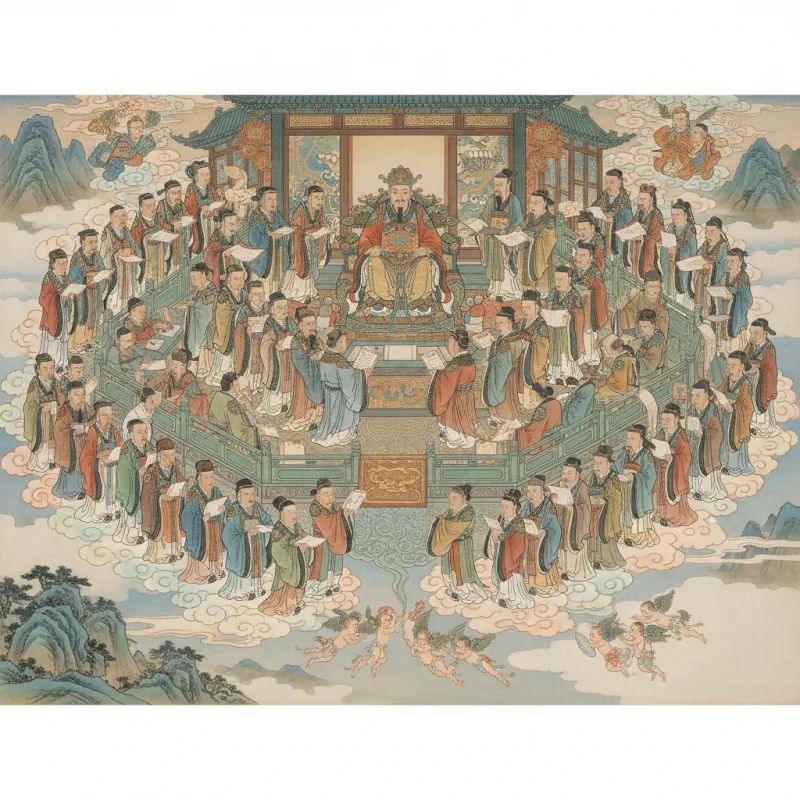
When the Jade Emperor needs to punish a dragon king for causing floods, he doesn't just wave his hand and make it happen. He convenes a meeting. There are forms to fill out, celestial officials to consult, and proper channels to follow. Welcome to the Heavenly Court (天庭, Tiāntíng), where even the gods can't escape paperwork.
This isn't your typical divine realm of omnipotent beings doing whatever they please. The Chinese celestial hierarchy operates more like the imperial bureaucracy of the Tang or Ming dynasties—complete with ministries, departments, ranks, and an organizational chart that would make any modern HR department weep with envy. It's a cosmos where immortality doesn't exempt you from filing reports, and where even the most powerful deities answer to someone higher up the chain of command.
The Jade Emperor: Heaven's Chief Executive
At the apex of this divine bureaucracy sits the Jade Emperor (玉皇大帝, Yùhuáng Dàdì), though calling him a "king" undersells his role. He's more like the CEO of the cosmos, the ultimate administrator who delegates authority across countless departments. Unlike the omnipotent creator gods of other traditions, the Jade Emperor earned his position through merit—specifically, through 3,200 trials over millions of years, according to Taoist texts.
His authority isn't absolute in the Western sense. The Jade Emperor governs through a complex system of checks and balances, consulting with other high-ranking deities and following established celestial law. In Journey to the West (西遊記, Xīyóu Jì), when Sun Wukong wreaks havoc in Heaven, the Jade Emperor can't simply obliterate him. Instead, he must negotiate, call in favors from the Buddha, and work within the system. It's divine governance, not divine dictatorship.
The Jade Emperor's court convenes regularly to address cosmic affairs—natural disasters, human prayers, disputes between lesser deities, and the occasional rogue immortal causing trouble. These celestial assemblies mirror the imperial court audiences held by Chinese emperors, complete with formal protocols and hierarchical seating arrangements.
The Three Pure Ones and the Power Structure
Above even the Jade Emperor in spiritual authority (though not administrative power) stand the Three Pure Ones (三清, Sānqīng), the highest deities in Taoist cosmology. They represent the primordial forces of the Dao itself: the Celestial Worthy of Primordial Beginning (元始天尊, Yuánshǐ Tiānzūn), the Celestial Worthy of Numinous Treasure (靈寶天尊, Língbǎo Tiānzūn), and the Celestial Worthy of the Way and its Virtue (道德天尊, Dàodé Tiānzūn)—the last being none other than Laozi himself, deified.
This creates an interesting dynamic: the Three Pure Ones hold supreme spiritual status but generally don't involve themselves in day-to-day cosmic administration. They're like constitutional monarchs or supreme court justices—revered, consulted on major matters, but not running the daily operations. The Jade Emperor handles the actual governance, making him simultaneously subordinate in cosmic hierarchy yet superior in practical authority.
This dual power structure reflects a uniquely Chinese approach to authority, where spiritual legitimacy and administrative competence don't always reside in the same position. It's reminiscent of how Chinese emperors held political power while Confucian scholars held moral authority, or how Buddhist abbots commanded spiritual respect while secular officials ran the government.
Ministries, Departments, and Divine Middle Management
The real genius of the Heavenly Court lies in its departmental structure. Just as the earthly imperial government had six ministries (Personnel, Revenue, Rites, War, Justice, and Works), the celestial realm has its own specialized departments, each staffed by gods and immortals with specific portfolios.
The Department of Thunder (雷部, Léi Bù) doesn't just make noise—it's responsible for divine punishment, executing the will of Heaven against wrongdoers. Lei Gong (雷公), the Thunder God, serves as its chief enforcer, while Dian Mu (電母), the Lightning Goddess, provides the visual effects. They work in coordination with the Department of Wind and the Department of Rain to manage weather phenomena, though jurisdictional disputes occasionally arise (as depicted in various Ming dynasty novels).
The Department of Wealth, overseen by various Gods of Wealth, manages prosperity and fortune distribution. The Department of Longevity tracks human lifespans, with the God of Longevity (壽星, Shòuxīng) as its figurehead. There's even a Department of Examinations, because apparently the imperial examination system was so beloved that the Chinese extended it into the afterlife.
Each department has its own hierarchy of officials, clerks, and assistants. The City God (城隍, Chénghuáng) system represents local divine governance, with each city having its own deity who reports up the chain to provincial and national level gods, who in turn report to the Heavenly Court. It's divine federalism.
The Bureaucracy of Immortality
Becoming an immortal (仙, xiān) doesn't mean escaping the system—it means entering it at a different level. Immortals are essentially celestial civil servants, and like their earthly counterparts, they're ranked. The hierarchy includes Celestial Immortals (天仙, Tiānxiān) at the top, followed by Spirit Immortals (神仙, Shénxiān), Earth Immortals (地仙, Dìxiān), Human Immortals (人仙, Rénxiān), and Ghost Immortals (鬼仙, Guǐxiān) at the bottom.
Promotion through these ranks requires merit, cultivation, and often, political savvy. In Investiture of the Gods (封神演義, Fēngshén Yǎnyì), the Ming dynasty novel that details the establishment of the celestial bureaucracy, we see exactly how gods receive their appointments. Jiang Ziya, acting on behalf of the Jade Emperor, literally invests defeated warriors and spirits with official divine positions, complete with titles, responsibilities, and ranks. It's a cosmic HR onboarding process.
Some immortals serve as officials in the Heavenly Court. Others work as field agents, monitoring human affairs and reporting back. The Eight Immortals (八仙, Bāxiān), despite their fame, are relatively low-ranking in the official hierarchy—they're more like freelance consultants than department heads. Their power comes from their cultivation and abilities, not their bureaucratic position.
When Bureaucracy Meets Mythology
The bureaucratic nature of the Heavenly Court creates narrative possibilities that wouldn't exist in less structured divine realms. In Journey to the West, Sun Wukong's rebellion isn't just about power—it's about rank and recognition. He's initially given the insulting title of "Keeper of the Heavenly Horses," essentially a stable boy position. His rage stems not from the work itself but from the bureaucratic slight, the lack of respect encoded in his official rank.
Later, when the Jade Emperor tries to appease him with the title "Great Sage Equal to Heaven" (齊天大聖, Qítiān Dàshèng), it's a purely honorary position with no actual duties or authority—the celestial equivalent of being kicked upstairs. Sun Wukong eventually realizes he's been given a meaningless title to keep him quiet, which triggers his most destructive rampage through Heaven.
This bureaucratic framework also explains why divine intervention in human affairs isn't arbitrary. Gods can't simply do whatever they want—they must operate within their jurisdiction, follow proper procedures, and often obtain approval from higher authorities. When humans pray to specific deities, they're essentially filing requests with the appropriate department. The Kitchen God reports annually to the Jade Emperor on each household's behavior, functioning as a divine inspector general.
The Earthly Mirror
The Heavenly Court's structure wasn't just inspired by earthly government—it actively reinforced it. By depicting the cosmos as a bureaucracy, Chinese culture validated the imperial system as the natural order of things. If even the gods operated through hierarchical administration, how could humans do otherwise?
This worked both ways. Emperors claimed to rule by the Mandate of Heaven (天命, Tiānmìng), positioning themselves as the earthly counterpart to the Jade Emperor. The imperial court's rituals, ranks, and procedures were deliberately designed to mirror celestial governance. When an emperor performed sacrifices at the Temple of Heaven in Beijing, he was essentially filing a report to his cosmic supervisor.
The system also provided a framework for incorporating new deities. When a historical figure like Guan Yu (關羽) was deified, he could be slotted into the existing hierarchy with a specific rank and responsibilities. He became the God of War and Righteousness, with clear duties and a position in the celestial org chart. This flexibility allowed Chinese religion to absorb new figures without disrupting the overall structure—just add another department or subdivision.
The Bureaucracy's Enduring Appeal
Why does this vision of Heaven persist in Chinese culture? Perhaps because it's fundamentally optimistic about order and fairness. In a bureaucracy, there are rules, procedures, and theoretically, justice. You might not like the outcome, but at least there's a process. The cosmos isn't chaotic or arbitrary—it's governed by principles, even if those principles sometimes involve filling out forms in triplicate.
The Heavenly Court also democratizes divinity in a way. Gods aren't fundamentally different from humans—they're just further along in the system. A human can become an immortal through cultivation, and an immortal can rise through the ranks through merit. It's a cosmic meritocracy, at least in theory. The path to immortality is difficult, but it's open to anyone willing to put in the work.
Modern Chinese popular culture continues to play with these concepts. Novels, films, and television shows set in the celestial realm inevitably feature bureaucratic intrigue, departmental rivalries, and gods navigating complex political situations. The 2015 film Monkey King: Hero is Back depicts Heaven as a place where even the most powerful beings must navigate institutional constraints. It resonates because it's both fantastical and familiar—a divine realm that operates on recognizable principles.
The Heavenly Court reminds us that the Chinese imagination didn't separate the sacred from the structured. Divinity and bureaucracy weren't opposites but complementary forces, both necessary for maintaining cosmic order. In a universe this vast and complex, even the gods need a good filing system.
Related Reading
- The Star Gods: Fu Lu Shou
- The Dragon Kings of the Four Seas
- Exploring Chinese Deities and Immortals: Rituals in Daoist and Buddhist Traditions
- The Heavenly Court: How Chinese Mythology Organized the Universe Like a Government Office
- Exploring the Rich Pantheon of Chinese Deities and Immortals in Daoism and Buddhism