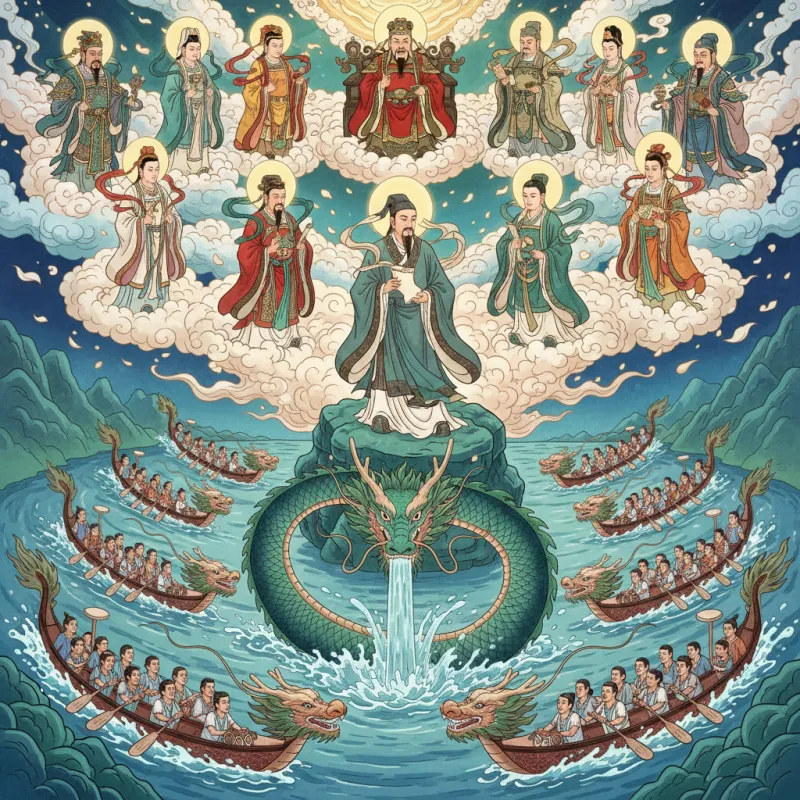
Every year on the fifth day of the fifth lunar month, millions of people across Asia climb into narrow boats shaped like dragons and race across rivers and lakes, paddling in synchronized fury. They're not just competing for glory — according to tradition, they're reenacting a desperate rescue mission that failed 2,300 years ago. The Dragon Boat Festival (端午节 Duānwǔ Jié) commemorates the death of Qu Yuan (屈原), a poet whose suicide by drowning sparked one of the world's most enduring athletic traditions. But dig deeper into the festival's origins, and you'll find something older and stranger: a day when the boundary between the living world and the realm of poisons, plagues, and malevolent spirits grows dangerously thin.
The Poet Who Chose the River
Qu Yuan (c. 340-278 BCE) wasn't just any government official — he was a visionary poet and loyal minister of the Chu Kingdom during the brutal Warring States period (战国 Zhànguó). While other states scrambled for territory and formed treacherous alliances, Qu Yuan saw the future with painful clarity: the Qin state would eventually devour them all. He urged his king to resist Qin's diplomatic overtures and strengthen Chu's defenses instead.
The king ignored him. Worse, court rivals slandered Qu Yuan, accusing him of disloyalty, and he was exiled from the capital. For years, he wandered the countryside, writing some of Chinese literature's most haunting poetry. His masterwork, the Li Sao (离骚 "Encountering Sorrow"), is a 373-line epic of political frustration, spiritual wandering, and conversations with gods and shamans. When Chu's capital finally fell to Qin forces in 278 BCE, Qu Yuan walked into the Miluo River (汨罗江 Mìluó Jiāng) in Hunan Province, clutching a stone to ensure he would sink.
The local people, who revered him, raced out in their fishing boats to save his body. They beat drums and splashed their paddles to scare away fish and water spirits that might devour his corpse. They threw packets of rice wrapped in bamboo leaves into the water — offerings to distract hungry river creatures. They were too late to save him, but their frantic rescue attempt became the template for dragon boat racing, and those rice packets evolved into zongzi (粽子), the pyramid-shaped sticky rice dumplings that remain the festival's signature food.
The Fifth Month's Poison
Here's what most retellings miss: the Dragon Boat Festival existed long before Qu Yuan drowned. The fifth lunar month was already considered the most dangerous time of year — a period when yang energy peaks, the weather turns hot and humid, and the natural world becomes toxic. Ancient Chinese calendars called it the "Poison Month" (毒月 Dú Yuè), and the fifth day of the fifth month was the "Poison Day" (毒日 Dú Rì), when venomous creatures emerged and epidemic diseases spread.
The festival's original purpose was apotropaic — warding off evil and protecting against the season's dangers. Families hung bundles of mugwort (艾草 àicǎo) and calamus (菖蒲 chāngpú) above their doors because these aromatic plants were believed to repel demons and disease. Children wore silk pouches filled with fragrant herbs and cinnabar. People drank realgar wine (雄黄酒 xiónghuáng jiǔ), a toxic arsenic sulfide mixture that supposedly counteracted poisons — though it probably caused more harm than good.
The festival's protective rituals reveal an older worldview where the natural and supernatural weren't separate categories. Snakes, centipedes, scorpions, geckos, and toads — the "Five Poisons" (五毒 Wǔ Dú) — were both real threats and symbolic manifestations of cosmic imbalance. The Dragon Boat Festival was humanity's annual battle against chaos itself.
Dragons, Not Boats
The boats themselves carry profound symbolic weight. They're not decorated with dragons as a mere aesthetic choice — they are dragons, or at least temporary vessels for dragon spirits. In Chinese cosmology, dragons control water and weather, making them natural allies against the fifth month's dangers. The dragon boat races invoke these powerful beings, channeling their protective energy through synchronized human effort.
Each boat is ritually awakened before the races begin. A Daoist priest or community elder "dots the eyes" (点睛 diǎn jīng) of the dragon figurehead in a ceremony that transforms carved wood into a living spiritual presence. Only after this ritual can the boat enter the water. The paddlers aren't just athletes — they're participants in a collective act of sympathetic magic, their coordinated movements mimicking the undulating power of dragons swimming through rivers.
This explains why dragon boat racing feels different from other competitive sports. There's a ritual intensity to it, a sense that something more than victory is at stake. The drums that pace the paddlers echo the drums that once tried to frighten away water spirits from Qu Yuan's body. Every race reenacts both a rescue mission and an invocation of protective forces.
The Festival's Dark Twin
What makes the Dragon Boat Festival unique among Chinese celebrations is its acknowledgment of genuine danger. While the Mid-Autumn Festival celebrates harmony and reunion, and the Spring Festival focuses on renewal and prosperity, the Dragon Boat Festival confronts mortality, poison, and the threat of cosmic disorder. It's a festival born from tragedy and sustained by anxiety about the natural world's hostile forces.
This darker character appears in regional variations. In some areas, people still practice "sending away the plague boats" (送瘟船 sòng wēn chuán) — setting small boats filled with offerings adrift to carry away diseases and misfortune. In others, shamans perform exorcisms to drive out malevolent spirits that accumulate during the poison month. The festival's cheerful surface — the exciting races, the delicious zongzi, the colorful silk pouches — overlays a profound unease about the fifth month's dangers.
Qu Yuan's Afterlife
Over centuries, Qu Yuan himself underwent a transformation from tragic historical figure to protective deity. Some communities worship him as a river god who can prevent drowning and ensure safe water travel. His death by drowning paradoxically made him a guardian against drowning — a common pattern in Chinese folk religion, where those who died violently or unjustly often become powerful spirits.
His poetry ensured his immortality in another sense. The Li Sao and his other works established him as China's first great poet of individual conscience, someone who chose personal integrity over political survival. Later scholars and officials facing similar dilemmas looked to Qu Yuan as a model. During times of political turmoil, his story resonated with particular intensity — a reminder that some principles matter more than life itself.
The Festival Today
Modern dragon boat racing has become an international sport, with teams competing in countries far from China. The races have been standardized, professionalized, stripped of most ritual content. Yet something of the original spirit persists. Teams still name their boats, still feel that collective rhythm when dozens of paddles strike the water in perfect unison, still experience that strange intensity that comes from synchronized physical effort.
The zongzi have evolved too, with regional variations reflecting local tastes: sweet red bean paste in the north, savory pork and salted egg in the south, alkaline water versions in Southeast Asia. But the basic form remains — sticky rice wrapped in leaves, a food that carries memory in its very structure.
The protective rituals have mostly faded. Few people still hang mugwort and calamus, and realgar wine has been recognized as dangerously toxic. But the festival's timing still marks a transition point in the agricultural calendar, the moment when summer's heat arrives in full force. The ancient anxiety about the fifth month's dangers has been replaced by modern concerns about heat waves and seasonal illnesses, but the underlying pattern remains: this is a dangerous time that requires special attention.
Racing Against Time
The Dragon Boat Festival endures because it addresses something fundamental: the human need to act in the face of tragedy, even when action comes too late. The people who raced out to save Qu Yuan's body knew they wouldn't reach him in time. They went anyway. That futile rescue attempt, repeated annually for over two millennia, has become a meditation on loyalty, memory, and the importance of trying even when success is impossible.
Every dragon boat race reenacts that original failure and transforms it into something else — a celebration of collective effort, a demonstration that communities can mobilize quickly when needed, a reminder that some people are worth remembering. The boats slice through the water, drums pounding, paddles flashing, and for a few minutes, the boundary between past and present dissolves. We're all racing to save the poet, and we're all too late, and somehow that doesn't matter because the race itself has become the point.
The festival teaches that tragedy can be transformed but not erased, that the past remains present in our rituals and foods and stories, that sometimes the most important thing we can do is remember someone who chose principle over survival. Qu Yuan walked into the river 2,300 years ago, and we're still racing to save him. We always will be.
Related Reading
- The Mythology of the Mid-Autumn Festival: Chang'e, Hou Yi, and the Moon Rabbit
- The Lantern Festival: When Gods Walk Among Mortals
- Exploring Chinese Deities and Immortals: Traditions of the Daoist and Buddhist Pantheon
- Chinese Festivals and Their Gods: The Calendar of Divine Celebrations
- Gods of Chinese New Year: The Deities Behind the Festival
- Ancient Chinese Underworld Deities: Guardians of Death and Afterlife Realms
- Exploring the Rich Tapestry of Chinese Deities and Immortals
- Exploring the Rich Tapestry of Chinese Deities and Immortals in Buddhism and Daoism