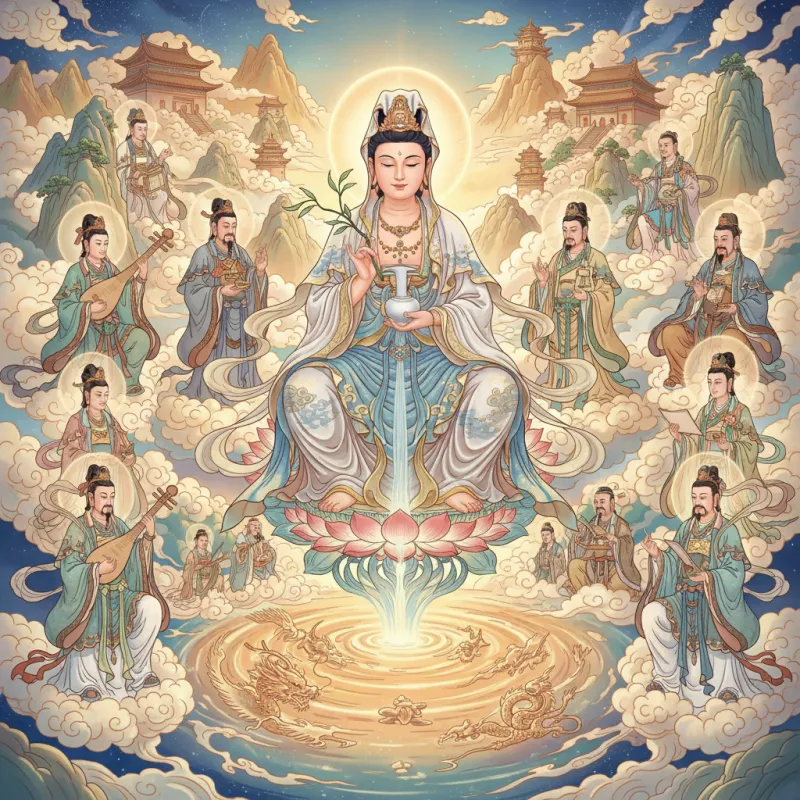
A mother kneels before a small altar, incense smoke curling upward as she whispers desperate prayers for her sick child. Across town, a fisherman caught in a sudden storm clutches a jade pendant and calls out a single name. In both moments, they invoke Guanyin (观音, Guānyīn)—the Goddess of Mercy whose compassion knows no boundaries. But here's what makes her story remarkable: this beloved Chinese deity began as a male Indian bodhisattva and underwent one of the most fascinating transformations in religious history.
From Avalokiteshvara to Guanyin
Guanyin's origins lie with Avalokiteshvara, the bodhisattva of compassion in Indian Buddhism. When Buddhist texts traveled along the Silk Road during the Tang Dynasty (618-907 CE), something extraordinary happened. The Sanskrit name Avalokiteshvara—meaning "the lord who looks down"—was translated into Chinese as Guanshiyin (观世音), later shortened to Guanyin, which means "Observing the Sounds of the World." This wasn't just a linguistic shift; it marked the beginning of a complete reimagining.
Early Chinese depictions from the 6th and 7th centuries show Guanyin with a mustache, clearly masculine. But by the Song Dynasty (960-1279 CE), artists increasingly portrayed her as female, often dressed in flowing white robes. This gender transformation wasn't arbitrary—it reflected Chinese cultural associations between femininity, motherhood, and nurturing compassion. The change also made Guanyin more accessible to common people, particularly women who found in her a divine figure they could relate to intimately.
The Thousand Arms of Compassion
Walk into any Chinese Buddhist temple, and you'll likely encounter Guanyin's most striking form: Qianshou Qianyan Guanyin (千手千眼观音), the Thousand-Armed, Thousand-Eyed Goddess of Mercy. This isn't mere artistic excess—each hand holds a different implement for saving beings, and each eye watches for those in distress. The iconography tells a profound story about the scope of compassion itself.
According to the Mahākaruṇā Dhāraṇī Sūtra, Guanyin made a vow to help all sentient beings, but upon witnessing the vastness of suffering, her head split into eleven pieces from despair. Amitabha Buddha, her spiritual teacher, restored her and gave her eleven heads to see in all directions and a thousand arms to reach all beings. This myth captures something essential: true compassion requires both awareness and action, seeing suffering and having the means to address it.
Princess Miaoshan and Chinese Folk Religion
The most popular Chinese origin story for Guanyin centers on Princess Miaoshan (妙善, Miàoshàn), a legend that emerged during the Song Dynasty. According to this tale, Miaoshan was the third daughter of King Miaozhuang. Despite her father's wishes for her to marry, she insisted on becoming a Buddhist nun. Enraged, the king tried to make her life at the monastery unbearable, but she persevered through supernatural assistance.
When her father fell gravely ill, only medicine made from the eyes and arms of a willing person could save him. Miaoshan sacrificed her own without hesitation. Upon learning his daughter had saved him, the king was overcome with remorse and converted to Buddhism. Miaoshan's selfless act transformed her into the Thousand-Armed Guanyin. This story brilliantly sinicized the Indian bodhisattva, giving her a Chinese royal lineage and emphasizing filial piety—a core Confucian value—alongside Buddhist compassion.
The Miaoshan legend became so influential that Mount Putuo (普陀山, Pǔtuó Shān) in Zhejiang Province, where she supposedly achieved enlightenment, became one of China's four sacred Buddhist mountains. Pilgrims have journeyed there for over a millennium, and the island remains a major devotional center today.
Guanyin's Many Faces
Unlike the relatively fixed iconography of many deities, Guanyin appears in at least thirty-three different forms, each addressing specific needs. There's Songzi Guanyin (送子观音), the Child-Giving Guanyin, depicted holding a baby—the form most commonly worshipped by couples hoping to conceive. Baiyi Guanyin (白衣观音), the White-Robed Guanyin, represents purity and is often shown seated on a lotus or rock by the sea.
Yulan Guanyin (鱼篮观音), the Fish Basket Guanyin, appears as a beautiful woman carrying a basket of fish, based on a Tang Dynasty story about converting a village through skillful means. Then there's Shuiyue Guanyin (水月观音), the Water-Moon Guanyin, shown contemplating the moon's reflection in water—a meditation on the illusory nature of reality. This multiplicity isn't confusion; it's strategic flexibility. Guanyin meets people where they are, in whatever form they need.
The Goddess Who Hears Everything
The name Guanyin literally means "Perceiving Sounds," but it's often interpreted as "Hearing the Cries of the World." This auditory emphasis sets her apart from many other deities. She doesn't wait for elaborate rituals or perfect offerings—she responds to the simple, desperate cry of anyone in distress. Sailors caught in typhoons, women in difficult childbirth, prisoners facing execution, farmers during drought—all call upon Guanyin.
The Lotus Sutra, one of the most important Mahayana Buddhist texts, devotes an entire chapter (the "Universal Gateway" chapter) to Guanyin's salvific powers. It promises that anyone who calls her name will be saved from fire, water, demons, imprisonment, bandits, and even their own negative emotions like greed, anger, and ignorance. This accessibility made Guanyin phenomenally popular across all social classes.
What's particularly interesting is how Guanyin's cult absorbed and transformed local Chinese folk beliefs. She became associated with Mazu, the Daoist sea goddess, in coastal regions. She merged with indigenous mother goddess worship. This religious syncretism—the blending of different traditions—is quintessentially Chinese, and Guanyin exemplifies it perfectly.
Guanyin in Literature and Popular Culture
Chinese literature overflows with Guanyin appearances, but her role in Journey to the West (西游记, Xīyóu Jì) deserves special attention. In this 16th-century novel, Guanyin serves as the primary divine orchestrator of the monk Xuanzang's pilgrimage to India. She selects Sun Wukong and the other disciples, intervenes at crucial moments, and even provides the magical headband that controls the Monkey King.
Wu Cheng'en, the novel's author, portrays Guanyin as both compassionate and strategically brilliant—she's not just merciful but wise, understanding that true compassion sometimes requires tough love. When Sun Wukong rebels, she doesn't simply forgive him; she creates conditions for his transformation. This nuanced characterization influenced how generations of Chinese people understood divine mercy: not as indulgent softness but as wisdom that guides beings toward enlightenment.
In contemporary culture, Guanyin remains ubiquitous. She appears in films, television dramas, video games, and even as a protective figure in taxi cabs and restaurants. During the 2008 Sichuan earthquake, many survivors reported praying to Guanyin, and her image became a symbol of hope amid devastation. This enduring relevance speaks to something deeper than religious doctrine—Guanyin represents an ideal of compassion that transcends any single tradition.
The Living Goddess
What makes Guanyin truly remarkable isn't her mythological origins or artistic representations—it's her continued presence in daily Chinese life. Visit any Chinese neighborhood, whether in Beijing, San Francisco, or Singapore, and you'll find Guanyin altars in homes, shops, and restaurants. She's not a distant, abstract deity but an intimate presence, someone you talk to like a trusted friend or loving mother.
This intimacy explains why Guanyin worship persisted even during periods of religious suppression. She adapted, survived, and continues to offer what humans have always needed: the assurance that someone is listening, that compassion exists in a world often marked by suffering. In a sense, Guanyin's greatest miracle isn't the supernatural rescues described in sutras—it's her ability to embody an ideal that remains relevant across centuries, cultures, and changing beliefs.
The Goddess of Mercy doesn't demand perfection from her devotees. She simply asks that they call her name, and she promises to hear. In that simple exchange lies the secret of her enduring power.
Related Reading
- Exploring the Rich Tapestry of Chinese Deities and Immortals in Buddhism and Daoism
- Maitreya: The Laughing Buddha
- Unveiling Chinese Deities and Immortals in Daoist and Buddhist Traditions
- Dizang: The Bodhisattva Who Empties Hell
- Meet the Eight Immortals: Profiles of China's Favorite Supernatural Squad
- Nezha: From Rebellious Child God to China's Biggest Animated Film
- Guardians of the Night Sky: The Star Gods in Chinese Daoist and Buddhist Traditions