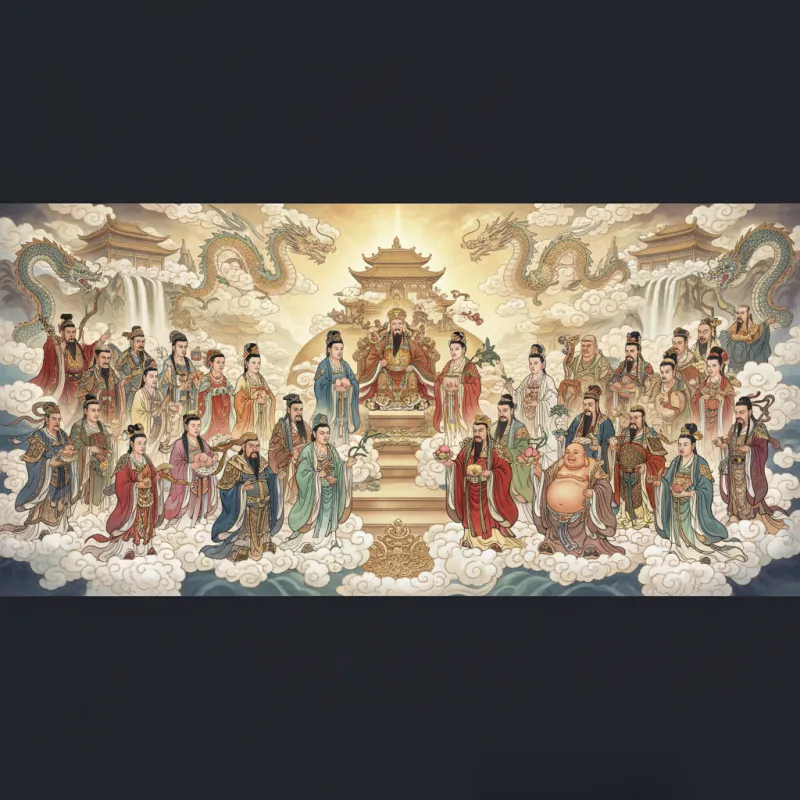
The old Daoist master once told me that if you want to understand China, don't start with Confucius or the emperors—start with the gods. He was right. Walk into any temple from Fujian to Gansu, and you'll find a bewildering array of deities: warrior gods with flaming beards, serene bodhisattvas draped in silk, immortals riding cranes, and local spirits who once were human. This isn't chaos—it's a living cosmology that's been evolving for over two thousand years, absorbing Buddhism from India, folk beliefs from villages, and philosophical concepts from reclusive mountain hermits. Understanding this pantheon means understanding how millions of Chinese people have imagined the universe, sought protection, and pursued transcendence.
The Three Pure Ones and the Daoist Hierarchy
At the apex of the Daoist pantheon sit the Sanqing (三清, Sānqīng), the Three Pure Ones, who represent the primordial forces that existed before creation. These aren't gods you pray to for a good harvest—they're cosmic principles made manifest. Yuanshi Tianzun (元始天尊, Yuánshǐ Tiānzūn), the Celestial Worthy of Primordial Beginning, embodies the Dao itself in its most undifferentiated state. Below him sits Lingbao Tianzun (靈寶天尊, Língbǎo Tiānzūn), who governs the sacred texts and cosmic law. The third, Daode Tianzun (道德天尊, Dàodé Tiānzūn)—often identified with Laozi himself—represents the Dao as it manifests in the world.
What strikes me about this hierarchy is how it mirrors bureaucratic China. The Jade Emperor (玉皇大帝, Yùhuáng Dàdì), who sits below the Three Pure Ones but administers the celestial bureaucracy, literally holds court like a Tang Dynasty emperor. He has ministers, generals, record-keepers, and even celestial executioners. When you read Journey to the West, Sun Wukong's rebellion isn't just mythological chaos—it's a satire of imperial administration, with the Monkey King wreaking havoc in a heaven that operates like the Forbidden City.
The Eight Immortals: Humanity's Path to Transcendence
The Baxian (八仙, Bāxiān), or Eight Immortals, represent something fundamentally different from the cosmic deities—they're proof that humans can achieve immortality through cultivation. Each immortal embodies a different social class and path to enlightenment, making them far more relatable than abstract cosmic forces. Lü Dongbin (呂洞賓, Lǚ Dòngbīn), a Tang Dynasty scholar who failed the imperial examinations, became the most popular of the eight after encountering a Daoist master. His story resonates because it transforms failure into spiritual opportunity—a powerful message in examination-obsessed imperial China.
Then there's He Xiangu (何仙姑, Hé Xiāngū), the only female among the eight, who achieved immortality by eating powdered mica and moonbeams. Her presence challenges the notion that transcendence was exclusively male territory. Li Tieguai (李鐵拐, Lǐ Tiěguǎi), the beggar immortal with an iron crutch, shows that even the disabled and destitute can achieve enlightenment—his spirit once left his body to visit Laozi, and when he returned, his original body had been cremated, forcing him to inhabit a beggar's corpse.
These aren't just colorful characters. They appear constantly in Ming and Qing Dynasty literature, opera, and art, representing the Daoist belief that immortality isn't reserved for the virtuous elite but available to anyone willing to cultivate their inner nature. For more on cultivation practices, see The Path of Internal Alchemy in Daoist Tradition.
Buddhist Bodhisattvas: Compassion Made Divine
When Buddhism arrived in China during the Han Dynasty, it didn't replace the existing pantheon—it merged with it. The result is a uniquely Chinese form of Buddhism where bodhisattvas function almost like Daoist immortals. Guanyin (觀音, Guānyīn), the Bodhisattva of Compassion, underwent a remarkable transformation on Chinese soil. Originally male in Indian Buddhism (Avalokiteśvara), Guanyin became predominantly female in China by the Song Dynasty, absorbing characteristics of indigenous mother goddesses and the Daoist Queen Mother of the West.
I've always found Guanyin's thousand arms and eyes fascinating—each eye sees suffering, each hand offers help. This isn't abstract theology; it's a visual representation of infinite compassion that resonates with anyone who's ever felt overwhelmed by the world's pain. The Lotus Sutra describes thirty-three manifestations of Guanyin, allowing this bodhisattva to appear as whatever form is needed—a fisherman to save drowning sailors, a scholar to teach students, a child to comfort the grieving.
Dizang (地藏, Dìzàng), known as Ksitigarbha in Sanskrit, made a vow not to achieve Buddhahood until all hells are empty. He's the bodhisattva who descends into the underworld to rescue suffering souls, making him particularly important in Chinese funeral rites. His cult center at Mount Jiuhua in Anhui Province became one of the four sacred Buddhist mountains, where pilgrims still come to pray for deceased relatives.
The Jade Emperor's Court: Celestial Bureaucracy
The Jade Emperor's administration mirrors earthly government so precisely that it's almost satirical. He has a Ministry of Thunder, a Department of Epidemics, a Bureau of Time, and countless other offices. Each deity has specific responsibilities, jurisdictions, and reporting requirements. The City God (城隍, Chénghuáng) of each city reports to provincial deities, who report upward through the hierarchy. When someone dies, their soul must appear before the Ten Kings of Hell (十殿閻王, Shí Diàn Yánwáng), who review their life records maintained by celestial bureaucrats.
This bureaucratic heaven reflects a deep cultural assumption: the cosmos operates through orderly administration, not arbitrary divine will. It's why Chinese people traditionally burned paper money and goods for the dead—you need currency in the afterlife to bribe officials, just like in earthly bureaucracy. The Fengshen Yanyi (封神演義, Investiture of the Gods), a Ming Dynasty novel, literally describes how various humans and spirits received their official celestial appointments after the Shang-Zhou transition.
Folk Deities: From Human to Divine
What makes the Chinese pantheon endlessly fascinating is its permeability—humans can become gods. Guan Yu (關羽, Guān Yǔ), the Three Kingdoms general who died in 220 CE, was gradually deified over centuries until he became Guandi (關帝, Guāndì), the God of War and patron of merchants, police, and triads alike. His temples outnumber those of almost any other deity. How does a historical general become a god? Through a combination of imperial patronage, popular devotion, and the belief that exceptional virtue and loyalty create spiritual power that persists after death.
Mazu (媽祖, Māzǔ), the goddess of the sea, was originally Lin Moniang, a Song Dynasty woman from Fujian who died saving sailors. Her cult spread with Chinese maritime trade, and now she has temples from Taiwan to San Francisco. The Stove God (灶神, Zàoshén) watches over every household kitchen, reporting annually to the Jade Emperor about the family's behavior—which is why people traditionally smeared honey on his image before he ascended, hoping to sweeten his report.
This process of deification reveals something profound about Chinese religious thought: divinity isn't absolutely separate from humanity. The boundary is permeable. Exceptional humans can become gods; gods can be demoted for incompetence. It's a remarkably pragmatic approach to the sacred. For more on this transformation process, see The Journey from Mortal to Immortal.
The Queen Mother of the West: Ancient Power
Xi Wangmu (西王母, Xī Wángmǔ), the Queen Mother of the West, predates organized Daoism by centuries. She appears in the Shanhaijing (Classic of Mountains and Seas) as a fearsome deity with tiger teeth and a leopard tail, ruling over a paradise in the Kunlun Mountains where the peaches of immortality grow. By the Han Dynasty, she had transformed into a beautiful goddess who hosted elaborate banquets for immortals, serving peaches that ripened once every three thousand years.
Her mythology reveals layers of Chinese cosmology. She represents yin, the feminine principle, balanced by her consort the King Father of the East (though he's far less prominent in worship). Her peach garden appears in Journey to the West when Sun Wukong crashes her birthday party and eats all the immortality peaches, causing cosmic chaos. But beneath the entertaining stories lies a serious theological point: immortality isn't freely given—it must be earned, cultivated, or stolen, and even then, it comes with cosmic consequences.
Living Traditions in Modern China
These aren't museum pieces. Walk through any Chinese city today, and you'll find temples where people burn incense to Guanyin for compassion, Guandi for business success, and Wenchang (文昌, Wénchāng) for academic achievement. The pantheon adapts: there are now patron deities of taxi drivers and internet cafes. During Chinese New Year, families still honor the Stove God. Pregnant women visit temples dedicated to Songzi Guanyin (送子觀音, Sòngzǐ Guānyīn), the Child-Giving Guanyin.
What strikes me most is the practical relationship Chinese people maintain with these deities. It's transactional but not cynical—you make offerings, the deity provides protection or blessings, and if they don't deliver, you might switch to another temple. This isn't irreverence; it's treating the divine with the same pragmatic respect you'd give any powerful official. The gods are real, but they're also part of a system that can be navigated, negotiated with, and occasionally circumvented.
The Chinese pantheon isn't a fixed doctrine but a living ecosystem that's been growing for millennia. New deities emerge, old ones fade, and the boundaries between Buddhist, Daoist, and folk traditions remain productively blurred. Understanding this flexibility—this willingness to absorb, adapt, and syncretize—is key to understanding Chinese religious life. The gods aren't jealous; there's room for everyone in a cosmos this vast.
Related Reading
- Exploring the Rich Pantheon of Chinese Deities and Immortals in Daoism and Buddhism
- How to Pray at a Chinese Temple: A Practical Guide
- Sun Wukong as a Real Deity: Temples and Worship of the Monkey God