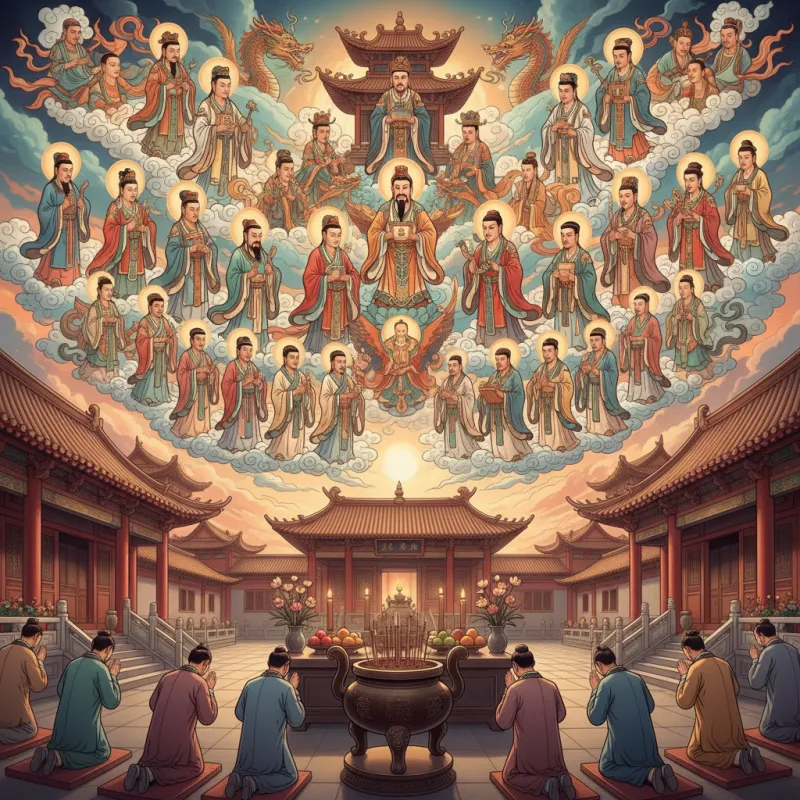
The incense smoke curls upward in three thin streams, and you're standing there wondering if you're supposed to bow now or after you plant the sticks in the ash pot. The elderly woman next to you moves through the ritual with practiced ease — three bows, a murmured prayer, incense placed just so — while you're trying to remember if you read somewhere that you're supposed to circle clockwise or counterclockwise. Welcome to your first time praying at a Chinese temple, where every gesture carries centuries of meaning and nobody posted instructions in English.
Here's the truth: Chinese temple worship isn't mysterious, but it is precise. The rituals follow patterns that make sense once you understand them. They're not arbitrary rules designed to trip up outsiders — they're a language of respect, a choreography of devotion that's been refined over thousands of years. And like any language, you can learn it.
The Threshold Matters More Than You Think
That raised wooden beam at the temple entrance? Don't step on it. Step over it. This isn't superstition for its own sake — the threshold (门槛, ménkǎn) represents the boundary between the mundane world and sacred space. In traditional Chinese architecture and philosophy, thresholds hold spiritual significance. They're barriers against wandering spirits and markers of transition.
Which foot goes first? Traditionally, men step with the left foot first, women with the right. But honestly, most modern temples don't enforce this strictly. What matters more is that you don't step on the threshold itself. I've seen temple caretakers physically wince when tourists use it as a footrest for tying shoelaces.
The same principle applies when you leave. Step over the threshold backward if you can manage it without looking ridiculous — it's a sign you're reluctant to leave the divine presence. But if you're going to trip and fall, just step over it normally. The gods appreciate grace over strict adherence to form.
The Incense Ritual: Three Sticks, Three Bows, Three Meanings
Incense (香, xiāng) is the primary offering in Chinese temples, and there's a specific way to handle it. Take three sticks — always three. In Chinese religious practice, three represents the harmony of heaven, earth, and humanity. Some say it represents the Three Pure Ones (三清, Sānqīng) in Daoism or the Three Jewels (三宝, Sānbǎo) in Buddhism. The number itself carries weight.
Light all three sticks from the temple's main flame. Don't use a lighter if you can avoid it — taking fire from the communal source connects your offering to everyone else's. If the sticks catch fire and flame up, don't blow them out like birthday candles. Wave them gently or fan them with your other hand until only the ember remains. Blowing is considered disrespectful because you're using your breath, which in Chinese thought can carry impurities.
Hold the incense at forehead level with both hands, sticks pointing upward. Now bow three times. Not casual nods — proper bows from the waist, bringing the incense down to chest level with each bow. The first bow is for heaven, the second for earth, the third for your ancestors or the specific deity you're addressing. Some practitioners add a fourth bow for all sentient beings, but three is standard.
After bowing, plant the incense in the ash pot or sand urn. Don't just stick them in randomly. Place them upright and evenly spaced. The aesthetic matters — your offering should look intentional, not haphazard. If you're praying to multiple deities in the same temple, you'll repeat this process at each altar, though you might use one stick per deity instead of three.
What to Say (and What Not to Say)
You don't need to speak Chinese to pray at a Chinese temple, but you should understand what you're asking for. Chinese temple prayers tend to be transactional in a way that might surprise Western visitors. You're not just expressing gratitude or seeking spiritual enlightenment — you're negotiating. You're asking for specific things and, implicitly, promising something in return.
Common requests include health, wealth, academic success, marriage prospects, and safe travels. Be specific. Don't just ask for "good fortune" — ask for success in your upcoming job interview, or for your mother's surgery to go well, or for your daughter to get into a good university. Chinese deities, like Chinese bureaucrats, appreciate clarity and detail.
The traditional format goes something like this: state your name and address (so the deity knows who you are), explain your situation, make your specific request, and promise to return with a thanksgiving offering if your prayer is answered. That last part is important. If Guanyin helps you pass your exam, you're expected to come back with fruit offerings or a donation. This isn't bribery — it's reciprocity, the fundamental principle of Chinese social and spiritual relationships.
What shouldn't you pray for? Harm to others, obviously. But also avoid vague, greedy requests. Asking to win the lottery is considered tacky. Asking for enough money to support your family is fine. The distinction matters. Chinese deities are often portrayed as moral authorities who judge the worthiness of requests. For more on the specific deities and their domains, see our guide on major Chinese deities.
The Divination Blocks: Getting a Yes or No Answer
After you've made your prayer, you might want to know if the deity heard you and agrees to help. This is where the divination blocks (筊杯, jiǎobēi) come in — those crescent-shaped wooden pieces you'll see at most temples, usually red, with one flat side and one rounded side.
Hold both blocks between your palms, ask your yes-or-no question clearly, then drop them on the floor. The way they land gives you the answer:
- One flat side up, one rounded side up (阴阳杯, yīnyáng bēi): Yes, the deity agrees. This is the favorable answer.
- Both rounded sides up (笑杯, xiàobēi): The "laughing blocks" — the deity is amused by your question or finds it unclear. Rephrase and try again.
- Both flat sides up (怒杯, nùbēi): The "angry blocks" — the deity disagrees or disapproves. This is a no.
You typically throw the blocks three times to confirm the answer. Three consecutive "yes" results is considered a very strong affirmation. If you get mixed results, the answer is uncertain — you might need to reconsider your request or approach.
I've watched people argue with the divination blocks, throwing them repeatedly until they get the answer they want. This defeats the purpose. The blocks are meant to provide guidance, not validation. If you keep getting "no," maybe the deity is telling you something important.
Fortune Sticks: When You Need More Than Yes or No
For more detailed guidance, temples offer fortune sticks (签, qiān) — numbered bamboo sticks in a cylindrical container. The process is more involved than the divination blocks, but it provides much more specific answers.
Kneel before the altar, state your question, and shake the container until one stick works its way out and falls. Note the number on the stick, then use the divination blocks to confirm this is the correct fortune for you. If you get a "yes," take the numbered stick to the temple office or check the wall where fortune papers are posted. Each number corresponds to a fortune poem, usually a four-line verse in classical Chinese.
These poems are deliberately cryptic. They reference historical events, classical literature, and traditional symbolism. Number 23 might reference Liu Bei's three visits to Zhuge Liang's cottage, suggesting that persistence will be rewarded. Number 47 might mention a boat in a storm, warning of upcoming difficulties. The temple usually has someone who can interpret the fortune for you, though they might expect a small donation.
The fortunes are ranked as superior (上签, shàngqiān), medium (中签, zhōngqiān), or inferior (下签, xiàqiān). Don't panic if you draw an inferior fortune. These aren't curses — they're warnings. They tell you to be cautious, to prepare for challenges, to reconsider your plans. Think of them as weather forecasts, not death sentences.
Offerings Beyond Incense
Incense is the baseline offering, but you can bring more. Fruit is traditional — apples, oranges, bananas, anything fresh and unblemished. Arrange it neatly on the offering table. Some deities have specific preferences: Guanyin appreciates vegetarian offerings, while Guan Yu might receive meat and wine. Research the specific deity before bringing offerings.
Flowers are acceptable but less common than in Western religious practice. Avoid white flowers, which are associated with funerals. Red and yellow are safe choices.
Money offerings come in two forms: spirit money (冥币, míngbì) that you burn in the temple's furnace, and actual donations to the temple. Spirit money is meant for deities and ancestors in the spiritual realm. Real money supports the temple's operations. Both are appreciated, but they serve different purposes.
Some temples sell specific offerings — longevity peaches for birthday blessings, lotus flowers for purity, gold ingots for wealth. These are usually paper representations that you burn. The burning transforms the physical offering into spiritual currency. It's not destruction — it's transmission.
The Unwritten Rules Nobody Tells You
Don't point at statues or deities. It's rude. If you need to indicate which deity you're discussing, gesture with an open palm, not a finger.
Don't turn your back to the main altar when taking photos. If you want a picture, stand to the side. Better yet, ask permission first — some temples prohibit photography entirely.
Don't touch the statues. This should be obvious, but I've seen people rub Buddha's belly for luck or try to adjust a deity's clothing. The statues are consecrated objects, not props.
Don't bring meat into vegetarian temples. Many Buddhist temples are strictly vegetarian. Check before entering with food.
Don't visit temples during menstruation if you're planning to participate in rituals. This is a traditional taboo that many modern practitioners ignore, but some older temples still observe it. Use your judgment.
Don't make noise. Temples are places of contemplation. Keep your voice low, turn off your phone, and be mindful of others praying.
When You Leave
Before you exit, turn back toward the main altar and bow once more. This final bow is your thank you for the audience, your acknowledgment that you've been in sacred space. Step over the threshold — don't step on it — and you're back in the mundane world.
If your prayer is answered, return to the temple with thanksgiving offerings. This isn't optional. The relationship between devotee and deity is built on reciprocity. If you ask for help and receive it, you owe gratitude. Bring fruit, make a donation, light more incense. Some people return annually on the same date to maintain the relationship.
Chinese temple worship isn't about blind faith or mysterious rituals. It's about respect, reciprocity, and relationship. The gods are treated like honored officials or respected elders — you approach them with courtesy, make your case clearly, and follow through on your commitments. Do that, and whether you believe in the spiritual efficacy or simply appreciate the cultural practice, you'll be doing it right.
The elderly woman who knew exactly how to bow and where to place her incense? She learned the same way you're learning now. Nobody is born knowing this. The difference is that she's had decades of practice, and you're just starting. That's fine. The gods, if they exist, are patient. And if they don't, the practice itself — the mindfulness, the ritual, the connection to centuries of tradition — has value enough.
Related Reading
- How to Pray at a Chinese Temple: A Respectful Visitor's Guide
- A Practical Guide to Visiting Chinese Temples: What to Do and What Not to Do
- Setting Up a Chinese Home Altar: A Practical Guide
- The Chinese Religious Calendar: When to Worship What
- Exploring the Rich Pantheon of Chinese Deities and Immortals in Daoism and Buddhism
- Exploring the Rich Tapestry of Chinese Deities and Immortals
- Chinese Festivals and Their Gods: The Calendar of Divine Celebrations