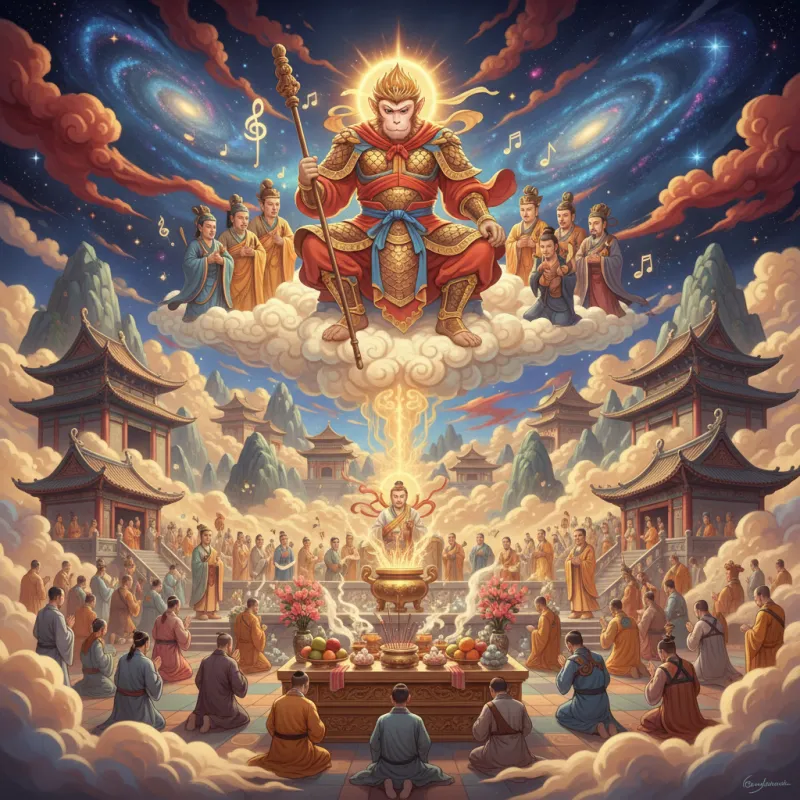
The stone monkey who ate the Peaches of Immortality and fought the armies of Heaven now receives offerings in temples across Asia. Worshippers light incense before his statues, petition him for protection, and believe he answers their prayers. Sun Wukong (孙悟空 Sūn Wùkōng) — the Monkey King — was invented by a novelist in the 1590s. He had no ancient lineage, no scriptural authority, no imperial recognition. Yet somehow, this fictional troublemaker became a god.
The Impossible Transition
Most deities work the other way around. They start as gods in mythology or religion, then later appear in stories and novels. Erlang Shen existed in Daoist tradition long before Journey to the West made him famous. The Eight Immortals were objects of worship centuries before their adventures were compiled into popular literature.
Sun Wukong reversed this process entirely. Wu Cheng'en created him for Journey to the West (西游记 Xīyóu Jì), a novel published around 1592 during the Ming Dynasty. The book was entertainment — a Buddhist pilgrimage story mixed with comedy, action, and satire. Sun Wukong was its breakout character, but he was fiction. No temple inscriptions mentioned him. No ritual manuals included his name. No one prayed to him because he didn't exist outside the pages of a book.
Within two centuries, that changed. By the Qing Dynasty, temples dedicated to Sun Wukong were appearing in southeastern China. People were burning joss paper to him. Local communities were organizing festivals in his honor. A literary character had somehow crossed the boundary into actual religious practice — a transition so rare in world religion that scholars still debate how it happened.
Where the Monkey King Receives Worship
Sun Wukong's cult centers on specific regions, not spread evenly across China. This geographic concentration tells us something important: his worship emerged from local communities, not from official religious institutions.
Fujian Province hosts the highest concentration of Monkey King temples. The Shuitou Qitian Dasheng Temple (水头齐天大圣宫 Shuǐtóu Qítiān Dàshèng Gōng) in Quanzhou is among the most prominent, with a history stretching back to the Qing Dynasty. Fujian's maritime culture and tradition of folk religion created fertile ground for new deities — especially protective figures who could guard against danger.
Taiwan inherited Fujian's religious traditions through migration and developed its own robust Sun Wukong worship. The Monkey God Temple in Taipei's Muzha district draws steady crowds. Worshippers petition him for protection against evil spirits, success in business ventures, and safety during travel. Some temples position him as a guardian deity for children, playing on his role as protector of the Tang Monk in Journey to the West.
Southeast Asia — particularly Malaysia, Singapore, and Thailand — hosts significant Monkey King worship among Chinese diaspora communities. The Monkey God Temple in Singapore's Eng Neo Avenue has operated since 1920. These overseas temples often emphasize Sun Wukong's martial prowess and his ability to defeat demons, making him a protector deity for communities navigating unfamiliar territories.
Notably absent from this list: northern China, where Daoist and Buddhist orthodoxy held stronger sway. Sun Wukong worship thrived in regions with vibrant folk religion traditions that readily incorporated new deities without requiring official sanction.
What Worshippers Ask For
Sun Wukong's portfolio as a deity reflects his character in Journey to the West, but with practical applications. He's not a god of agriculture or fertility or wealth — the traditional concerns of Chinese folk religion. His domain is protection, particularly against supernatural threats.
Demon expulsion tops the list. In the novel, Sun Wukong defeats eighty-one demons during the pilgrimage to India. Worshippers invoke this demon-fighting expertise when they believe evil spirits are causing illness, bad luck, or household disturbances. Some temples employ spirit mediums who channel Sun Wukong to diagnose spiritual problems and prescribe solutions.
Protection for travelers makes sense given his role escorting the Tang Monk across dangerous territories. Modern worshippers pray to him before long journeys, especially overseas travel. Taxi drivers in Taiwan sometimes keep small Sun Wukong amulets in their vehicles.
Success in competition draws on his martial abilities and his victories against Heaven's armies. Students pray to him before exams. Athletes seek his blessing before competitions. Business people ask for his help in defeating commercial rivals — a somewhat aggressive approach to divine assistance, but consistent with his combative personality.
Children's health and safety represents a newer development in his worship. Some temples market him as a protector of children, perhaps because his mischievous nature resonates with childhood energy. Parents bring sick children to his temples, seeking healing or protection from childhood illnesses.
The Rituals and Offerings
Worshipping Sun Wukong follows standard Chinese folk religion practices, but with distinctive elements that reference his story. Offerings typically include fresh fruit — especially peaches, recalling his theft of the Peaches of Immortality from the Queen Mother of the West's garden. Some worshippers bring bananas, playing on his monkey nature, though this feels more like popular culture influence than traditional practice.
Incense and joss paper are standard. The paper offerings sometimes include miniature versions of his signature weapon, the Ruyi Jingu Bang (如意金箍棒 Rúyì Jīngū Bàng) — the magical staff he stole from the Dragon King's underwater palace. Burning these paper staffs symbolically arms him to fight on the worshipper's behalf.
His birthday celebration falls on the sixteenth day of the eighth lunar month in some temples, though this date has no basis in Journey to the West and varies by location. The flexibility around his birthday reveals his unofficial status — no central religious authority standardized his worship practices.
Spirit medium possession occurs in some temples, particularly in Taiwan and Southeast Asia. Mediums enter trance states and claim to channel Sun Wukong's spirit, speaking in his voice and exhibiting his aggressive, playful personality. They might perform acrobatic movements or martial arts demonstrations while possessed. Skeptics see performance; believers see genuine divine presence. Either way, these possession rituals create dramatic, memorable worship experiences that reinforce Sun Wukong's reality as a deity.
Why Fiction Became Faith
The transformation of Sun Wukong from character to god raises a fundamental question: why him? Chinese literature contains thousands of memorable characters. Why did this particular monkey achieve divinity while others remained safely fictional?
Timing matters. Journey to the West appeared during the late Ming Dynasty, when printing technology made books widely accessible. The novel became genuinely popular culture, read across social classes. Sun Wukong wasn't an obscure character known only to scholars — he was famous, his stories repeated in teahouses and street performances. Widespread recognition created the foundation for worship.
His powers are useful. Unlike many literary characters whose abilities are impressive but impractical, Sun Wukong's demon-fighting skills address real concerns. People in traditional Chinese society genuinely worried about evil spirits causing illness and misfortune. A deity who specialized in defeating demons filled a practical need. His seventy-two transformations, his ability to travel vast distances instantly, his invulnerability — these weren't just entertaining plot devices. They were exactly the powers you'd want in a protective deity.
He lacks official opposition. Buddhist and Daoist authorities might have suppressed worship of a fictional character if they'd seen him as threatening their traditions. But Sun Wukong's story is fundamentally Buddhist — he accompanies a monk on a pilgrimage to obtain Buddhist scriptures. His eventual enlightenment and appointment as "Victorious Fighting Buddha" (斗战胜佛 Dòuzhàn Shèng Fó) gives him quasi-official Buddhist status, even if no actual Buddhist text mentions him. This Buddhist framework made him acceptable, or at least not worth fighting against.
Folk religion is flexible. Chinese folk religion has always incorporated new deities without much fuss. Unlike monotheistic traditions with strict boundaries around divinity, Chinese religious practice readily adds gods who prove useful. Historical figures like Guan Yu became gods. Why not fictional characters, if enough people find them effective?
The Authenticity Question
Does it matter that Sun Wukong was invented? His worshippers generally know he originated in a novel — this isn't hidden knowledge. Yet they pray to him anyway, and many report that their prayers are answered. They experience his presence as real, regardless of his fictional origins.
This challenges Western assumptions about religion requiring historical or metaphysical truth. For Sun Wukong's devotees, his effectiveness as a deity matters more than his provenance. If prayers to him bring comfort, if rituals in his honor create community, if his temples provide spaces for spiritual practice — then he functions as a god, whatever his origins.
Some scholars argue that all deities are, in a sense, human creations — products of culture, imagination, and social need. Sun Wukong's fictional origin just makes this process more visible and recent. Others maintain that his worship represents a category error, confusing literary appreciation with genuine religious devotion.
The worshippers themselves seem unconcerned with these philosophical debates. They light their incense, make their offerings, and petition the Monkey King for protection. Whether he was "real" before people started worshipping him matters less than the fact that he's real to them now.
A Living Tradition
Sun Wukong worship continues to evolve. New temples open, particularly in areas with growing Chinese diaspora populations. His image appears in home shrines alongside traditional deities. Young people who grew up with Journey to the West adaptations in film, television, and video games sometimes develop devotional practices around him, blending pop culture fandom with religious expression in ways that blur traditional boundaries.
This ongoing development suggests that Sun Wukong's transition from fiction to faith isn't complete — it's still happening. Each generation reinterprets him, adds new practices, finds new reasons to petition him. The stone monkey who achieved immortality by erasing his name from the Book of Life and Death has achieved a different kind of immortality: the kind that comes from being genuinely worshipped, by real people, in real temples, for real needs.
Whether this makes him a "real" god depends on your definition of reality. But the incense smoke rising from his altars is undeniably real. So are the prayers, the offerings, the festivals, and the faith of those who call upon him. In the end, perhaps that's enough.
Related Reading
- Xuanwu: The Turtle-Snake God of the North
- Animal Deities in Chinese Religion: When Foxes, Snakes, and Turtles Become Gods
- Dragon Worship in China: The Most Powerful Animal Deity
- The Dragon Kings: Rulers of Rain and Sea
- He Xiangu: The Only Female Among the Eight
- How to Pray at a Chinese Temple: A Practical Guide
- Meet the Eight Immortals: Profiles of China's Favorite Supernatural Squad