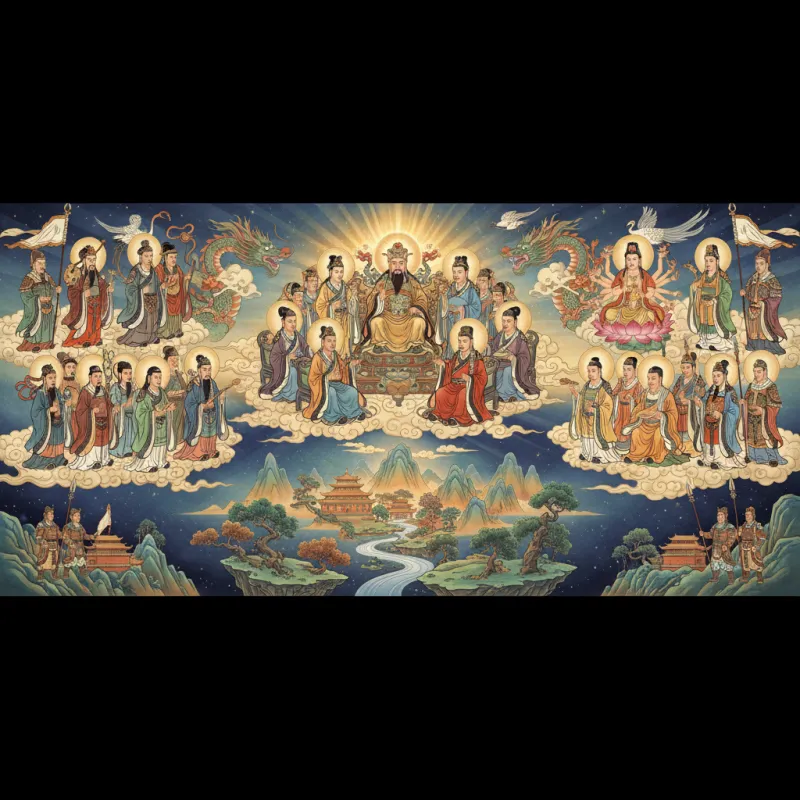
The Jade Emperor sits enthroned in the highest heaven, flanked by celestial bureaucrats shuffling paperwork for the souls of the dead. Meanwhile, down in the mortal realm, a kitchen god tattles on families to determine their fortunes for the coming year. This isn't fantasy—it's the daily reality of Chinese religious life, where deities punch time cards, immortals achieve their status through rigorous cultivation, and the boundary between heaven and earth is as permeable as morning mist. The Chinese pantheon isn't a static collection of myths gathering dust in ancient texts; it's a living, breathing bureaucracy that mirrors earthly government, complete with promotions, demotions, and interdepartmental rivalries.
The Celestial Bureaucracy: Heaven as Imperial Court
Chinese deities operate within what scholars call the "celestial bureaucracy"—a divine government structure that would make any civil servant feel right at home. The Jade Emperor (玉皇大帝, Yùhuáng Dàdì) presides as the supreme ruler, but unlike the omnipotent gods of Western traditions, he's more CEO than creator. He delegates responsibilities, reviews performance reports from subordinate deities, and can even be petitioned or criticized by mortals who feel he's not doing his job properly.
This bureaucratic model emerged during the Song Dynasty (960-1279 CE), when the imperial examination system reached its zenith and government administration became increasingly complex. The heavens, it seemed, needed to reflect earthly order. Below the Jade Emperor, you'll find departments for everything: the Ministry of Thunder handles weather and punishment, the Department of Epidemics manages diseases, and yes, there's even a Bureau of Time that keeps the cosmic calendar running smoothly.
The genius of this system lies in its flexibility. Local deities can be promoted to higher ranks based on their effectiveness—a concept that would be heretical in most religious traditions. Guan Yu (關羽, Guān Yǔ), the red-faced general from the Three Kingdoms period (220-280 CE), started as a historical figure, became a folk hero, and eventually got promoted to Guan Di (關帝, Guān Dì), the God of War and Righteousness, with temples across China. His career trajectory reads like a divine LinkedIn profile.
The Eight Immortals: Daoist Celebrities and Their Quirks
If the celestial bureaucracy represents order, the Eight Immortals (八仙, Bāxiān) embody the Daoist principle of transcending it. These aren't your typical holy figures radiating generic benevolence—each immortal has a distinct personality, backstory, and often a drinking problem. They're the rock stars of Chinese mythology, instantly recognizable by their attributes and beloved for their very human flaws.
Take Lü Dongbin (呂洞賓, Lǚ Dòngbīn), the scholarly swordsman who failed the imperial examinations and turned to Daoist cultivation instead. He's known for his magical sword that slays demons and his weakness for wine and women—hardly the ascetic ideal. Or consider He Xiangu (何仙姑, Hé Xiāngū), the only female among the eight, who achieved immortality by eating powdered mica and moonbeams. She carries a lotus flower and represents purity, but her inclusion in this otherwise male group speaks to the complex role of women in Daoist practice.
The immortals achieved their status through cultivation (修煉, xiūliàn), a process involving meditation, alchemy, breathing exercises, and moral refinement. This is crucial: Chinese immortality isn't granted by divine grace but earned through effort. It's a meritocracy of the spirit. The concept appears throughout classics like Journey to the West (西遊記, Xīyóujì), where even the Monkey King must undergo trials to achieve his supernatural status. For more on cultivation practices, see Daoist Immortality and Cultivation Techniques.
Buddhist Bodhisattvas: Compassion Meets Chinese Culture
When Buddhism arrived in China via the Silk Road around the 1st century CE, it didn't simply transplant Indian deities onto Chinese soil—it transformed them. Guanyin (觀音, Guānyīn), the Bodhisattva of Compassion, exemplifies this cultural translation. Originally the male Indian deity Avalokiteśvara, Guanyin gradually became female in Chinese Buddhism, reflecting indigenous goddess worship and Daoist feminine principles.
Guanyin's thousand arms and eyes represent her infinite capacity to see suffering and reach out to help. But here's what makes her distinctly Chinese: she's accessible. Unlike distant, transcendent buddhas, Guanyin responds to prayers about everyday problems—sick children, difficult births, financial troubles. She appears in dreams, manifests in visions, and occasionally shows up disguised as a beggar to test people's compassion. This practical, interventionist approach resonated with Chinese folk religion, where deities are expected to deliver results.
The Four Heavenly Kings (四大天王, Sì Dà Tiānwáng) guard the cardinal directions in Buddhist temples, but their fierce expressions and warrior gear owe more to Chinese military tradition than Indian iconography. They carry Chinese weapons, wear Tang Dynasty armor, and their names—Dhṛtarāṣṭra, Virūḍhaka, Virūpākṣa, and Vaiśravaṇa—get sinicized into Chiguo, Zengzhang, Guangmu, and Duowen. This cultural adaptation allowed Buddhism to flourish in China rather than remain a foreign curiosity.
Folk Deities: The Gods Next Door
While philosophers debated the nature of Dao and monks meditated on emptiness, ordinary Chinese people populated their world with intensely local, practical deities. The Kitchen God (灶神, Zàoshén) lives above the stove and reports annually to the Jade Emperor about the family's behavior. Smart households smear honey on his lips before his ascent to heaven, hoping he'll deliver sweet words about them. This isn't sophisticated theology—it's spiritual pragmatism.
City God (城隍, Chénghuáng) temples exist in nearly every Chinese city, each with a deity responsible for that specific municipality's welfare and the judgment of its dead. These gods often started as historical figures—upright magistrates or virtuous officials who got deified after death. The City God of Shanghai, for instance, was Qin Yubo, a Ming Dynasty official known for his integrity. His promotion to deity came with the job description: protect the city, maintain order, and process souls in the afterlife courthouse.
Then there's Mazu (媽祖, Māzǔ), the goddess of the sea, who began as Lin Moniang, a Song Dynasty girl from Fujian Province with shamanic abilities. After her death saving sailors, she became the patron deity of fishermen and sailors, with her cult spreading wherever Chinese maritime communities established themselves. Today, Mazu temples dot coastlines from Taiwan to Southeast Asia, and her birthday celebration is one of the largest religious festivals in the Chinese-speaking world. Her story illustrates how Chinese deification works: demonstrate virtue and efficacy in life, perform miracles after death, gain popular following, receive official recognition, achieve divine status.
The Underworld: Chinese Hell's Bureaucratic Nightmare
If you thought earthly bureaucracy was bad, wait until you see the Chinese afterlife. The Ten Courts of Hell (十殿閻羅, Shí Diàn Yánluó) process the dead through a judicial system that would make Kafka weep. Each court, presided over by a Yama King, specializes in punishing specific sins. Lie to your parents? Court Three has a tongue-ripping station. Waste food? Court Four features a pool of blood and filth. The punishments are creative, gruesome, and meticulously organized.
King Yama (閻羅王, Yánluówáng), the chief judge, isn't inherently evil—he's doing his job, maintaining cosmic justice. The underworld operates on strict karmic accounting, with every deed recorded in the Book of Life and Death. This ledger appears in Journey to the West when Monkey King breaks into hell and erases his name, achieving immortality through bureaucratic fraud—a very Chinese solution to a metaphysical problem.
But here's the twist: the underworld isn't permanent. After serving their sentences, souls drink Mengpo's (孟婆, Mèngpó) amnesia soup and reincarnate, their memories wiped clean. This Buddhist concept of cyclical rebirth merged with Chinese ancestor worship creates a complex eschatology where the dead are simultaneously in hell, in heaven, and receiving offerings from descendants. The logic doesn't quite track, but that's never bothered practitioners. For more on death and the afterlife, see Chinese Underworld and Afterlife Beliefs.
Syncretism: When Pantheons Collide
The real magic of Chinese religion isn't in individual deities but in how they coexist. Walk into any traditional Chinese temple, and you might find Daoist immortals, Buddhist bodhisattvas, and Confucian sages sharing altar space. This isn't confusion—it's syncretism, the blending of different religious traditions into a functional whole.
The classic formulation goes: "Three teachings, one truth" (三教合一, Sānjiào héyī). Confucianism governs social ethics and political order, Daoism addresses personal cultivation and harmony with nature, Buddhism handles death and the afterlife. Why choose when you can have all three? A merchant might pray to Guan Di for business success, consult a Daoist priest about feng shui, and fund a Buddhist monastery to accumulate merit for the next life. It's not hypocrisy; it's comprehensive spiritual insurance.
This flexibility extends to the deities themselves. The Queen Mother of the West (西王母, Xīwángmǔ) appears in ancient Daoist texts as a fierce goddess with tiger teeth and a leopard tail, but by the Tang Dynasty, she's been domesticated into an elegant celestial hostess who throws peach banquets for immortals. She absorbs characteristics from Buddhist and folk traditions, becoming whatever her worshippers need her to be.
Modern Relevance: Ancient Gods in Contemporary Life
These aren't museum pieces. During Chinese New Year, families still paste door gods (門神, Ménshén) on their entrances—usually generals Qin Shubao and Yuchi Gong from the Tang Dynasty, who once guarded Emperor Taizong's bedroom from demons. Businesses display Guan Di statues for protection and prosperity. Pregnant women visit Guanyin temples hoping for healthy babies. The gods remain employed.
What's fascinating is how these deities adapt to modernity. Guan Di, the ancient warrior god, now serves as patron of the Hong Kong police force and protector of triads—law enforcement and organized crime both claim him. Mazu has been invoked to bless new subway lines and protect astronauts. The Kitchen God now presumably monitors electric stoves and microwaves with equal vigilance.
The Chinese pantheon survives because it's never been dogmatic. There's no orthodoxy to defend, no heresy to punish. Deities who stop delivering results lose followers; effective ones gain temples. It's a religious free market, and the gods know they're only as good as their last miracle. This pragmatic approach to the divine—treating gods as powerful but accountable beings rather than unknowable mysteries—might be China's most distinctive contribution to world religion.
The tapestry of Chinese deities and immortals isn't just rich; it's alive, constantly rewoven by each generation's needs and beliefs. These gods work for their worshippers, and in return, they receive incense, offerings, and continued relevance in an increasingly secular world. Not a bad arrangement for beings who've been on the job for millennia.
Related Reading
- The Quest for Immortality: Why Chinese Mythology Is Obsessed With Living Forever
- Guardians of the Night Sky: The Star Gods in Chinese Daoist and Buddhist Traditions
- Journey to the West: From Novel to Netflix — Every Major Adaptation