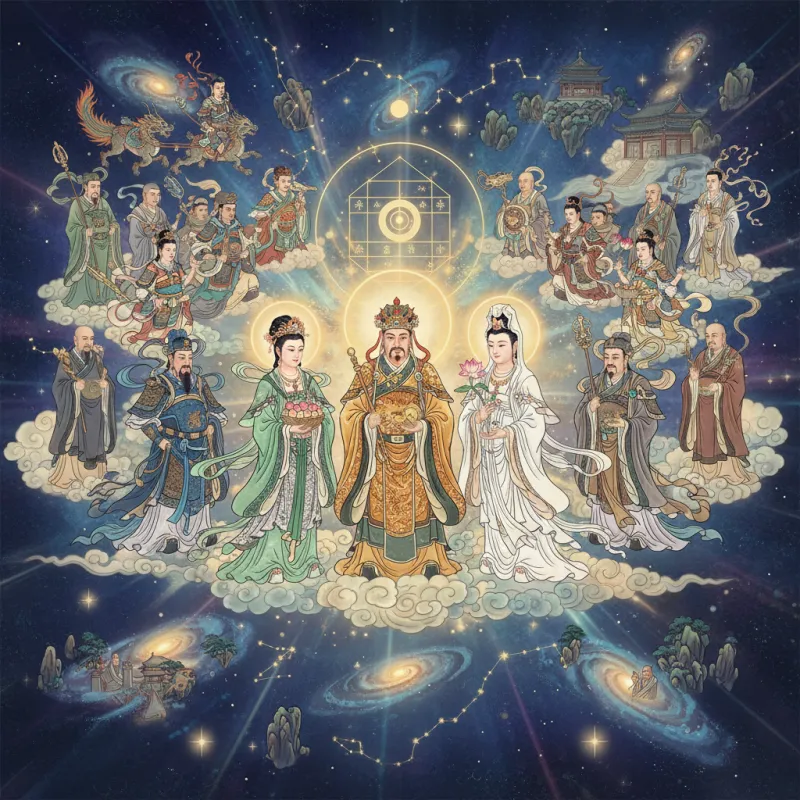
Look up on any clear night in China, and you're not just seeing distant suns—you're gazing at a bureaucracy. Each star, each constellation has its administrator, its divine official stamping celestial paperwork and managing the cosmic order. The Chinese didn't just map the heavens; they populated them with gods, immortals, and bureaucrats who make the Jade Emperor's court look like a small-town planning committee.
The Bureaucratization of Heaven
The Chinese approach to star gods reveals something fundamental about how traditional Chinese culture understood the universe: as a mirror of earthly government. When Han Dynasty astronomers (206 BCE - 220 CE) catalogued over 1,400 stars and organized them into 283 asterisms, they weren't just doing science—they were mapping the celestial civil service. The Purple Forbidden Enclosure (紫微垣, Zǐwēi Yuán) at the north celestial pole became the emperor's heavenly palace, surrounded by ministries, military camps, and administrative offices, all staffed by star gods with specific portfolios.
This wasn't metaphor. It was cosmology. The Doumu (斗母, Dǒumǔ), Mother of the Big Dipper, literally gave birth to the nine stars that became the administrative heads of destiny itself. Her sons, the Nine Emperor Gods (九皇大帝, Jiǔ Huáng Dàdì), control human fate through a celestial filing system that would make any modern bureaucrat weep with envy. During the Nine Emperor Gods Festival, still celebrated across Southeast Asia, devotees wear white and observe vegetarian diets for nine days—essentially filing their appeals directly with the cosmic HR department.
The Big Dipper: Heaven's Executive Committee
If there's a power center in the stellar pantheon, it's the Big Dipper (北斗七星, Běidǒu Qīxīng). These seven stars aren't just navigation aids—they're the executive committee of fate itself. Each star governs a specific aspect of human destiny, from birth to death, wealth to calamity. The Daoist text Beidou Yanshou Jing (北斗延壽經, Scripture of the Big Dipper's Extension of Life) details how proper veneration of these stars can literally add years to your lifespan.
The Big Dipper gods work in tandem with their southern counterparts, the stars of the Southern Dipper (南斗六星, Nándǒu Liùxīng), creating a cosmic checks-and-balances system. According to the Soushen Ji (搜神記, In Search of the Supernatural) compiled by Gan Bao in the 4th century, the Southern Dipper records births while the Northern Dipper records deaths. The famous story of Yan Chao illustrates this perfectly: a young man destined to die at nineteen tricks the stellar bureaucrats into extending his life to ninety-nine by getting them drunk during a game of chess. Even cosmic administrators, apparently, aren't immune to a good wine buzz.
The Twenty-Eight Mansions: Zodiac on Steroids
Western astrology has twelve zodiac signs. China said, "Hold my baijiu," and created twenty-eight lunar mansions (二十八宿, Èrshíbā Xiù), each ruled by its own star god. These mansions divide the celestial equator into segments, creating a far more granular system for tracking celestial influences on earthly affairs. Each mansion has its own personality, mythology, and sphere of influence—from the Azure Dragon of the East to the White Tiger of the West.
Take the mansion of Mao (昴宿, Mǎo Xiù), corresponding to the Pleiades cluster. Its star god governs military affairs and punishments. When Mao is prominent, generals pay attention. The mansion of Xin (心宿, Xīn Xiù), containing the bright star Antares, rules over fire and the emperor's authority. Its position was so politically significant that imperial astronomers who misread it could lose their heads—literally.
These weren't abstract concepts. The Kaiyuan Zhanjing (開元占經, Treatise on Astrology of the Kaiyuan Era), compiled in the 8th century, runs to 120 volumes detailing how each mansion's position affects everything from agriculture to warfare. It's astrology as statecraft, with star gods as the ultimate policy advisors.
Buddhist Stars: When India Met the Middle Kingdom
Buddhism's arrival in China during the Han Dynasty created a fascinating syncretism in stellar worship. Indian nakshatra (lunar mansion) concepts merged with existing Chinese asterisms, while Buddhist deities acquired stellar associations they never had in India. The result? A hybrid pantheon where Daoist immortals rub shoulders with bodhisattvas in the night sky.
Marici (摩利支天, Mólizhītiān), a Buddhist deity associated with the Big Dipper, became particularly popular during the Tang Dynasty (618-907 CE). Originally a minor Indian deity of the dawn, in China she transformed into a powerful star goddess who could make warriors invisible in battle. Her cult spread rapidly among military officers, who wore her image as protective talismans. The Marici Sutra describes her as riding a chariot pulled by seven pigs—one for each star of the Big Dipper—a detail that makes perfect sense in Chinese stellar cosmology but would baffle Indian Buddhists.
The Planetary Deities (九曜, Jiǔ Yào)—the sun, moon, five visible planets, plus Rahu and Ketu (the lunar nodes)—entered Chinese religion through Buddhist channels but quickly acquired Daoist characteristics. By the Song Dynasty (960-1279 CE), these nine celestial bodies had their own temples, feast days, and elaborate rituals that blended Buddhist mantras with Daoist talismanic magic.
Stellar Immortals: When Humans Become Stars
Chinese mythology doesn't just populate the stars with born deities—it offers a career path. Humans can become star gods through cultivation, merit, or imperial appointment (yes, even in death, there's bureaucracy). The most famous example is Wen Chang (文昌, Wénchāng), god of literature and examinations, identified with a constellation of six stars near the Big Dipper.
Wen Chang's origin story varies, but most versions agree he was a mortal scholar who achieved such excellence that he was posthumously appointed to manage all scholarly success in the empire. Students still burn incense to him before exams, essentially lobbying a celestial administrator who controls their academic fate. His cult became so influential that by the Ming Dynasty (1368-1644 CE), every county had a Wen Chang temple, making him one of the most widely worshipped star gods in China.
The Eight Immortals (八仙, Bāxiān), while not exclusively stellar deities, each have associations with specific stars and constellations. Lü Dongbin (呂洞賓), the most popular of the eight, is linked to the star Wenqu (文曲星, Wénqǔ Xīng), another literary star that works in Wen Chang's department. The celestial bureaucracy, it seems, has its own networking circles.
The Dark Side: Malevolent Stars and Cosmic Troublemakers
Not all star gods are benevolent administrators. Chinese stellar mythology includes its share of cosmic troublemakers and malevolent influences. The Tai Sui (太歲, Tài Suì), or Grand Duke Jupiter, is technically not a star but Jupiter's position in its twelve-year orbit. However, it's personified as a fearsome deity whose direction must never be directly faced during construction or major undertakings. Offending Tai Sui brings calamity—a belief so persistent that modern Chinese almanacs still mark his annual direction.
The Sha Shen (煞神, Shà Shén), or Killing Stars, represent malevolent stellar influences that bring disaster, disease, and death. These aren't evil gods in the Western sense—they're more like cosmic hazards, natural forces that must be appeased or avoided. The Five Ghosts (五鬼, Wǔ Guǐ) constellation, for instance, brings misfortune when prominent, requiring specific rituals to deflect its influence.
The Broom Star (掃帚星, Sàozhou Xīng)—what we call comets—was universally dreaded as an omen of dynastic change, war, or natural disaster. When Halley's Comet appeared in 1066 CE, Chinese astronomers recorded it meticulously, while the imperial court scrambled to perform protective rituals. The star god associated with comets wasn't worshipped—it was feared and propitiated, a celestial force to be managed rather than celebrated.
Living Traditions: Star Gods in Modern Practice
Walk into any traditional Chinese temple today, and you'll likely find star god worship alive and well. The Tai Sui altar, with its sixty generals representing the sixty-year cycle, receives offerings from worshippers seeking to appease the year's ruling deity. During the Qixi Festival (七夕, Qīxī), celebrating the star-crossed lovers Niulang and Zhinü, millions still gaze at Vega and Altair, the stars embodying this celestial romance.
Daoist temples conduct regular star-worship ceremonies, particularly during the Three Yuan Festivals (三元節, Sānyuán Jié), when the celestial bureaucracy supposedly reviews human conduct. The Zhongyuan Festival (中元節, Zhōngyuán Jié) on the fifteenth day of the seventh lunar month involves elaborate rituals to the star gods, seeking their intercession for deceased ancestors.
Even in modern, urban China, feng shui practitioners still calculate the influence of the Nine Stars (九星, Jiǔ Xīng) when designing buildings or planning important events. The Flying Star system (飛星派, Fēixīng Pài) tracks how stellar influences move through space and time, affecting the fortune of buildings and their inhabitants. It's ancient stellar worship dressed in contemporary consulting fees.
The star gods of Chinese tradition represent something profound: a universe that's not cold and mechanical but alive, populated, and responsive to human action. Whether you see them as literal beings, psychological archetypes, or cultural metaphors, they reveal a worldview where heaven and earth, human and divine, are in constant, bureaucratic conversation. And somewhere up there, a celestial official is filing a report about it.
Related Reading
- Exploring the Rich Tapestry of Chinese Deities and Immortals
- The Most Sacred Temples in China You Can Visit
- Unveiling the Rich Tapestry of Chinese Deities and Immortals