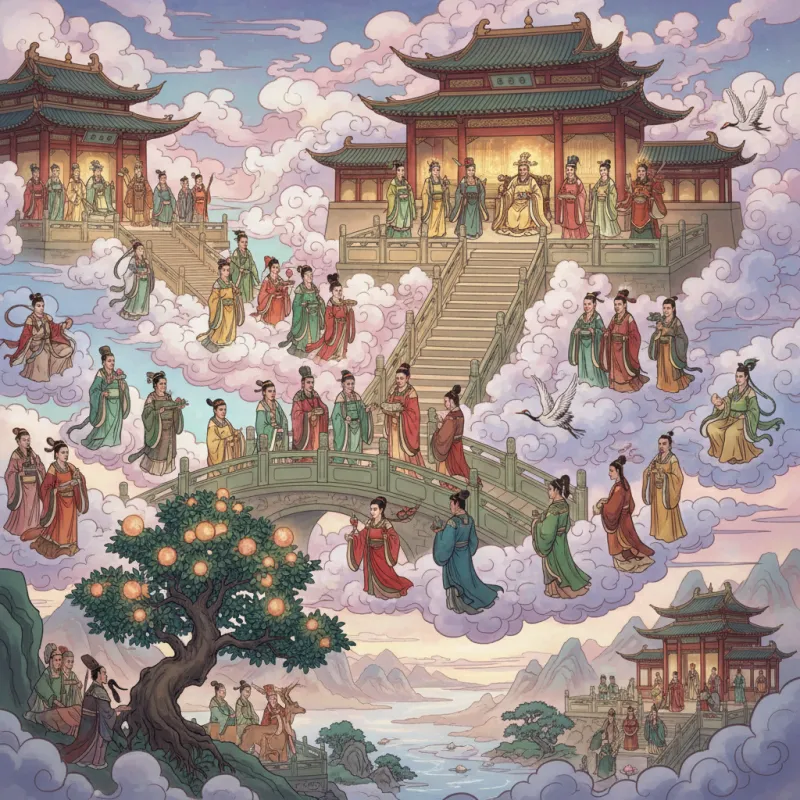
The Jade Emperor's peach trees bloom once every three thousand years. When the fruit ripens, the immortals gather for a feast that grants another cycle of eternal life. Miss the banquet, and you're just another ghost wandering the Yellow Springs. This image—from the Journey to the West (西游记, Xīyóu Jì)—captures something essential about Chinese mythology: immortality isn't a given. It's a prize you fight for, cultivate, steal, or earn through centuries of discipline.
The Problem With Dying in China
Western religions promise heaven. You die, you're judged, you go somewhere better (or worse). Death is a doorway. Chinese cosmology offers no such comfort. The default afterlife is the underworld—a bureaucratic nightmare ruled by Yanluo Wang (阎罗王, Yánluó Wáng), the King of Hell, where you're processed, judged, and reincarnated based on karmic debt. Even the virtuous don't escape. They just get a better next life.
This is why Chinese mythology doesn't romanticize death. There's no Valhalla where warriors feast forever. No Elysian Fields for heroes. The underworld is cold, administrative, and temporary. You're paperwork in a cosmic filing system. The only way out is to never die in the first place—to achieve xian (仙), the state of immortality that places you outside the cycle entirely.
The stakes are existential. Immortality isn't about living forever in the Western sense. It's about escaping a system designed to grind you down through endless reincarnations until you're purified enough to exit. But why wait? Why not hack the system now?
Three Paths to Forever
Chinese tradition offers multiple routes to immortality, each with its own logic and practitioners.
The Alchemical Path involves external alchemy (waidan, 外丹)—consuming elixirs made from mercury, lead, gold, and other substances believed to confer immortality. This killed more people than it saved. Emperor Qin Shi Huang, obsessed with eternal life, likely died from mercury poisoning around 210 BCE. The Tang Dynasty lost at least five emperors to alchemical elixirs. Yet the practice persisted for centuries because the theory was sound: if jade and gold don't decay, consuming them should make your body equally imperishable.
The Cultivation Path focuses on internal alchemy (neidan, 内丹)—breathing exercises, meditation, sexual practices, and dietary restrictions designed to refine your qi (气, vital energy) and transform your mortal body into an immortal one. This is the method favored by Daoist practitioners and the foundation of cultivation mythology in Chinese fiction. The Eight Immortals each achieved xian through different cultivation methods, proving there's no single correct path.
The Divine Path involves eating or stealing immortality from the gods themselves. The Peaches of Immortality (pantao, 蟠桃) grown in the Queen Mother of the West's garden are the most famous example. Sun Wukong crashes her banquet and eats the peaches, drinks the immortality wine, and swallows Laozi's pills of immortality—making himself five times immortal and functionally unkillable. It's the ultimate shortcut, though it tends to anger the celestial bureaucracy.
Why Emperors Kept Poisoning Themselves
The imperial obsession with immortality reveals something darker about Chinese political philosophy. An emperor who achieves immortality never has to worry about succession, rebellion, or the mandate of heaven expiring. He becomes the permanent axis around which the empire revolves.
Qin Shi Huang sent expeditions to find the mythical Penglai Island (蓬莱, Pénglái), where immortals supposedly lived. He consumed mercury thinking it would preserve his body like it preserved corpses. He died at 49. Emperor Jiajing of the Ming Dynasty (r. 1521-1567) spent decades obsessed with Daoist alchemy, neglecting state affairs while consuming toxic elixirs. He died from mercury poisoning at 59.
The pattern repeats because the logic is irresistible: if immortality is achievable—and Chinese mythology insists it is—then an emperor has both the resources and the mandate to pursue it. The tragedy is that the methods that promise immortality (mercury, lead, arsenic) are precisely what kill you fastest.
Immortals Aren't Gods
Here's what confuses Western readers: Chinese immortals (xian) aren't gods (shen, 神). They're humans who succeeded. This distinction matters enormously.
Gods are born divine or appointed to celestial positions. The Jade Emperor rules heaven because he's the supreme deity. Guanyin is a bodhisattva with cosmic compassion. These beings operate on a different ontological level. Immortals, by contrast, are self-made. They were human, they cultivated, they transformed. Lü Dongbin was a Tang Dynasty scholar who achieved immortality through internal alchemy. He Xiangu was a woman who ate powdered mica and learned to fly. Zhang Guolao rode a white donkey backward and could fold it up like paper.
This makes immortality democratic in a way Western salvation isn't. You don't need to be chosen by God or born into the right bloodline. You need discipline, knowledge, and often a good teacher. The Eight Immortals include scholars, soldiers, beggars, and women—proof that any human can transcend mortality through the right methods.
The Cultivation Novel Explosion
Modern Chinese fantasy fiction—particularly xianxia (仙侠) cultivation novels—is immortality mythology repackaged for the internet age. These stories follow protagonists who cultivate through increasingly powerful realms: Qi Condensation, Foundation Establishment, Golden Core, Nascent Soul, and beyond. The goal is always the same: transcend mortality, achieve immortality, become powerful enough that even heaven can't touch you.
This genre exploded in the 2000s and now dominates Chinese web fiction. Why? Because it taps into the same obsession that drove emperors to drink mercury and Daoist monks to meditate in caves for decades. The promise that you—yes, you specifically—can transcend your limitations through effort and cultivation is intoxicating. It's the ultimate meritocracy fantasy.
Western fantasy often features chosen ones with special bloodlines. Chinese cultivation novels feature protagonists who grind their way to godhood through sheer determination. The difference reflects deeper cultural assumptions about how immortality works: it's not granted, it's earned.
The Wellness Industry's Immortal Dreams
Walk into any Chinese medicine shop and you'll see the immortality obsession alive and well. Ginseng for longevity. Goji berries for vitality. Reishi mushrooms for spiritual cultivation. These aren't marketed as supplements—they're marketed as life-extension technologies, the modern equivalent of Daoist elixirs minus the mercury.
The language is telling. Products promise to "nourish qi," "strengthen jing (精, essence)," and "support longevity." This isn't metaphor. It's the same theoretical framework that drove alchemists to create immortality pills, now applied to consumer goods. The Chinese wellness industry is worth hundreds of billions because it sells what Chinese mythology has always promised: the possibility of living longer, healthier, and maybe—just maybe—forever.
What Immortality Actually Means
The Western reader might ask: why this obsession? Why not accept death as natural?
Because Chinese philosophy doesn't see death as natural—it sees it as a problem with a solution. The universe operates on principles (dao, 道). If you understand those principles deeply enough, you can manipulate them. Immortality isn't supernatural; it's advanced natural science. It's what happens when you align your body with the fundamental patterns of reality.
This is why Daoist immortals aren't portrayed as blessed or chosen. They're portrayed as people who figured something out. They cracked the code. And if they can do it, so can you—given enough time, discipline, and the right techniques.
The quest for immortality in Chinese mythology isn't about escaping death. It's about refusing to accept limitations. It's the ultimate expression of human ambition: the belief that with enough effort, you can transcend even the most fundamental constraint of existence. Every peach of immortality, every cultivation manual, every alchemical formula is a promise that mortality is optional.
The emperors who poisoned themselves with mercury weren't fools. They were optimists who believed the mythology was real, that immortality was achievable, that they could be the ones to finally succeed. They died trying. But the dream never dies. It just waits for the next person brave or foolish enough to pursue it.
Related Reading
- The Eight Immortals: Complete Guide to China's Most Beloved Gods
- The Peaches of Immortality: Xi Wangmu Garden
- The Quest for the Elixir of Life: From Emperor Qin to Modern Fiction
- Types of Immortals (仙): A Classification Guide
- Chinese Rituals and Ceremonies: The Sacred Practices That Connect Heaven and Earth
- Unveiling the Mystique of Chinese Animal Spirits in Daoist and Buddhist Beliefs
- Discovering Nature Spirits in Chinese Mythology: Guardians of the Earth and Sky