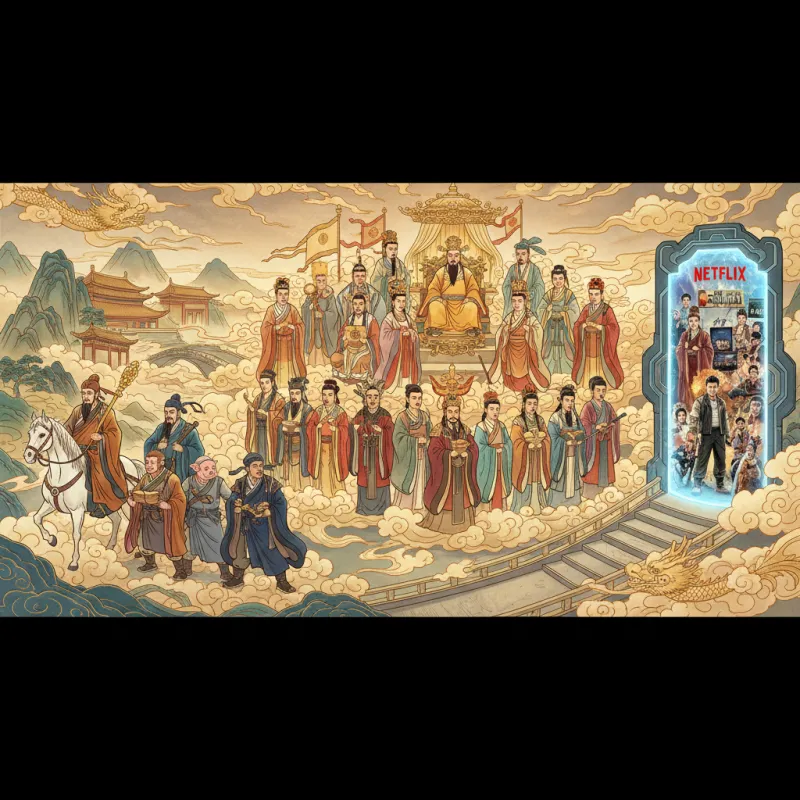
Every year, someone announces they're making a new Journey to the West adaptation. Every year, fans groan, roll their eyes, and then... watch it anyway. Because here's the thing: Wu Cheng'en's (吴承恩 Wú Chéng'ēn) sixteenth-century novel about a Buddhist monk, a rebellious monkey king, a gluttonous pig demon, and a river monster trudging to India has become the most remixed story in human history. Not the most famous—that's probably the Bible or Hamlet. But the most adapted. The sheer volume of films, TV series, anime, manga, video games, operas, and puppet shows based on Journey to the West (西游记 Xīyóu Jì) is staggering. And in 2024, Netflix threw its hat in the ring. So how did we get here? Let's trace the journey of the Journey itself.
The 1986 Series: The Untouchable Classic
If you ask anyone in China—or honestly, most of East Asia—what Journey to the West looks like, they'll describe the 1986 CCTV series. Not the novel. Not any other adaptation. This one. Starring Liu Xiao Ling Tong (六小龄童 Liù Xiǎolíngtóng) as Sun Wukong (孙悟空 Sūn Wùkōng), the Monkey King, this 25-episode series was produced on a shoestring budget with practical effects that look charmingly dated now. But it doesn't matter. The show aired during Chinese New Year and became appointment television for an entire generation.
Liu Xiao Ling Tong's performance is the gold standard. His physicality—the way he scratches his head, the mischievous glint in his eye, the acrobatic staff work—defined Sun Wukong for millions. The theme song, "Yun Gong Xun Yin" (云宫迅音), is instantly recognizable. People who've never seen the show know that song. It's been memed, remixed, and used in everything from wedding videos to political satire. The 1986 series set an impossibly high bar, and every adaptation since has been measured against it. Most fail.
Hong Kong Cinema's Chaotic Energy
While mainland China was reverently adapting the novel for television, Hong Kong filmmakers were doing something completely different: they were having fun with it. The 1960s through the 1990s saw an explosion of Journey to the West films that treated the source material like a playground. Shaw Brothers produced multiple versions. Stephen Chow (周星驰 Zhōu Xīngchí) made A Chinese Odyssey (大话西游 Dàhuà Xīyóu) in 1995, a two-part time-traveling romantic comedy that has almost nothing to do with the original plot but somehow captures its spirit perfectly.
Chow's version is weird. Sun Wukong is reincarnated as a bandit. He falls in love with a spider demon. There's a tragic romance with Zixia Fairy (紫霞仙子 Zǐxiá Xiānzǐ). The ending will make you cry. It flopped initially, then became a cult classic, then became one of the most quoted films in Chinese internet culture. "There was once a sincere love in front of me..." If you know, you know.
Hong Kong's approach was irreverent, inventive, and willing to completely reimagine the story. They understood something crucial: Journey to the West isn't sacred scripture. It's a folk tale that's been retold and remixed for centuries. Wu Cheng'en himself was compiling and embellishing existing stories. The novel is already an adaptation.
Japanese Anime: When Goku Went Super Saiyan
Here's a fact that surprises people: Dragon Ball is a Journey to the West adaptation. Not loosely inspired by. Not vaguely based on. Akira Toriyama's 1984 manga starts as a straight retelling: a monkey-tailed boy named Goku (Son Goku in Japanese, which is the Japanese reading of 孙悟空) with a magic staff, a flying cloud, and superhuman strength. Bulma is Tripitaka. They're collecting dragon balls instead of Buddhist scriptures, but the structure is identical.
Then Toriyama got bored with the premise and turned it into a fighting tournament manga, and the rest is history. But Dragon Ball's influence on how the West understands Sun Wukong cannot be overstated. For millions of people outside Asia, Goku was their first exposure to the Monkey King archetype. They just didn't know it.
Japan has produced dozens of other Journey to the West adaptations—the 1978 TV series starring Masaaki Sakai is beloved, and various anime versions pop up every few years. The Japanese approach tends to emphasize the adventure and comedy aspects, sometimes adding romantic subplots that would make Wu Cheng'en raise an eyebrow. But they get the core appeal: a powerful, impulsive hero learning discipline and compassion through a long, difficult journey.
The 2010s: CGI Spectacles and Diminishing Returns
The 2010s saw big-budget Chinese film adaptations that prioritized spectacle over story. Journey to the West: Conquering the Demons (2013) and Journey to the West: The Demons Strike Back (2017), produced by Stephen Chow, had impressive effects but felt hollow. The Monkey King trilogy (2014-2018) starring Donnie Yen and Aaron Kwok threw money at the screen—elaborate costumes, massive sets, armies of CGI demons—but struggled to find an emotional core.
These films made money. They looked gorgeous. But they're forgettable. The problem with modern big-budget adaptations is they often mistake scale for substance. The original novel works because it's episodic, character-driven, and funny. It's a road trip story. The demons are obstacles, but the real journey is internal—Sun Wukong learning humility, Zhu Bajie (猪八戒 Zhū Bājiè) confronting his appetites, Tang Sanzang (唐三藏 Táng Sānzàng) maintaining faith despite constant danger.
When you turn that into a two-hour CGI battle against a generic demon king, you lose what makes the story work. The 1986 series understood this. It had terrible effects, but it had heart. It took time with the characters. Modern adaptations often don't.
Netflix's Monkey King: The American Attempt
In 2023, Netflix released The Monkey King, an animated film featuring the voices of Jimmy O. Yang, Bowen Yang, and Jolie Hoang-Rappaport. It's... fine. The animation is competent. The voice acting is energetic. They clearly did their research—the story hits the major beats of Sun Wukong's origin story, the havoc in heaven, and his eventual imprisonment under Five Elements Mountain.
But it feels like a DreamWorks movie that happens to be about Chinese mythology. The humor is very American—lots of quips, pop culture references, and self-aware jokes. Sun Wukong is less a complex trickster figure and more a generic "chosen one who learns to believe in himself." The Buddhist and Daoist cosmology that gives the original story its structure is simplified into a basic good-versus-evil framework.
This isn't necessarily bad. Netflix was trying to make Journey to the West accessible to a global audience that doesn't know the source material. But something gets lost in translation. The novel is deeply embedded in Chinese religious and philosophical traditions. Sun Wukong's journey from chaos to enlightenment mirrors Buddhist concepts of ego death and spiritual cultivation. When you strip that away, you're left with a fun adventure story, but not Journey to the West.
Video Games: Where the Story Lives Now
Honestly? The most interesting Journey to the West adaptations in the past decade have been video games. Black Myth: Wukong (2024) became a global phenomenon, a Chinese-developed action RPG that takes the mythology seriously while delivering spectacular combat. It doesn't retell the novel—it's set after the journey, exploring what happened to the pilgrims and the demons they encountered.
The game understands something crucial: Journey to the West is about transformation. Sun Wukong isn't just a powerful fighter; he's a being struggling with his nature. The novel asks whether someone fundamentally chaotic and selfish can achieve enlightenment. Black Myth: Wukong explores that question through gameplay, letting players experience the weight of Sun Wukong's choices.
Other games have taken different approaches. Enslaved: Odyssey to the West (2010) transplanted the story to a post-apocalyptic future. Asura's Wrath (2012) borrowed heavily from the mythology. Mobile games in China release Journey to the West tie-ins constantly. The story's episodic structure—travel to a new place, fight a new demon, learn a new lesson—maps perfectly onto video game level design.
Why This Story Won't Die
So why does Journey to the West keep getting adapted? Why does every generation need to retell it?
Because it's a perfect story structure. Four distinct characters with clear personalities and conflicts. An episodic journey that can be expanded or condensed. Themes of redemption, loyalty, and spiritual growth that resonate across cultures. And at its center, Sun Wukong—a character who embodies both our worst impulses and our highest potential.
The Monkey King is arrogant, violent, and selfish. He's also loyal, brave, and capable of profound growth. He's us. That's why he works in a 1986 Chinese TV series, a 1995 Hong Kong comedy, a 1984 Japanese manga, and a 2024 video game. The details change, but the core remains: a powerful being learning to be good.
Wu Cheng'en probably didn't imagine his novel would spawn thousands of adaptations across every medium humans have invented. But he tapped into something universal. The journey to enlightenment—whether Buddhist, Daoist, or just personal growth—is never straightforward. It requires companions, challenges, and the willingness to change. That's a story worth telling again and again.
Even if Netflix's version has too many quips.
Related Reading
- Nezha: From Rebellious Child God to China's Biggest Animated Film
- Chinese Gods in Anime and Manga: Eastern Mythology Goes Global
- Chinese Gods in Marvel and DC Comics
- Nezha: From Ancient Deity to Box Office Hit
- Black and White Impermanence: The Soul Collectors
- Exploring Chinese Deities and Immortals: Rituals in Daoist and Buddhist Traditions
- Dragon Boat Festival: The Poet, the River, and the Race