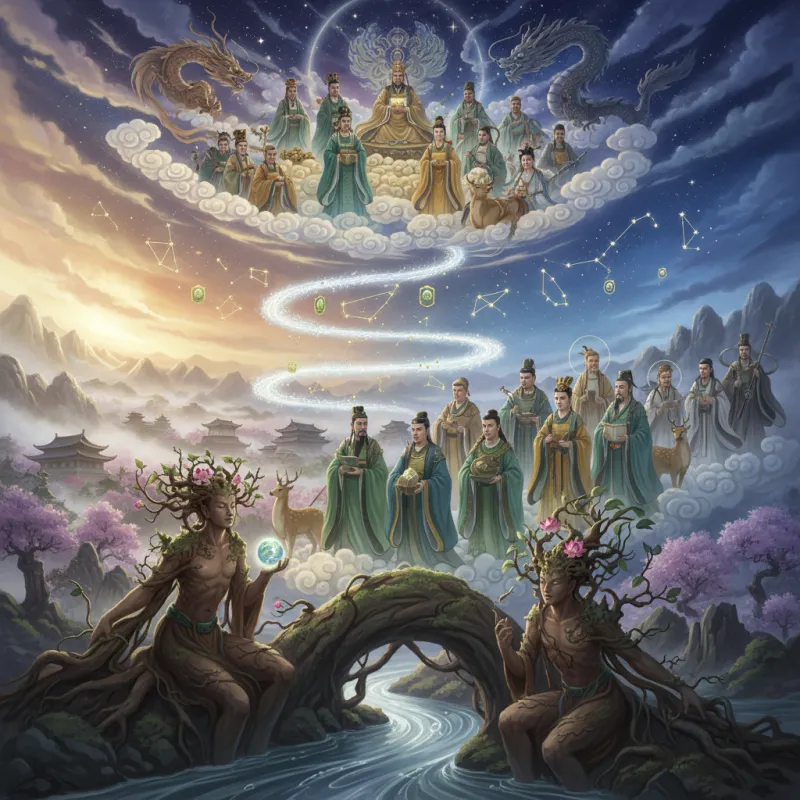
When the legendary Yellow Emperor ascended Mount Tai in 2697 BCE, he didn't climb alone. According to the Shiji (史記), he was accompanied by an entire retinue of nature spirits—mountain gods who had governed those peaks since time immemorial, river deities who controlled the waters below, and tree spirits whose roots remembered dynasties that hadn't yet been born. This wasn't mythology making things up. This was how ancient Chinese people actually understood their world: every rock, every stream, every gust of wind had a consciousness, a personality, and often, a very specific job description.
The Hierarchy of Earth and Sky
Chinese nature spirits operate within a bureaucracy that would make any government official proud. At the top sit the Four Dragon Kings (龍王, lóng wáng), each governing one of the cardinal seas. Below them, you'll find mountain gods like the Wuyue (五嶽, wǔ yuè)—the Five Great Mountains—each with their own celestial rank and administrative territory. The Eastern Peak, Mount Tai, holds special significance as the place where souls are judged after death, making its presiding deity, Dongyue Dadi (東嶽大帝, dōng yuè dà dì), one of the most powerful nature spirits in the entire pantheon.
But the real action happens at the local level. Every village well had its spirit. Every ancient tree housed a deity. The Soushen Ji (搜神記), compiled in the 4th century CE, catalogs hundreds of these localized spirits, from the god of a particular bridge in Jiangsu to the spirit inhabiting a specific boulder in Sichuan. This wasn't abstract theology—these were the deities people actually prayed to when their crops failed or their children fell ill.
River Gods and Water Spirits
The He Bo (河伯, hé bó), or Count of the River, represents one of the oldest documented nature spirits in Chinese literature. The Zhuangzi tells the story of He Bo's hubris—how he thought himself the greatest being in existence until he reached the ocean and realized how small his river truly was. It's a philosophical parable, yes, but it also reveals something crucial: these spirits had personalities, flaws, and character arcs. They weren't just symbols.
The Dragon Kings took this further, appearing in everything from Tang dynasty rain prayers to Ming dynasty novels like Journey to the West. Ao Guang (敖廣, áo guǎng), the Dragon King of the Eastern Sea, gets bullied by Sun Wukong in one of literature's most famous scenes—the Monkey King barges into his underwater palace and demands a weapon, eventually walking away with the magical staff that becomes his signature weapon. The fact that a nature deity could be portrayed as both powerful and somewhat bumbling tells you something about how Chinese culture viewed these spirits: they were divine, but they were also part of the cosmic order, subject to its rules and hierarchies just like everyone else.
Mountain Deities and Forest Guardians
Mountains in Chinese cosmology aren't just geological formations—they're living beings with agency. The goddess Xiwangmu (西王母, xī wáng mǔ), the Queen Mother of the West, rules from the Kunlun Mountains, where she tends the peaches of immortality. But she's an exception—most mountain gods are male, reflecting ancient patriarchal structures that mapped onto the natural world.
The Tudi Gong (土地公, tǔ dì gōng), or Earth God, operates at a more intimate scale. Every neighborhood, every field, every forest grove had its own Tudi Gong—a local deity responsible for that specific patch of earth. These weren't grand cosmic forces; they were middle managers in the celestial bureaucracy, and people treated them accordingly. You'd offer them incense and fruit, sure, but you'd also complain to them when things went wrong, sometimes even threatening to withhold offerings if they didn't do their jobs properly. The relationship was transactional, almost contractual.
Tree spirits deserve special mention. The Liaozhai Zhiyi (聊齋誌異), Pu Songling's 17th-century collection of supernatural tales, features dozens of stories about tree spirits—usually depicted as beautiful women who emerge from ancient trees to seduce scholars. These weren't random fantasies. In traditional Chinese belief, trees that reached a certain age (usually 100 years or more) could develop consciousness and spiritual power. The older the tree, the more powerful its spirit. This is why you'll still see red ribbons tied around ancient trees in China today—they're markers of respect, acknowledgments that something divine dwells within.
Seasonal Spirits and Agricultural Deities
The agricultural calendar shaped Chinese civilization, so naturally, it shaped Chinese mythology too. Houji (后稷, hòu jì), the Lord of Millet, taught humanity how to cultivate crops according to the Shijing (詩經). But more interesting are the seasonal spirits who governed specific times of year.
The Spring Ox (春牛, chūn niú) appears in almanacs and folk rituals marking the beginning of the agricultural season. Local officials would ceremonially whip a clay ox to "wake up" the earth and encourage spring's arrival. This wasn't metaphor—people genuinely believed that ritual actions could influence natural spirits and, through them, the natural world itself.
Feng Bo (風伯, fēng bó) and Yu Shi (雨師, yǔ shī)—the Wind Earl and Rain Master—controlled weather patterns. Drought? You'd petition Yu Shi. Destructive storms? You'd try to appease Feng Bo. The Book of Rites describes elaborate state ceremonies for these deities, complete with specific offerings and ritual protocols. When these ceremonies failed (and they often did), it wasn't seen as proof that the spirits didn't exist—it meant you'd performed the ritual incorrectly or that you'd somehow offended the deity in question.
The Daoist Systematization
Daoism took these scattered folk beliefs and organized them into a coherent system. The Daozang (道藏), the Daoist canon, catalogs nature spirits with the thoroughness of a modern database, assigning each one a rank, jurisdiction, and set of responsibilities. This systematization peaked during the Song dynasty (960-1279 CE), when Daoist priests essentially created an organizational chart for the spirit world.
But here's what's fascinating: the systematization never fully replaced local variation. A river god in Guangdong might have completely different attributes and stories than a river god in Hebei, even though technically they both answered to the same Dragon King. Chinese mythology maintained this tension between universal principles and local specificity, between the official pantheon and folk practice. For more on how Daoism shaped these beliefs, see Daoist Immortals and Their Paths to Transcendence.
Nature Spirits in Contemporary Practice
Walk through any Chinese city today and you'll still find shrines to nature spirits. That small red temple next to the construction site? Probably dedicated to the local Tudi Gong, appeased before breaking ground. The offerings left at the base of an old tree? Recognition of the spirit dwelling within.
These practices persist not because people are superstitious (though some are), but because they represent a fundamentally different way of relating to the environment. When every mountain has a god, you think twice before strip-mining it. When every river has a spirit, pollution becomes not just an environmental issue but a spiritual transgression. The nature spirits of Chinese mythology encoded an ecological ethic long before anyone used that term.
The Mountain Gods and Sacred Peaks continue to draw pilgrims, while urban temples still maintain altars to river deities even when those rivers have been paved over or redirected underground. The spirits remain, even when their physical domains have been transformed by modernity.
The Living Tradition
Chinese nature spirits never died out because they never stopped being useful. They provided—and still provide—a framework for understanding humanity's relationship with the natural world. They're not primitive superstition waiting to be replaced by scientific understanding. They're a sophisticated system for encoding environmental knowledge, social values, and spiritual practice into memorable, transmissible stories.
The next time you see a red ribbon tied around a tree or incense burning at a mountain shrine, remember: you're witnessing a tradition that stretches back thousands of years, one that recognized something we're only now rediscovering—that the natural world deserves not just our protection, but our respect, our attention, and yes, even our reverence.
Related Reading
- Ancient Chinese Underworld Deities: Guardians of Death and Afterlife Realms
- Unveiling the Rich Tapestry of Chinese Deities and Immortals
- The Most Sacred Temples in China You Can Visit