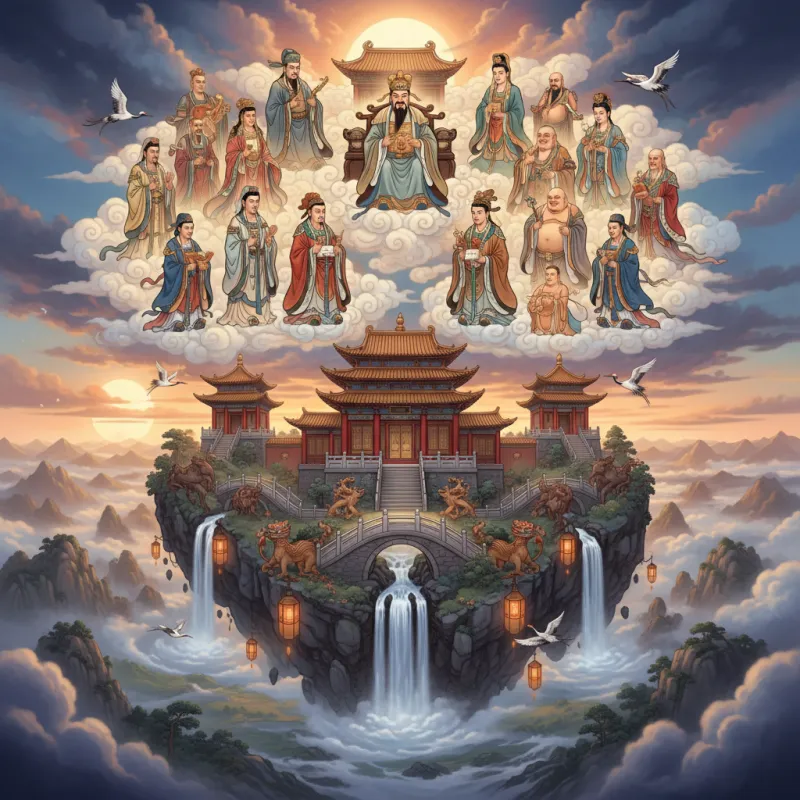
The first time I walked into Lingyin Temple (灵隐寺, Língyǐn Sì) in Hangzhou, a monk was chanting the Heart Sutra in the main hall. His voice echoed off stone walls that had heard the same words for 1,700 years. Outside, mist rolled through the bamboo groves. Inside, incense smoke curled toward ceiling beams carved during the Song Dynasty. I understood then what makes a temple sacred — it's not the architecture or the statues. It's the accumulated weight of devotion, layer upon layer, century after century, until the very stones seem to remember.
China has tens of thousands of temples. Most are worth visiting. A few dozen are genuinely sacred — places where the boundary between the mundane and the numinous feels thinner. These are the ones that matter.
Wutai Shan: Where Manjushri Lives
Wutai Shan (五台山, Wǔtái Shān) in Shanxi Province is the earthly abode of Manjushri (文殊菩萨, Wénshū Púsà), the Bodhisattva of Wisdom. It's the most important of China's Four Sacred Buddhist Mountains, and the only one outside of southern China. The mountain has over fifty active monasteries, but three stand out.
Xiantong Temple (显通寺, Xiǎntōng Sì) is the oldest, founded in 68 CE during the Eastern Han Dynasty — making it one of the first Buddhist temples in China, contemporary with the White Horse Temple in Luoyang. The Bronze Hall, cast entirely from bronze in the Ming Dynasty, contains ten thousand small Buddha statues. Stand inside it at dawn when the light hits the metal just right, and the whole structure seems to glow from within.
Tayuan Temple (塔院寺, Tǎyuàn Sì) is dominated by the Great White Stupa, a 56-meter Tibetan-style dagoba that's visible from everywhere on the mountain. Pilgrims circumambulate it clockwise, spinning prayer wheels, their lips moving in mantras. The stupa contains relics of the Buddha himself — or so the tradition claims. Whether you believe that or not, the devotion is real.
Pusading Temple (菩萨顶, Púsàdǐng) sits at the mountain's peak. It's a Tibetan Buddhist monastery, and during the Qing Dynasty, emperors would stop here on their way to the summer palace. The main hall contains a massive statue of Manjushri riding his lion. The statue's eyes follow you as you move — a trick of the sculptor's art, but unsettling nonetheless.
The White Cloud Temple: Daoist Headquarters
White Cloud Temple (白云观, Báiyún Guàn) in Beijing is the headquarters of the Complete Perfection (全真, Quánzhēn) school of Daoism. It's been destroyed and rebuilt multiple times — most recently after the Cultural Revolution — but the current structure maintains the essential character of a Daoist sacred space.
The temple complex follows the traditional layout: you enter through the Mountain Gate, pass through courtyards dedicated to different deities, and gradually ascend toward the innermost sanctum. Each hall houses different members of the Daoist pantheon — the Jade Emperor, the Three Pure Ones, the Eight Immortals. But the real power of the place is in the details.
In the Hall of the Four Celestial Marshals, there's a stone carving of a monkey. Touch it for good luck, the tradition says. The stone is worn smooth from centuries of hands. In the courtyard, there's a bronze coin hanging from a bell. Throw a coin through the hole and your wishes will be granted. I watched a grandmother try seventeen times before she succeeded. Her face when she did — pure joy.
The temple's library contains one of the most complete collections of Daoist texts in China, including rare manuscripts of the Daozang (道藏, Dàozàng), the Daoist Canon. Scholars come from around the world to study here. But you don't need to read classical Chinese to feel the weight of the tradition. Just sit in the courtyard at dusk when the monks are chanting evening prayers. The sound seems to come from the earth itself.
Shaolin Temple: Where Chan Buddhism Began
Everyone knows Shaolin Temple (少林寺, Shàolín Sì) for kung fu. Fewer people know it's one of the most important sites in Chan (禅, Chán) Buddhism — the tradition that became Zen in Japan. The temple was founded in 495 CE, and Bodhidharma (达摩, Dámó), the legendary founder of Chan Buddhism, meditated here in a cave for nine years.
The cave is still there, a short hike up the mountain behind the temple. The rock face where Bodhidharma supposedly stared at the wall for so long that his shadow burned into the stone. The shadow is gone now — or maybe it was never there — but the cave remains. It's small, dark, and cold. Sit in it for ten minutes and you'll understand why meditation was necessary. There's nothing else to do.
The temple itself is a strange mix of sacred and commercial. The main courtyard has a gift shop selling Shaolin-branded everything. But walk past that into the deeper halls, and you'll find monks practicing kung fu forms that are also moving meditations. The Pagoda Forest, where the ashes of accomplished monks are interred in individual stupas, is genuinely moving — 240 stone towers spanning eight centuries, each one a life devoted to practice.
The Hall of a Thousand Buddhas contains Ming Dynasty frescoes showing the legendary Shaolin monks saving the Tang Dynasty emperor. The paintings are faded now, but you can still make out the monks' faces — fierce, focused, fully present. That's what makes Shaolin sacred despite the commercialization. The practice continues. The lineage is unbroken.
Jokhang Temple: Tibet's Spiritual Heart
Jokhang Temple (大昭寺, Dàzhāo Sì) in Lhasa is the most sacred site in Tibetan Buddhism. It was built in 647 CE by King Songtsen Gampo to house a statue of the Buddha brought to Tibet by his Chinese wife, Princess Wencheng. That statue — the Jowo Shakyamuni — is still there, covered in gold and jewels, surrounded by butter lamps that never go out.
Pilgrims prostrate themselves on the ground outside the temple, full-body prostrations, over and over, sometimes for hours. Some have traveled for months to get here, prostrating the entire way from their home villages. Their foreheads are calloused from touching the ground. Their hands are wrapped in leather to protect them from the stones.
Inside, the air is thick with yak butter smoke from thousands of lamps. The walls are black with soot from centuries of offerings. Monks chant in the deep, resonant tones of Tibetan liturgy. The sound vibrates in your chest. You don't need to understand the words to feel their power.
The temple's roof offers views of the Potala Palace and the surrounding mountains. At sunset, the light turns everything gold — the roofs, the mountains, the faces of the pilgrims. It's one of the most beautiful sights I've ever seen, and one of the most humbling. These people believe with an intensity that makes my own doubts feel small and petty.
Longmen Grottoes: Stone Sutras
Longmen Grottoes (龙门石窟, Lóngmén Shíkū) near Luoyang isn't technically a temple — it's a series of caves carved into limestone cliffs along the Yi River. But it functions as a sacred space, and it's one of the most impressive Buddhist sites in China.
The caves contain over 100,000 Buddhist statues carved between the 5th and 8th centuries. The largest is the Vairocana Buddha in the Fengxian Temple cave — 17 meters tall, with a face that's said to be modeled on Empress Wu Zetian, the only woman to rule China in her own right. The Buddha's expression is serene but not passive. There's strength in it, and intelligence.
The smaller caves are even more remarkable. Thousands of tiny Buddhas, each one individually carved, each one slightly different. Some caves have inscriptions — sutras carved into the stone, prayers for the dead, dedications from donors. The stone itself becomes scripture.
Many statues are damaged — heads missing, faces worn smooth by wind and rain, arms broken off by vandals and art thieves. But the damage doesn't diminish the power of the place. If anything, it enhances it. These statues have survived 1,500 years of war, revolution, and neglect. They're still here. That's its own kind of miracle.
Hanging Monastery: Defying Gravity and Doctrine
Hanging Monastery (悬空寺, Xuánkōng Sì) near Datong is built into a cliff face 75 meters above the ground. It's held up by wooden beams inserted into holes drilled into the rock. It looks impossible — and according to modern engineering analysis, it shouldn't work. But it's been there for 1,500 years.
What makes Hanging Monastery unique is its religious syncretism. It contains statues of Buddha, Laozi, and Confucius in the same hall — the only temple in China to honor all three traditions equally. This was controversial when it was built and remains unusual today. But it reflects a deeper truth about Chinese religion: the boundaries between traditions are more porous than orthodox believers like to admit.
The monastery is small — only forty rooms — and can only accommodate a few dozen visitors at a time. Walking through it feels precarious. The wooden walkways creak. The railings feel flimsy. You're very aware of the drop below. But that's part of the experience. The monks who built this place were making a statement: faith can accomplish the impossible.
Lingyin Temple: Where Poetry and Prayer Meet
I started with Lingyin Temple, so I'll end with it. Lingyin Temple (灵隐寺, Língyǐn Sì) in Hangzhou was founded in 328 CE by an Indian monk named Huili. The name means "Temple of the Soul's Retreat," and that's exactly what it is — a refuge from the world, hidden in a valley of limestone peaks and bamboo forests.
The temple has been destroyed and rebuilt sixteen times. The current structures date from the Qing Dynasty, but they follow the original layout. The main hall contains a massive statue of the Buddha carved from 24 pieces of camphor wood and covered in gold leaf. It's 19.6 meters tall, one of the largest wooden Buddha statues in China.
But the real treasure of Lingyin is the Feilai Feng (飞来峰, Fēilái Fēng), the "Peak That Flew Here." According to legend, the Indian monk Huili recognized the peak as a fragment of a sacred mountain in India that had flown to China overnight. The peak is covered with over 300 Buddhist carvings dating from the 10th to 14th centuries — laughing Buddhas, fierce guardians, serene bodhisattvas, all carved directly into the limestone.
The most famous is the Laughing Buddha (弥勒佛, Mílè Fó) — a fat, jolly figure with his robe open and his belly exposed. This is Budai, the legendary Chan monk who became identified with Maitreya, the Future Buddha. His expression is pure joy. Rub his belly for luck, the tradition says. The stone is worn smooth from centuries of hands.
Lingyin is also famous for its connection to Chinese poetry. The Tang Dynasty poet Bai Juyi served as governor of Hangzhou and wrote extensively about the temple. The Song Dynasty poet Su Shi visited frequently and left inscriptions on the rocks. Walking through Lingyin, you're walking through layers of literary and religious history, each one enriching the others.
What Makes a Temple Sacred
After visiting hundreds of temples across China, I've developed a theory about what makes a place sacred. It's not age, though age helps. It's not beauty, though beauty matters. It's not even religious significance, though that's part of it.
What makes a temple sacred is continuity of practice. It's the accumulated weight of devotion — prayers said, incense burned, prostrations made, sutras chanted, day after day, year after year, century after century. The practice soaks into the stones, the wood, the air itself. You can feel it when you walk in.
The temples on this list have that quality. They're not museums. They're living religious sites where people still come to pray, to meditate, to seek answers, to find peace. The monks and nuns who maintain them are continuing traditions that stretch back over a millennium. That continuity is what makes them sacred.
You don't have to be Buddhist or Daoist to appreciate these places. You don't have to believe in gods or enlightenment or immortality. You just have to be willing to pay attention, to be present, to let the place work on you. If you do that, you'll feel what I felt — that shift in the air, that change in the quality of light, that sense that you've stepped into a space where the ordinary rules don't quite apply.
That's what sacred means. Not separate from the world, but more intensely present in it. Not escape, but arrival. Not transcendence, but deep, deep immanence — the divine not above or beyond, but right here, in the stone and the smoke and the silence.
Related Reading
- 10 Most Sacred Daoist Temples in China You Can Visit
- Daoist Temples: Where to Go, What to Expect, and How Not to Embarrass Yourself
- Sacred Mountain Pilgrimage: The Chinese Tradition of Climbing to Heaven
- Chinese Temple Architecture: What Every Symbol Means
- Exploring the Rich Tapestry of Chinese Deities and Immortals in Temples
- The Eight Immortals: China's Most Beloved Supernatural Team
- Unraveling the Mystique of Chinese War Gods in the Daoist and Buddhist Pantheon
- Guardians of the Night Sky: The Star Gods in Chinese Daoist and Buddhist Traditions