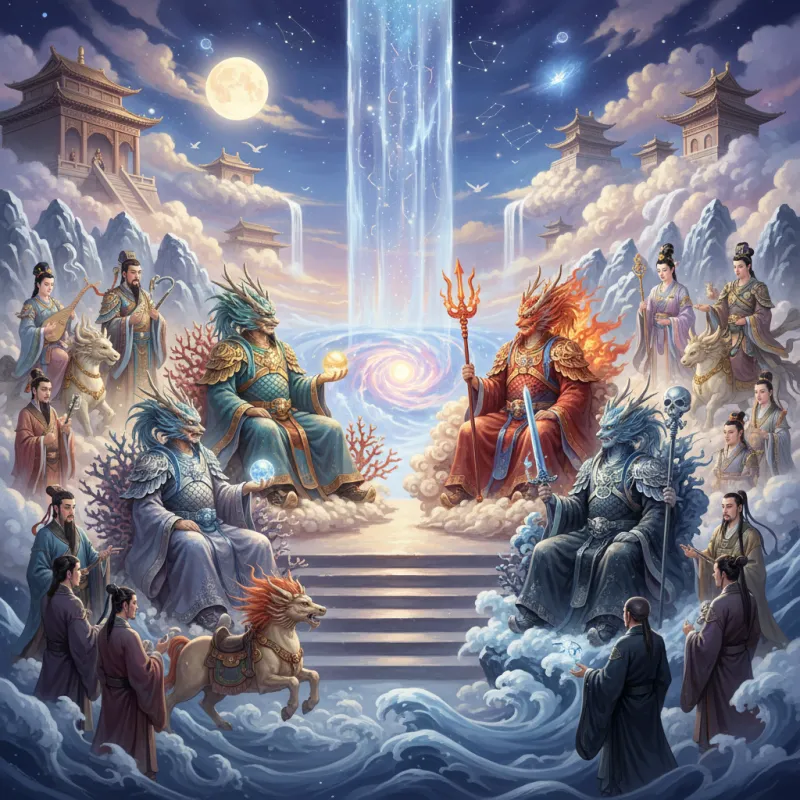
When the Jade Emperor needed someone to manage the world's waters, he didn't appoint bureaucrats or celestial scholars—he turned to dragons. Not just any dragons, but four brothers who would become the most powerful aquatic deities in Chinese mythology: the Dragon Kings of the Four Seas (四海龍王, Sìhǎi Lóngwáng). These aren't the fire-breathing monsters of Western fantasy. They're sophisticated divine administrators who control rain, rivers, and the fate of fishermen, all while navigating the complex politics of heaven's bureaucracy.
The Four Brothers and Their Domains
Each Dragon King rules one of the four cardinal seas surrounding the Middle Kingdom, and their names follow a telling pattern—all share the surname Ao (敖), marking them as brothers in the cosmic order. Ao Guang (敖廣) commands the East Sea, the most prestigious position since the east represents spring, renewal, and the rising sun. His palace beneath the waves near modern-day Zhejiang province serves as the de facto capital of dragon-kind.
Ao Qin (敖欽) governs the South Sea, associated with summer's heat and abundant rainfall. Ao Run (敖閏) presides over the West Sea, linked to autumn and the harvest season. Finally, Ao Shun (敖順) rules the North Sea, connected to winter's cold and the mysterious depths. This geographic and seasonal distribution reveals how ancient Chinese cosmology mapped divine power onto the physical world—every direction, every season, every body of water had its supernatural overseer.
The hierarchy among them matters. Ao Guang consistently appears as the eldest and most influential, the one who attends the most important celestial meetings and whose decisions carry the most weight. When the Jade Emperor needs something done in the aquatic realm, he summons Ao Guang first.
The Crystal Palaces Beneath the Waves
The Dragon Kings don't live in caves or lairs—they inhabit magnificent underwater palaces (龍宮, Lónggōng) that rival heaven's own architecture. These crystal structures shimmer with pearls, coral, and precious stones, staffed by armies of shrimp soldiers and crab generals (蝦兵蟹將, xiābīng xièjiàng). The palaces contain treasuries filled with magical weapons, rare herbs, and artifacts accumulated over millennia.
The most famous palace belongs to Ao Guang, and we know its layout intimately thanks to Journey to the West (西遊記). When Sun Wukong storms in demanding a weapon worthy of his strength, we see throne rooms with pillars of jade, armories containing weapons from every dynasty, and wine cellars stocked with thousand-year-old celestial vintages. The Dragon King's hospitality—forced though it may be—reveals the wealth and sophistication of these underwater kingdoms.
But these palaces aren't just for show. They're administrative centers where the Dragon Kings manage complex water systems, coordinate rainfall schedules, and adjudicate disputes among lesser water spirits. Think of them as a combination of royal court, weather bureau, and environmental protection agency, all rolled into one magnificent underwater complex.
Power, Politics, and the Heavenly Bureaucracy
Here's what makes the Dragon Kings fascinating: they're powerful but not supreme. They answer to the Jade Emperor and must follow heaven's regulations, yet they command enough force to cause droughts or floods if they choose rebellion. This tension between authority and subordination runs through every story about them.
In Investiture of the Gods (封神演義), we see Dragon Kings caught between competing powers during the Shang-Zhou transition. In Journey to the West, Ao Guang gets bullied by Sun Wukong but later becomes an ally, providing transportation and support for the pilgrimage. The Dragon Kings must constantly navigate between their pride as ancient, powerful beings and their position as mid-level officials in heaven's hierarchy.
Their relationship with Nezha perfectly illustrates this dynamic. When the young deity kills Ao Guang's third son and strips him for his tendons, it's not just a personal tragedy—it's a political crisis. Ao Guang must seek justice through proper channels, appealing to higher authorities rather than simply unleashing his power. The story reveals how even mighty Dragon Kings must operate within a system of cosmic law.
Masters of Rain and Weather
The Dragon Kings' primary responsibility is water management, and in agricultural China, this made them absolutely crucial to human survival. They don't just control the seas—they regulate rivers, lakes, springs, and most importantly, rainfall. Every drop that falls from the sky theoretically comes under their jurisdiction.
This power made them objects of intense worship. During droughts, emperors would personally conduct rituals at Dragon King temples, begging for rain. Local officials would parade dragon effigies through streets, sometimes even "punishing" dragon statues by leaving them in the sun if rain didn't come. These weren't quaint folk customs—they were desperate attempts to communicate with the beings who controlled agricultural prosperity.
The Dragon Kings could also weaponize weather. Flooding a region, withholding rain, or summoning storms were all within their power. This made them dangerous when angered, which is why so many stories emphasize the importance of showing them proper respect. Even the Jade Emperor couldn't simply command them—he had to issue formal decrees and maintain diplomatic relations.
The Monkey King's Weapon Shopping Trip
No discussion of the Dragon Kings is complete without addressing the most famous scene involving them: Sun Wukong's visit to Ao Guang's palace. The Monkey King, newly awakened to his powers and insufferably arrogant, decides he needs a proper weapon. He doesn't ask politely—he barges into the East Sea palace and demands the best they have.
Ao Guang tries to appease him with various weapons, but nothing satisfies the monkey until he spots the Ruyi Jingu Bang (如意金箍棒)—the magical staff that once helped Yu the Great control the floods. It weighs 17,550 pounds and can change size at will. When Sun Wukong lifts it effortlessly, Ao Guang realizes he's dealing with someone extraordinary and dangerous.
The scene is often played for comedy, but it reveals something important: the Dragon Kings possess incredible treasures but lack the power to protect them from truly exceptional beings. Ao Guang's humiliation at the hands of a monkey—even a magical one—shows the limits of his authority. He can't refuse without risking destruction, yet giving in damages his dignity. It's a perfect encapsulation of the Dragon Kings' position: powerful but not invincible, respected but not untouchable.
Living Worship and Modern Relevance
Unlike many Chinese deities who've faded into pure mythology, the Dragon Kings maintain active worship. Coastal communities throughout China, Taiwan, and Southeast Asia still maintain Dragon King temples. Fishermen pray to them before voyages. Farmers invoke them during planting season. The annual Dragon Boat Festival, while officially commemorating the poet Qu Yuan, also honors these aquatic deities.
The Dragon Kings' temples often sit near water—rivers, lakes, or coastlines—and their architecture reflects their dual nature as both fearsome and benevolent. Statues typically show them in human form wearing imperial robes and crowns, sometimes with dragon features like scales or horns. The iconography emphasizes their role as legitimate rulers, not monsters.
What's remarkable is how the Dragon Kings adapted to changing times. During the Communist era, when many religious practices were suppressed, Dragon King worship persisted in modified forms. Today, as traditional culture experiences revival, their temples are being restored and their festivals celebrated with renewed enthusiasm. They've survived because they represent something fundamental: humanity's relationship with water, that essential element we can neither control nor live without.
The Enduring Appeal of Divine Dragons
The Dragon Kings endure because they embody a particularly Chinese approach to the divine: powerful beings who nonetheless operate within a system, who can be both majestic and petty, who demand respect but can be negotiated with. They're not distant, abstract gods but active participants in the world's functioning, with personalities, families, and political concerns.
Their stories remind us that in Chinese cosmology, even the mightiest beings answer to someone. The Dragon Kings bow to the Jade Emperor, who in turn must maintain cosmic order. It's hierarchy all the way up, with each level having both power and responsibility. This reflects Confucian ideals of proper relationships and mutual obligation, projected onto the supernatural realm.
Whether you encounter them in classical novels, temple festivals, or modern adaptations, the Dragon Kings of the Four Seas remain what they've always been: magnificent, complicated, essential figures in the vast pantheon of Chinese mythology. They're proof that the most enduring deities aren't the most powerful—they're the ones who feel most real, with all the contradictions and complexities that implies.
Related Reading
- The Star Gods: Fu Lu Shou
- The Heavenly Court: China's Divine Bureaucracy
- The Celestial Bureaucracy: How Chinese Heaven Is Organized
- Guardians of the Night Sky: The Star Gods in Chinese Daoist and Buddhist Traditions
- Guanyin: The Goddess of Mercy