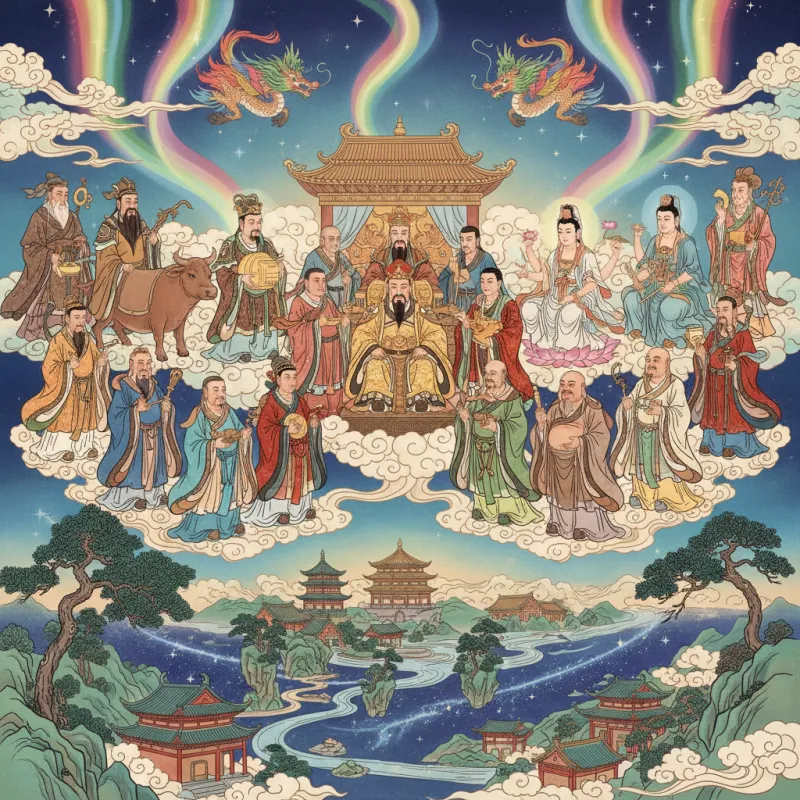
Picture this: a celestial bureaucrat stamps your afterlife paperwork while a peach-stealing monkey wreaks havoc in heaven, and somewhere in the mountains, an alchemist is three pills away from immortality. Welcome to the organized chaos of Chinese divinity, where gods punch time cards, immortals play politics, and the line between human and divine is surprisingly negotiable.
The Divine Bureaucracy Nobody Talks About
Here's what most introductions to Chinese deities get wrong: they treat the pantheon like a static museum exhibit. In reality, Chinese divinity operates more like a cosmic civil service exam. The Jade Emperor (玉皇大帝, Yùhuáng Dàdì) doesn't just rule heaven—he manages it, complete with departments, hierarchies, and performance reviews. This isn't metaphor. Ming dynasty texts like the Fengshen Yanyi (封神演义, "Investiture of the Gods") literally describe gods receiving official appointments, complete with titles and jurisdictions.
The bureaucratic model reflects something profound about Chinese cosmology: the universe runs on order, not chaos. When you pray to the Kitchen God (灶神, Zàoshén), you're not appealing to some abstract force—you're filing a report with middle management. He literally returns to heaven once a year to brief the Jade Emperor on your household's behavior. Smart families smear honey on his lips before he leaves, hoping he'll only say sweet things. It's divine lobbying.
This administrative approach to divinity emerged during the Song dynasty (960-1279 CE), when Daoist theologians systematized what had been a sprawling collection of local spirits and folk heroes. They created the Daozang (道藏, Daoist Canon), essentially a divine organizational chart spanning 1,120 volumes. Compare this to the Eight Immortals, who represent the opposite impulse—transcendent beings who explicitly rejected bureaucratic heaven for wine-soaked freedom.
The Three Pure Ones: Philosophy Made Flesh
At the apex of Daoist cosmology sit the Sanqing (三清, Three Pure Ones), and they're far stranger than most accounts suggest. These aren't gods in the Western sense—they're personified stages of cosmic unfolding. The Yuanshi Tianzun (元始天尊, Celestial Worthy of the Primordial Beginning) represents pure potentiality, the moment before the universe exhales into existence. The Lingbao Tianzun (灵宝天尊, Celestial Worthy of Numinous Treasure) embodies the Dao's first movement into form. The Daode Tianzun (道德天尊, Celestial Worthy of the Way and Virtue)—often identified with Laozi himself—represents the Dao as it manifests in the world.
What's fascinating is how this trinity mirrors the Daodejing's famous passage: "The Dao produces one, one produces two, two produces three, three produces the ten thousand things." The Three Pure Ones aren't just deities to worship—they're a cosmological diagram you can pray to. Tang dynasty Daoists would meditate on these figures as stages of internal alchemy, visualizing cosmic creation happening inside their own bodies.
This philosophical sophistication coexists with wonderfully concrete mythology. The Lingbao Tianzun supposedly resides in the Jade Capital (玉京, Yùjīng), a celestial city with streets paved in gold and palaces built from condensed starlight. Medieval Daoist texts describe its architecture in obsessive detail, down to the number of pillars in each hall. The divine, in Chinese tradition, is never too transcendent for interior design.
Buddhist Imports and Creative Syncretism
When Buddhism arrived in China during the Han dynasty (206 BCE - 220 CE), it didn't conquer—it negotiated. Guanyin (观音, Guānyīn), the Bodhisattva of Compassion, offers the perfect case study. Originally male in Indian Buddhism (Avalokiteśvara), Guanyin underwent a remarkable transformation in China, becoming predominantly female by the Song dynasty. Why? Chinese devotees needed a maternal divine figure, and Guanyin filled that role with such success that most Chinese Buddhists today would be shocked to learn of her original gender.
But here's the deeper syncretism: Guanyin absorbed characteristics from the Daoist Queen Mother of the West (西王母, Xīwángmǔ), an ancient goddess who predates organized Daoism itself. Both figures offer salvation, both are associated with islands (Guanyin's Putuo Mountain, the Queen Mother's Kunlun), and both represent feminine compassion in male-dominated religious hierarchies. By the Ming dynasty, popular religion had so thoroughly blended them that village temples often couldn't distinguish between the two.
The Buddha himself received similar treatment. Chinese texts refer to him as Fo (佛, Fó), but also as Rulai (如来, Rúlái, "Thus-Come-One"), a translation of Tathāgata that sounds suspiciously like a Daoist immortal's title. The Journey to the West (西游记, Xīyóujì), that 16th-century masterpiece, places Buddha firmly within the Daoist cosmic hierarchy—he's powerful enough to trap Sun Wukong under a mountain, but he still operates within the Jade Emperor's jurisdiction. It's theological fan fiction that became canonical.
The Immortals: Humanity's Upgrade Path
Chinese immortals (仙, xiān) represent something unique in world religion: divinity as achievement rather than essence. You're not born a god—you become one through cultivation, alchemy, meditation, and occasionally eating the right peach. The Eight Immortals embody this democratic approach to transcendence: a cripple, a drunk, a woman, a scholar, a soldier, a flute player, a hermit, and a royal uncle. Their diversity is the point—anyone can achieve immortality if they find the right path.
The technical categories matter here. Earthly Immortals (地仙, dìxiān) achieve longevity but remain bound to the physical world. Spirit Immortals (神仙, shénxiān) can transform and fly but haven't fully transcended. Celestial Immortals (天仙, tiānxiān) have completed the Great Work and dwell in heaven. This isn't just theology—it's a roadmap. Tang dynasty alchemists like Ge Hong wrote detailed manuals on progressing through these stages, complete with recipes for immortality elixirs (spoiler: the mercury-based ones didn't work).
The most famous immortal origin story belongs to Lü Dongbin (吕洞宾, Lǚ Dòngbīn), one of the Eight Immortals. According to legend, he met Zhongli Quan in a tavern and fell asleep while rice cooked. In his dream, he lived an entire lifetime—marriage, children, career success, devastating failure, death. When he woke, the rice wasn't done. Zhongli smiled and said, "You've seen through the illusion of worldly life." Lü abandoned his plans for the civil service exam and pursued immortality instead. It's a story about enlightenment, sure, but also about the opportunity cost of divine ambition.
Local Gods and the Deification Assembly Line
Here's where Chinese religion gets truly wild: the deification of historical figures. Guan Yu (关羽, Guān Yǔ), a general who died in 220 CE, gradually accumulated divine status over centuries. By the Ming dynasty, he was Guandi (关帝, Guāndì), the God of War and Righteousness, with temples across China. The Qing dynasty promoted him further, and today he's worshipped by everyone from soldiers to accountants to Triad members. His apotheosis wasn't instant revelation—it was a 1,500-year PR campaign.
This pattern repeats constantly. Mazu (妈祖, Māzǔ), the Goddess of the Sea, started as Lin Moniang, a Song dynasty woman from Fujian who supposedly saved her brothers from drowning through shamanic trance. After her death, sailors reported visions of her during storms. Local officials investigated, confirmed the miracles (seriously—there are bureaucratic records), and she received official divine titles. By the Yuan dynasty, she had a full celestial portfolio.
The mechanism reveals something crucial: Chinese divinity is participatory. Communities don't just worship gods—they create them through collective belief and official recognition. The Jade Emperor himself supposedly began as a human prince who achieved enlightenment. Even the highest heaven was once earth-bound. This isn't heresy; it's the system working as designed.
The Underworld's Surprising Complexity
Western audiences often miss how sophisticated Chinese afterlife bureaucracy gets. Yanluo Wang (阎罗王, Yánluó Wáng), the King of Hell, doesn't just punish—he processes. The Ten Courts of Hell each specialize in different sins, with judges, clerks, and detailed record-keeping. The Jade Record (玉历, Yùlì), a popular religious text, describes these courts with the precision of a government manual: Court Three handles unfilial children, Court Five deals with murderers, Court Eight processes those who caused suffering to animals.
But here's the twist: hell isn't eternal. It's rehabilitative. Souls serve their sentences, then reincarnate. The system even includes appeals processes and merit transfers—living relatives can perform good deeds to reduce a deceased person's sentence. It's karmic accounting with double-entry bookkeeping. The Buddhist concept of karma merged with Chinese administrative logic to create something neither tradition would recognize alone.
The City God (城隍, Chénghuáng) adds another layer. Every Chinese city has one—a deified official who governs the local dead the way earthly magistrates govern the living. They report to Yanluo Wang but handle day-to-day afterlife administration. When someone dies, the City God's ghostly constables escort them to judgment. It's a parallel bureaucracy, and medieval Chinese took it so seriously that new City God appointments (yes, they changed) required official ceremonies.
Living Practice: How Deities Shape Daily Life
Theory is one thing; practice is where Chinese religion gets messy and beautiful. Walk into any traditional Chinese home, and you'll find a complex devotional ecosystem. The Kitchen God watches from above the stove. Door gods (门神, ménshén) guard the entrance—often historical generals like Qin Shubao and Yuchi Gong, whose fierce painted faces scare away demons. Wealth gods receive offerings during New Year. Guanyin might have a small shrine in the bedroom. The Jade Emperor gets incense on his birthday.
This isn't polytheism in the Greek sense—it's practical spirituality. Different deities handle different problems, like calling different government departments. Sick child? Pray to the Medicine King (药王, Yàowáng). Business troubles? Consult Caishen (财神, Cáishén), the God of Wealth. Exam coming up? Burn incense to Wenchang Wang (文昌王, Wénchāng Wáng), the God of Literature. The system is transactional but not cynical—it reflects a worldview where divine and human realms interpenetrate constantly.
The Queen Mother of the West exemplifies this practical mysticism. Ancient texts describe her as a fearsome goddess with tiger teeth and a leopard tail, dwelling in the Kunlun Mountains and guarding the peaches of immortality. By the Han dynasty, she'd become a graceful queen hosting celestial banquets. Today, Taiwanese temples present her as a maternal figure who helps with marriage and childbirth. Same goddess, different needs, evolving mythology. Chinese religion adapts.
The Pantheon's Future
Chinese deities aren't museum pieces—they're living traditions adapting to modernity. Guan Yu now protects police officers and appears in video games. Guanyin has Instagram accounts (run by devotees, presumably). Young Chinese urbanites who'd never call themselves religious still avoid offending the Kitchen God. The forms change, but the underlying logic persists: the universe is populated by conscious forces that respond to human action, and the boundary between mundane and sacred is thinner than rationalism admits.
What makes Chinese divinity endlessly fascinating is its refusal to choose between philosophy and mythology, transcendence and bureaucracy, ancient tradition and contemporary relevance. The gods are real and metaphorical, distant and intimate, eternal and evolving. They're whatever Chinese people need them to be, which is perhaps the most Daoist thing about them—flowing like water, taking the shape of their container, never quite graspable but always present.
Related Reading
- Unveiling the Rich Tapestry of Chinese Deities and Immortals
- Discovering Nature Spirits in Chinese Mythology: Guardians of the Earth and Sky
- Unraveling the Mystique of Chinese War Gods in the Daoist and Buddhist Pantheon
- Lü Dongbin: The Sword Immortal