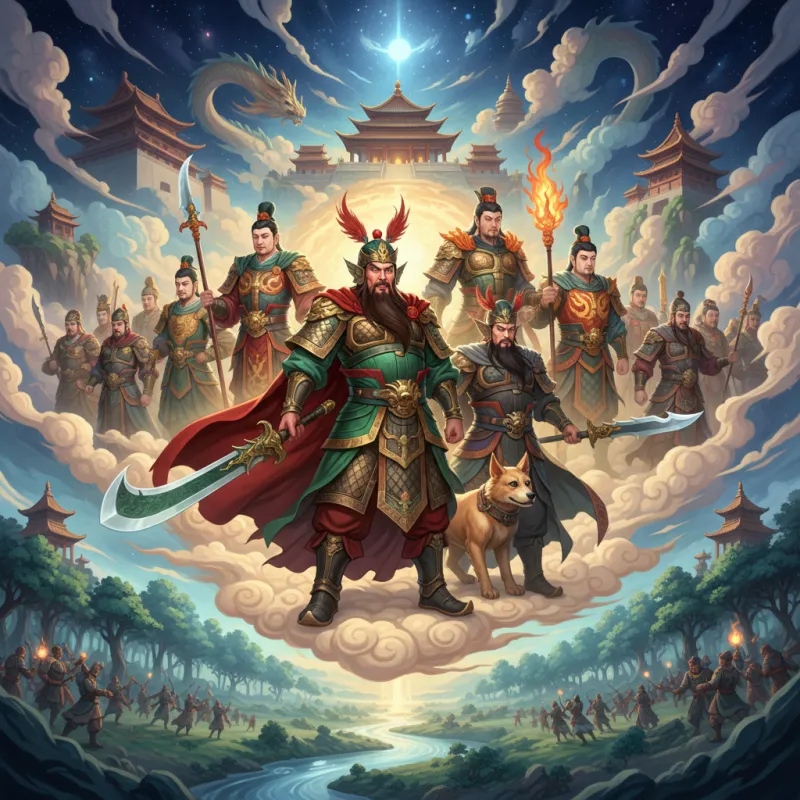
When Guan Yu's severed head supposedly opened its eyes and roared at his executioner in 219 CE, nobody could have predicted that this fallen general would become the most worshipped war deity in Chinese history—venerated equally in Daoist temples, Buddhist monasteries, and Confucian shrines. Yet this strange convergence reveals something fundamental about Chinese war gods: they're not merely divine warriors, but complex figures who embody the moral contradictions of violence itself.
The Paradox of the Righteous Warrior
Chinese war deities occupy a peculiar space in religious thought. Unlike the bloodthirsty war gods of other traditions, figures like Guan Yu (關羽, Guān Yǔ) and Nezha (哪吒, Nézhā) are celebrated not for their capacity for destruction, but for their restraint, loyalty, and adherence to cosmic order. This reflects a deeper philosophical tension: how can violence ever be righteous? The answer, according to both Daoist and Buddhist interpretations, lies in intention and context.
Guan Yu's transformation from historical general to divine protector illustrates this perfectly. The Romance of the Three Kingdoms immortalized his unwavering loyalty to Liu Bei, but it was his Buddhist canonization as Sangharama Bodhisattva (伽藍菩薩, Qiélán Púsà) that truly elevated him. Buddhist monks, theoretically committed to non-violence, found in Guan Yu a protector who wielded his Green Dragon Crescent Blade only in defense of the dharma. The Daoists, meanwhile, elevated him to the status of Saintly Emperor Guan (關聖帝君, Guān Shèng Dìjūn), a celestial administrator who punishes the wicked and rewards the virtuous.
The Celestial Military Hierarchy
The Daoist pantheon organizes its war deities with the same bureaucratic precision that characterized imperial China. At the apex sits the Jade Emperor (玉皇大帝, Yùhuáng Dàdì), who commands a vast celestial army through his marshals and generals. This isn't metaphorical—Daoist texts describe detailed military structures, complete with ranks, responsibilities, and chains of command.
Marshal Zhao (趙公明, Zhào Gōngmíng), for instance, serves as both a war deity and god of wealth, commanding legions of spirit soldiers while simultaneously managing cosmic finances. This dual role makes perfect sense in Chinese thought: military power and economic prosperity are inseparable. The Ming Dynasty novel Investiture of the Gods (封神演義, Fēngshén Yǎnyì) codifies these relationships, describing how deceased warriors and immortals receive their celestial appointments after death.
The Four Heavenly Kings (四大天王, Sì Dà Tiānwáng) represent Buddhism's contribution to this martial pantheon. Borrowed from Hindu tradition but thoroughly sinicized, these guardian deities protect the four cardinal directions. Each wields distinctive weapons—Vaishravana's umbrella, Dhritarashtra's pipa, Virudhaka's sword, and Virupaksha's pearl and serpent—that symbolize different aspects of Buddhist teaching. They're not conquerors but defenders, a crucial distinction that allows them to exist within a fundamentally pacifist religious framework.
Nezha: The Rebel Prince Who Became a Protector
If Guan Yu represents the ideal of mature, disciplined martial virtue, Nezha embodies its opposite: youthful rebellion channeled toward righteous ends. His mythology reads like a cautionary tale about uncontrolled power. Born after a three-year pregnancy, Nezha emerged as a fully-formed child who immediately began causing havoc—killing the Dragon King's son, stripping him of his scales, and using his tendons as a belt.
The story takes a darker turn when Nezha's father, the military commander Li Jing (李靖, Lǐ Jìng), demands he commit suicide to atone for his crimes. Nezha complies, cutting his flesh to return to his father and his bones to return to his mother—a scene that still disturbs readers of the Investiture of the Gods. His resurrection through lotus flowers, orchestrated by his master Taiyi Zhenren (太乙真人, Tàiyǐ Zhēnrén), transforms him from a destructive force into a protective deity who guards children and fights demons.
This narrative arc matters because it addresses a fundamental question about war deities: can violence be redeemed? Nezha's story suggests that destructive power, when properly directed and controlled, becomes protective power. His weapons—the Universe Ring, the Red Armillary Sash, and the Fire-tipped Spear—remain the same, but their purpose transforms entirely.
The Buddhist Appropriation of Martial Power
Buddhism's relationship with war gods reveals the religion's remarkable adaptability. Theoretically committed to ahimsa (non-violence), Chinese Buddhism nevertheless developed an extensive pantheon of wrathful protectors. The key theological innovation was the concept of "skillful means" (方便, fāngbiàn)—the idea that enlightened beings might employ seemingly violent methods to prevent greater suffering.
Weituo (韋馱, Wéituó), the bodhisattva guardian of Buddhist monasteries, exemplifies this principle. Depicted in full armor wielding a vajra staff, he protects the sangha from demons and thieves. Yet his violence is always defensive, never aggressive. The distinction might seem subtle, but it allowed Buddhist institutions to maintain armed guards and even, during certain periods, their own military forces, without contradicting core doctrinal commitments.
The wrathful manifestations of bodhisattvas like Mahakala (大黑天, Dàhēitiān) push this logic even further. These terrifying figures, adorned with skulls and trampling demons, represent compassion expressed through fierce means. They destroy not out of anger but out of love—eliminating obstacles to enlightenment with the same determination a surgeon removes a tumor.
War Gods in Popular Religion and Daily Life
The theological sophistication of elite religious texts tells only part of the story. In popular practice, war gods serve intensely practical functions. Guan Yu's image appears in police stations, triad headquarters, and business offices—sometimes in the same neighborhood. This promiscuous veneration would scandalize religious purists, but it reflects the pragmatic spirituality of ordinary Chinese people.
During the Qing Dynasty, soldiers would carry small statues of war deities into battle, believing these figures could deflect bullets and arrows. The Boxer Rebellion of 1900 took this to an extreme, with rebels claiming that martial arts training combined with spirit possession by war gods made them invulnerable to Western weapons. The tragic outcome demonstrated the limits of faith, but the underlying impulse—seeking divine protection in warfare—remains deeply embedded in Chinese culture.
Modern Taiwan preserves some of the most vibrant war god worship. The annual procession of Guan Yu's statue in Taipei draws hundreds of thousands of participants, while spirit mediums channel Nezha and other martial deities, offering advice on everything from business decisions to family disputes. These practices blur the line between religion and folk culture, creating a living tradition that academic categories struggle to capture.
The Enduring Appeal of Divine Warriors
Why do war gods remain relevant in contemporary Chinese societies, long after the imperial system that spawned them has collapsed? Part of the answer lies in their symbolic flexibility. Guan Yu represents loyalty in an age of corporate restructuring and political uncertainty. Nezha embodies youthful resistance against oppressive authority. These figures adapt to new contexts while maintaining their essential characteristics.
The philosophical depth of Chinese war deities also contributes to their longevity. Unlike simple personifications of violence, they embody complex moral reasoning about when force is justified, how power should be constrained, and what distinguishes protection from aggression. These questions remain urgently relevant in any society grappling with military power, police authority, and the ethics of violence.
The synthesis of Daoist, Buddhist, and folk elements in war god worship demonstrates Chinese religion's remarkable capacity for integration. Rather than demanding exclusive allegiance, these traditions layer upon each other, creating rich, multivalent symbols that speak to different aspects of human experience. A single deity like Guan Yu can simultaneously represent Confucian loyalty, Daoist cosmic order, Buddhist compassion, and popular aspirations for wealth and protection—without contradiction.
This theological flexibility reflects a pragmatic wisdom: the divine, like human nature itself, contains multitudes. War gods embody not just martial prowess but the full complexity of moral life in a world where violence sometimes seems necessary, yet always remains troubling. Their continued veneration suggests that Chinese culture has never fully resolved this tension—and perhaps never intended to.
Related Reading
- The Star Gods: Fu Lu Shou
- Unveiling the Rich Tapestry of Chinese Deities and Immortals
- Dragon Worship in China: The Most Powerful Animal Deity