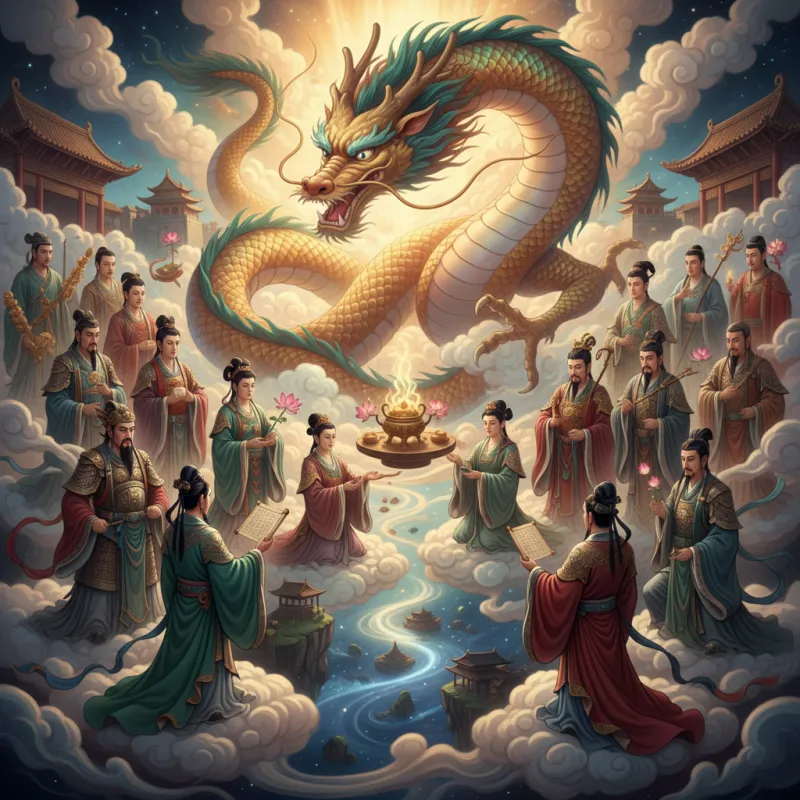
The Yellow River floods again. Entire villages vanish overnight. Crops drown in muddy torrents. Then, just as suddenly, the rains stop — and for three years, nothing falls from the sky. The wells run dry. The earth cracks. Children die of thirst. This is not mythology. This is Chinese history, repeating itself for millennia. And at the center of this existential terror sits a creature that Westerners consistently misunderstand: the dragon (龙 lóng), the most powerful animal deity in the Chinese pantheon, controller of rain, rivers, and the very survival of civilization.
The Dragon Is Not Your Enemy
Let's be clear from the start: if you grew up on European fairy tales, everything you think you know about dragons is wrong. The Western dragon is a villain — a fire-breathing hoarder of gold that kidnaps princesses and gets a sword through the heart for its trouble. The Chinese dragon is the exact opposite. It doesn't breathe fire; it commands water. It doesn't steal treasure; it is the treasure, the living embodiment of imperial authority. And nobody, absolutely nobody, tries to kill one. That would be like trying to kill the rain itself.
The difference isn't just aesthetic. It reflects two fundamentally different relationships with nature. European dragons represent chaos that must be conquered. Chinese dragons represent natural forces that must be negotiated with, respected, and — when you're desperate — bribed with elaborate offerings. Because in an agricultural society where survival depends on seasonal rains arriving exactly on schedule, the dragon isn't your enemy. It's your only hope.
The Four Dragon Kings and Their Bureaucratic Empire
Chinese cosmology doesn't do simple. The dragon isn't just one deity — it's an entire administrative hierarchy, because of course the Chinese would turn even their water gods into bureaucrats. At the top sit the Four Dragon Kings (四海龙王 Sìhǎi Lóngwáng), each governing one of the cardinal seas:
Ao Guang (敖广) rules the East Sea and serves as the de facto leader, the most frequently mentioned in literature. He's the one who gets bullied by the Monkey King in Journey to the West and whose palace gets ransacked by Nezha in Investiture of the Gods. Despite being supposedly all-powerful, Ao Guang spends a suspicious amount of time getting humiliated by upstart deities and rebellious children.
Ao Qin (敖钦) governs the South Sea, Ao Run (敖闰) the West, and Ao Shun (敖顺) the North. Each maintains an underwater crystal palace staffed by shrimp soldiers and crab generals (虾兵蟹将 xiābīng xièjiàng) — a phrase that has entered Chinese idiom to mean "incompetent underlings," which tells you something about how seriously people took this aquatic military.
Below the Dragon Kings exists a vast hierarchy of lesser dragons, each responsible for specific rivers, lakes, wells, and even individual springs. The Soushen Ji (搜神记), a 4th-century collection of supernatural tales, catalogs dozens of local dragon deities, each with their own temple, festival day, and preferred offerings. This wasn't abstract theology. This was practical religion. If your village well ran dry, you knew exactly which dragon had failed you.
The Dragon and the Emperor: A Dangerous Partnership
The dragon's association with imperial power runs so deep that the two became virtually inseparable. The emperor sat on the Dragon Throne (龙椅 lóng yǐ), wore Dragon Robes (龙袍 lóng páo) embroidered with five-clawed dragons — a design forbidden to anyone else on pain of death — and was sometimes referred to as the "True Dragon Son of Heaven" (真龙天子 zhēnlóng tiānzǐ).
This wasn't just flattering symbolism. It was a political claim with teeth. By identifying himself with the dragon, the emperor claimed control over the cosmic forces that determined whether the harvest succeeded or failed. When the rains came on time, it proved the emperor had Heaven's mandate. When drought struck, it suggested he'd lost it — and peasant rebellions often began with accusations that the emperor had offended the dragons.
The Qing Dynasty took this so seriously that they maintained an official Bureau of Dragon Worship, responsible for conducting state sacrifices at dragon temples during droughts. The Kangxi Emperor personally composed prayers to the Dragon Kings, which were read aloud at temples while officials prostrated themselves before dragon statues. This wasn't superstition. This was crisis management. When millions faced starvation, you tried everything — including begging the dragons for mercy.
Dragons in Literature: From Cosmic Force to Comic Relief
Chinese literature's treatment of dragons reveals a fascinating evolution. In early texts like the Shanhaijing (山海经, Classic of Mountains and Seas), dragons are remote, powerful, and terrifying — more force of nature than character. But by the Ming Dynasty, when novels like Journey to the West and Investiture of the Gods were written, dragons had become almost comically bureaucratic.
Ao Guang, the East Sea Dragon King, appears in Journey to the West as a pompous official who gets his palace looted by Sun Wukong, the Monkey King. The scene is played for laughs — this supposedly all-powerful deity reduced to filing complaints with the Jade Emperor like a middle manager reporting theft to HR. Later, when the monk Xuanzang's disciples need rain, they don't petition the dragons respectfully; they threaten to beat them up if they don't comply.
This shift reflects changing attitudes toward authority itself. The early imperial period treated dragons with genuine awe. By the late imperial era, after centuries of corrupt officials and failed dynasties, even the cosmic bureaucracy looked suspect. The dragons became symbols of an establishment that talked big but couldn't actually deliver — much like the Jade Emperor, who supposedly ruled heaven but spent most of his time being manipulated by cleverer gods.
The Dragon Boat Festival: Tragedy Turned Celebration
The Dragon Boat Festival (端午节 Duānwǔ Jié), celebrated on the fifth day of the fifth lunar month, reveals the dragon's connection to both water and death. The festival commemorates Qu Yuan (屈原), a 3rd-century BCE poet and official who drowned himself in the Miluo River after his state fell to invaders. Legend says locals raced out in boats, beating drums to scare away fish and water dragons that might eat his body, while throwing rice dumplings (粽子 zòngzi) into the water as offerings.
The dragon boat races that continue today — with their long, narrow boats carved with dragon heads and tails — aren't just sport. They're ritual reenactments of that desperate rescue attempt, and simultaneously offerings to the water dragons themselves. The boats must be "awakened" each year through a ceremony where a Daoist priest paints eyes on the dragon head, bringing it to life. Without this ritual, the boat is just wood. With it, it becomes a vessel capable of negotiating with the dragons that control the water.
The festival's timing is significant. The fifth month is when summer rains begin in southern China, when rivers swell and flooding threatens. It's also when disease spreads most rapidly in the heat. The Dragon Boat Festival marks the moment when human communities must negotiate with water's dual nature — life-giving and deadly — embodied in the dragon itself.
Dragon Worship Today: Temples, Tourists, and Belief
Walk into any traditional Chinese temple complex, and you'll find dragons everywhere. They coil around pillars, writhe across ceiling beams, guard doorways, and decorate incense burners. But are people actually worshiping them, or are dragons just decorative motifs, cultural heritage stripped of religious meaning?
The answer is both, and it varies wildly by region and individual. In coastal areas and farming communities dependent on rainfall, dragon temples still receive genuine worship. The Longwang Temple (龙王庙) in Beijing's Miyun District sees crowds during drought years, with farmers bringing offerings of fruit, incense, and paper money. In 2022, during a particularly severe dry spell, local officials quietly organized a traditional rain-summoning ceremony — officially labeled a "cultural heritage demonstration" to avoid accusations of promoting superstition, but functionally identical to rituals performed for centuries.
Meanwhile, dragon imagery has been thoroughly commercialized. Dragon dances at New Year are tourist attractions. Dragon boat races are international sporting events. The dragon appears on everything from corporate logos to Olympic ceremonies, stripped of religious context and transformed into a symbol of generic "Chinese culture."
Yet the old beliefs persist in unexpected ways. Feng shui practitioners still identify "dragon veins" (龙脉 lóngmài) — underground channels of cosmic energy that dragons supposedly travel through — when selecting building sites. The 2008 Beijing Olympics opening ceremony featured a massive dragon performance, but also included subtle ritual elements: the specific colors used, the direction of movement, the number of performers. These weren't random aesthetic choices. They were calculated to invoke auspicious dragon symbolism, a modern state ceremony incorporating ancient religious logic.
The Dragon's Enduring Power
The Chinese dragon survives because it represents something deeper than mythology. It embodies the fundamental relationship between human civilization and the natural forces that sustain or destroy it. In a country where floods and droughts have toppled dynasties and killed millions, the dragon isn't a fairy tale monster. It's a way of conceptualizing the terrifying power of water itself — unpredictable, essential, and utterly beyond human control.
Western environmentalism talks about "conquering" nature or "saving" it, as if humans stand outside the natural world. The dragon represents a different philosophy: humans exist within nature's power structures, and survival depends on maintaining proper relationships with forces greater than ourselves. You don't defeat the dragon. You don't even fully understand it. You offer respect, perform the correct rituals, and hope it looks favorably on your village this year.
That worldview hasn't disappeared. It's simply adapted. Climate change discussions in China increasingly invoke dragon imagery — not as superstition, but as cultural shorthand for humanity's relationship with water systems we've disrupted but cannot control. The dragon remains what it has always been: a reminder that some forces are too vast to fight, too essential to ignore, and too dangerous to disrespect. Whether you call it a deity, a symbol, or a metaphor, the dragon still rules the waters. And we still need the rain.
Related Reading
- Animal Deities in Chinese Religion: When Foxes, Snakes, and Turtles Become Gods
- The Dragon Kings: Rulers of Rain and Sea
- Sun Wukong as a Real Deity: Temples and Worship of the Monkey God
- Xuanwu: The Turtle-Snake God of the North
- Buddhist Deities in Chinese Culture: How India's Gods Became Chinese
- Unveiling the Rich Tapestry of Chinese Deities and Immortals
- Exploring Chinese Deities and Immortals: Traditions of the Daoist and Buddhist Pantheon