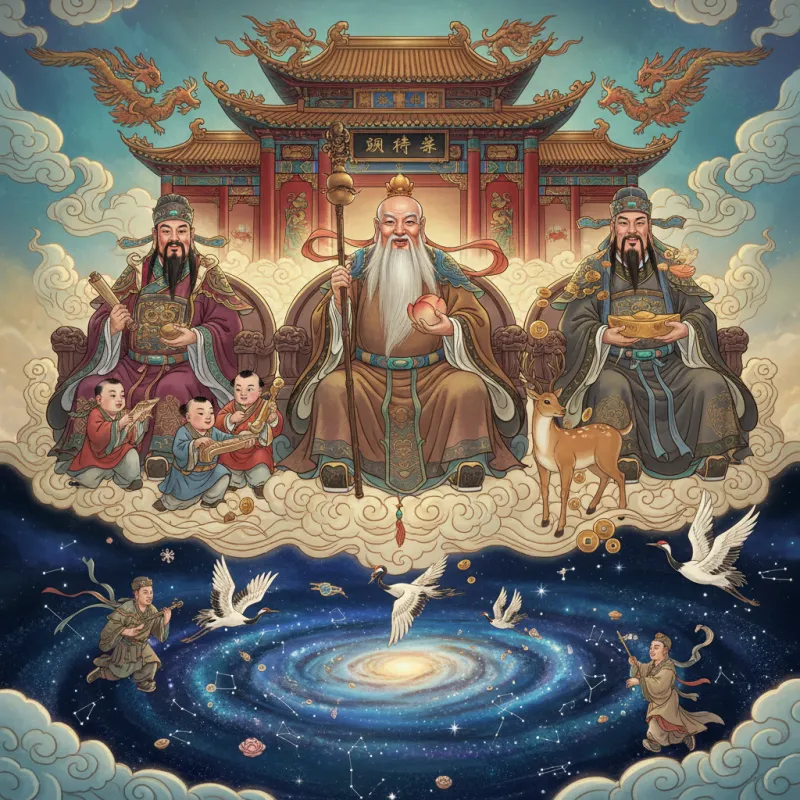
Three elderly men stand together in countless Chinese homes, restaurants, and temples—one holding a child, another a scroll, the third cradling a peach. To the uninitiated, they might seem like generic symbols of good wishes. But these are the San Xing (三星), the Three Star Gods, and their presence in Chinese culture runs deeper than almost any other divine figures. Fu Lu Shou (福祿壽)—Fortune, Status, and Longevity—aren't just deities you pray to. They're the distilled essence of what it means to live a good life in the Chinese worldview.
The Celestial Origins of the Three Stars
The San Xing didn't start as gods at all. They began as actual stars—specifically, three stellar mansions in traditional Chinese astronomy. Fu corresponded to Jupiter, Lu to Ursa Major's Mizar, and Shou to Canopus in the southern sky. During the Han Dynasty (206 BCE - 220 CE), astronomers observed these stars and associated them with earthly fortunes. When Jupiter appeared bright, harvests flourished. When the Lu star shone prominently, officials received promotions. The Shou star's visibility correlated with peaceful, prosperous times when people lived longer.
This astronomical foundation matters because it reveals something crucial: these weren't abstract concepts imposed by priests or philosophers. They emerged from centuries of sky-watching, pattern-recognition, and the very human desire to find meaning in celestial movements. By the Tang Dynasty (618-907 CE), these stellar associations had crystallized into anthropomorphic deities, complete with backstories, iconography, and dedicated worship practices.
Fu: The God Who Brings Fortune Home
Fu (福), the God of Fortune, typically appears as a dignified official in embroidered robes, often holding a child or a scroll inscribed with the character for fortune. His most common origin story identifies him as Yang Cheng, a magistrate from the Western Han period who governed Daozhou (in modern Hunan province). The Emperor demanded an annual tribute of dwarf entertainers from this region, causing immense suffering to families. Yang Cheng submitted a memorial protesting this cruel practice, risking his career and life. The Emperor, moved by his courage, abolished the tribute.
This historical anchor—whether factual or legendary—gives Fu a moral dimension often overlooked in simplified explanations. He's not just about getting rich. He represents fortune earned through righteousness, the prosperity that comes when leaders prioritize people over power. In folk practice, Fu is invoked not merely for wealth but for household harmony, protection from calamity, and the kind of good luck that allows families to thrive together.
The visual symbolism reinforces this. When Fu holds a child, he's blessing fertility and family continuity. When he carries a scroll, he's bringing official recognition and social stability. During Chinese New Year, his image appears on door gods and hanging scrolls, often accompanied by bats (蝠, fú)—a visual pun since the character sounds identical to fortune.
Lu: Status, Salary, and the Scholar-Official Dream
Lu (祿) represents official salary, status, and career success—the rewards of the imperial examination system that dominated Chinese society for over a millennium. He's usually depicted wearing the robes of a high-ranking official, sometimes holding a ruyi scepter or standing beside a deer (鹿, lù, another homophone). His most popular origin identifies him as Shi Fen, a historical figure from the Three Kingdoms period, though some traditions associate him with the stellar deity Wenchangdijun, the God of Literature and Examinations.
What makes Lu fascinating is how he embodies a specifically Chinese conception of success. In Western traditions, fortune and status often merge into generalized "success." But Chinese culture historically distinguished between wealth (having money) and lu (having position). A merchant might be rich but lack lu—the social prestige, political influence, and cultural capital that came with official rank. Conversely, a scholar-official might have modest personal wealth but tremendous lu.
This distinction shaped Chinese society for centuries. Families invested everything in educating sons for the imperial examinations, not primarily for wealth but for the transformative power of official status. Lu worship reflects this reality. Merchants and farmers prayed to Lu not because they wanted to become officials themselves, but because having an official in the family elevated everyone's standing, opened doors, and provided protection in a bureaucratic society.
The deer symbolism adds another layer. Beyond the phonetic connection, deer in Chinese culture represent grace, longevity, and the ability to find the sacred lingzhi mushroom—itself a symbol of immortality. Lu thus connects worldly achievement with spiritual cultivation, suggesting that true status comes from both external recognition and internal refinement.
Shou: The Ancient One Who Defies Death
Shou (壽), the God of Longevity, is the most visually distinctive of the three. He appears as an elderly man with an impossibly elongated forehead, flowing white beard, and a staff made from gnarled wood. He carries a peach—not just any peach, but one from the legendary garden of Xiwangmu, the Queen Mother of the West, which ripens once every three thousand years and grants immortality to those who eat it.
Unlike Fu and Lu, Shou has no clear historical prototype. He's pure mythology, often identified with the stellar deity Nanji Xianweng (南極仙翁), the Old Man of the South Pole. His exaggerated features—that dome-like forehead especially—mark him as fundamentally other, a being who has transcended normal human limitations. In Daoist internal alchemy traditions, the elongated forehead represents the expansion of the upper dantian, the energy center associated with spiritual consciousness and immortality.
Shou's iconography is rich with longevity symbols: the peach, the crane (which lives a thousand years), the tortoise (ten thousand years), the pine tree (evergreen and enduring), and the lingzhi mushroom. He often appears riding a deer or crane, emphasizing his connection to the natural world and its cycles of renewal. During birthday celebrations, especially for elders, Shou takes center stage, his image adorning everything from scrolls to cakes.
What's particularly interesting is how Shou represents not just long life but quality of life. He's always depicted as vigorous, mobile, and mentally sharp despite his age. This reflects the Chinese ideal of longevity: not merely surviving but thriving, maintaining vitality and engagement with the world. The goal isn't to become a decrepit centenarian but to be like Shou—ancient yet energetic, wise yet playful.
The Trinity in Practice: How Chinese Families Worship the San Xing
Walk into almost any traditional Chinese home, restaurant, or business, and you'll likely find the San Xing displayed together. They're usually arranged with Fu in the center (sometimes on the right), Lu to his left, and Shou on the right, though arrangements vary by region and tradition. This grouping isn't arbitrary—it represents the complete life well-lived: prosperity to meet material needs, status to contribute meaningfully to society, and longevity to enjoy the fruits of both.
The San Xing receive offerings during major festivals, especially Chinese New Year, the Lantern Festival, and birthday celebrations. Typical offerings include fruit (especially peaches and oranges), tea, rice wine, and incense. Unlike some deities who demand elaborate rituals, the Star Gods are remarkably accessible. You don't need a priest or special training—just sincere respect and the desire for their blessings.
What's particularly telling is how the San Xing have adapted to modern contexts. In contemporary China, Taiwan, Hong Kong, and diaspora communities, they appear in updated forms: on smartphone wallpapers, in animated films, as cute cartoon characters. Their core symbolism remains relevant because the desires they represent—security, achievement, health—are universal and timeless. A tech entrepreneur in Shenzhen praying to Lu for a successful IPO isn't so different from a Tang Dynasty scholar hoping to pass the imperial examinations.
Beyond Superstition: The Philosophy of Fu Lu Shou
Dismissing the San Xing as mere superstition misses their deeper philosophical significance. Together, they articulate a comprehensive vision of human flourishing that balances material and spiritual, individual and communal, present and future. Fu ensures you have enough—not excessive wealth, but sufficient resources for stability and generosity. Lu gives your life meaning through contribution and recognition. Shou provides the time to enjoy both while cultivating wisdom.
This trinity also implies a sequence and interdependence. You need Fu (basic prosperity) before you can pursue Lu (meaningful achievement). And both become hollow without Shou (the health and time to appreciate them). The San Xing thus function as a check against imbalance—the workaholic who sacrifices health for status, the miser who hoards wealth without enjoying life, the hedonist who pursues pleasure without building anything lasting.
In Daoist terms, the San Xing represent the harmonization of heaven, earth, and humanity. They're not asking you to transcend the world but to engage with it skillfully, to navigate the complexities of social existence while maintaining spiritual awareness. They're remarkably practical deities for a remarkably practical culture—one that never saw a contradiction between spiritual cultivation and worldly success, between honoring the gods and building a good life here and now.
Related Reading
- The Heavenly Court: China's Divine Bureaucracy
- The Dragon Kings of the Four Seas
- Unveiling the Rich Tapestry of Chinese Deities and Immortals
- How to Pray at a Chinese Temple: A Respectful Visitor's Guide
- Exploring the Rich Pantheon of Chinese Deities and Immortals in Daoism and Buddhism