Setting Up a Chinese Home Altar: A Practical Guide
The practice of maintaining a home altar—known as 神壇 (shéntán) or 佛堂 (fótáng)—represents one of the most enduring traditions in Chinese spiritual life. Whether you're honoring ancestors, venerating deities, or creating a space for daily devotion, a properly arranged altar serves as a sacred bridge between the earthly and divine realms. This guide will walk you through the essential elements, placement principles, and ritual considerations for establishing your own Chinese home altar.
Understanding Altar Types and Purposes
Before setting up your altar, it's crucial to understand what type of sacred space you're creating. Chinese home altars generally fall into three categories, each with distinct purposes and requirements.
The 祖先壇 (zǔxiān tán), or ancestral altar, focuses on honoring deceased family members. These altars maintain the vital connection between living descendants and their forebears, embodying the Confucian principle of 孝 (xiào, filial piety). Ancestral tablets bearing the names and dates of the deceased occupy the central position, and offerings typically include favorite foods of the departed and fresh tea.
The 神壇 (shéntán), or deity altar, serves as a devotional space for gods, immortals, and bodhisattvas. Families might venerate 觀音菩薩 (Guānyīn Púsà, the Bodhisattva of Compassion), 關公 (Guān Gōng, the deified general Guan Yu), or household protectors like 灶神 (Zàoshén, the Kitchen God). These altars focus on seeking blessings, protection, and spiritual guidance.
The 綜合壇 (zōnghé tán), or combined altar, integrates both ancestral veneration and deity worship. This arrangement follows the traditional hierarchy where deities occupy the upper level and ancestral tablets rest below, reflecting the cosmic order where gods rank above human spirits.
Choosing the Right Location
The placement of your altar carries profound significance in Chinese geomancy, or 風水 (fēngshuǐ). The location you select will influence the flow of 氣 (qì, vital energy) and determine the efficacy of your spiritual practice.
The ideal altar location faces the main entrance of your home, allowing deities to observe and protect all who enter. However, the altar should never directly face the front door, as this creates a confrontational energy flow. Instead, position it at an angle or on a perpendicular wall. The eastern or southeastern areas of your home are particularly auspicious, as these directions align with the rising sun and the 木 (mù, wood) element, symbolizing growth and vitality.
Avoid placing altars in bedrooms, bathrooms, or kitchens (unless specifically for the Kitchen God). These spaces carry energies incompatible with sacred practice—bedrooms involve intimate activities, bathrooms represent impurity, and kitchens (paradoxically) generate too much chaotic fire energy for most deities. The living room, dining room, or a dedicated prayer room offers the most appropriate setting.
Height matters significantly. Deity statues and images should sit at or above eye level when you're standing, demonstrating proper respect. Ancestral tablets typically rest slightly lower than deity images when both share an altar. Never place an altar where people will walk over it on an upper floor, and ensure nothing hangs directly above the sacred space.
Essential Altar Components
A properly appointed Chinese altar requires several key elements, each serving specific ritual and symbolic functions.
The Altar Table
The 供桌 (gòngzhuō), or offering table, forms the foundation of your sacred space. Traditional altar tables feature red or dark wood construction with carved motifs of dragons, phoenixes, or auspicious clouds. The table should be sturdy, clean, and used exclusively for religious purposes. A simple wooden table works perfectly well—what matters most is maintaining its sanctity through dedicated use.
Many practitioners cover the altar table with a red cloth embroidered with gold thread, as red symbolizes good fortune and gold represents the divine. The cloth should be kept immaculately clean and replaced when it shows wear.
Deity Images and Statues
The 神像 (shénxiàng), whether painted, printed, or sculpted, serves as the focal point for devotion. When selecting deity representations, choose images that resonate with your spiritual needs. 觀音菩薩 (Guānyīn Púsà) offers compassion and mercy, 財神 (Cáishén, the God of Wealth) brings prosperity, and 媽祖 (Māzǔ) protects travelers and seafarers.
Statues should face outward toward the room, never toward walls. If you venerate multiple deities, arrange them according to hierarchy: the highest-ranking deity occupies the center, with others flanking symmetrically. For example, if you honor both Guanyin and Guan Gong, Guanyin (as a bodhisattva) would take the central position.
Incense Burner
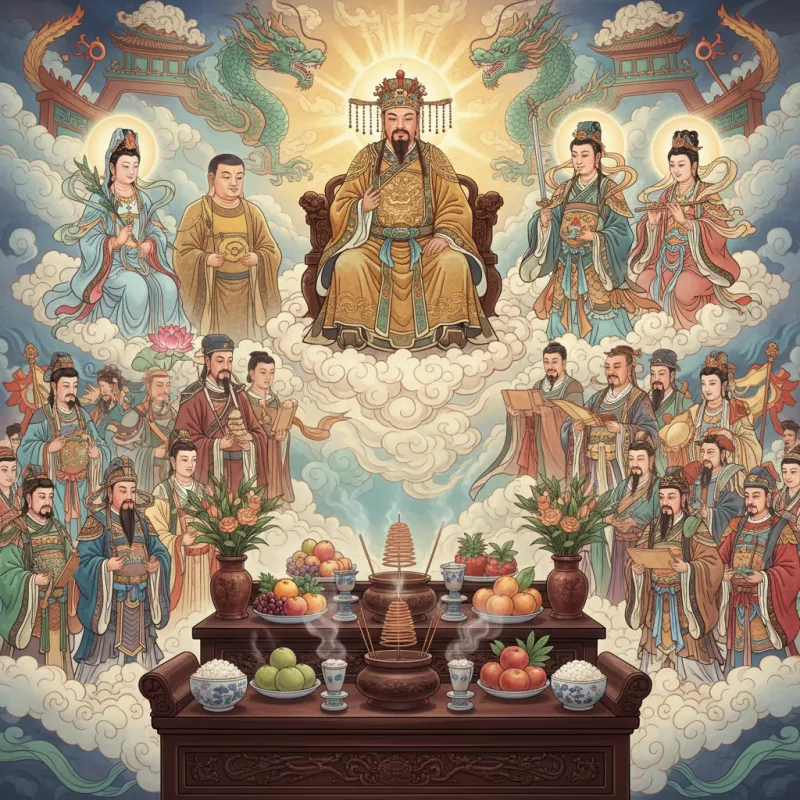
The 香爐 (xiānglú), or incense burner, represents the primary medium for communicating with the divine. Incense smoke carries prayers heavenward and purifies the sacred space. Traditional burners contain sand or rice to hold incense sticks upright. Bronze, ceramic, or porcelain burners work well, with designs featuring dragons, lions, or the 八卦 (bāguà, eight trigrams).
Place the incense burner directly in front of the central deity image. Some altars feature three burners: one for deities, one for ancestors, and one for local spirits or the 土地公 (Tǔdì Gōng, Earth God).
Candle Holders
A pair of 燭台 (zhútái), or candlesticks, should flank the incense burner symmetrically. Red candles are standard, though white candles suit ancestral altars. The candles represent illumination—both literal light and spiritual enlightenment. In modern practice, electric candles offer a safe alternative, though traditional practitioners prefer real flames for their transformative energy.
Offering Vessels
供杯 (gòngbēi), or offering cups, hold water, tea, or rice wine for the deities. A set of three cups is traditional, arranged in a row before the incense burner. Fresh water or tea should be offered daily, replaced each morning as a sign of continuous devotion.
供盤 (gòngpán), or offering plates, hold fruit, sweets, and other food offerings. Five types of fresh fruit—apples, oranges, pears, bananas, and grapes—represent the five elements and make an auspicious offering. Avoid pears when making offerings to couples or partnerships, as the word for pear (梨, lí) sounds like separation (離, lí).
Additional Elements
花瓶 (huāpíng), or flower vases, hold fresh flowers as offerings of beauty and impermanence. Lotus flowers, chrysanthemums, and orchids are particularly appropriate. Change the water regularly and remove wilted blooms promptly.
經書 (jīngshū), or sacred texts, might include Buddhist sutras, Daoist scriptures, or Confucian classics, depending on your tradition. These rest on a separate small table or stand to the side of the main altar.
木魚 (mùyú), a wooden fish-shaped percussion instrument, and 引磬 (yǐnqìng), a small bell, assist in chanting and meditation practices.
Arrangement and Hierarchy
The spatial arrangement of altar elements follows strict hierarchical principles rooted in Chinese cosmology and social order.
The vertical axis represents the hierarchy of beings. Deities and bodhisattvas occupy the highest position, followed by enlightened masters and immortals, then ancestors, and finally local spirits and protectors. If your altar includes multiple levels, place supreme deities on the top tier, ancestors on the middle tier, and earth spirits on the lowest level.
The horizontal axis follows the principle of 左尊右卑 (zuǒ zūn yòu bēi)—left is superior, right is inferior (from the deity's perspective, which is your right as you face the altar). When arranging multiple deities of similar rank, place the most important on the left side. For example, if venerating both 玉皇大帝 (Yùhuáng Dàdì, the Jade Emperor) and 王母娘娘 (Wángmǔ Niángniáng, the Queen Mother of the West), the Jade Emperor would sit on the left.
Symmetry creates harmony and balance. Offering vessels, candlesticks, and flower vases should be arranged in balanced pairs or groups. The incense burner, as the central communication tool, occupies the exact center of the altar.
Consecration and Activation
Once assembled, your altar requires consecration through the ritual of 開光 (kāiguāng), literally "opening the light." This ceremony invites divine presence into the images and activates the altar's spiritual function.
For a simple home consecration, choose an auspicious day according to the Chinese almanac (通書, tōngshū). Clean the altar thoroughly, then light incense and candles. Offer fresh fruit, tea, and flowers. Recite prayers or mantras appropriate to your tradition—for Buddhist altars, the 心經 (Xīnjīng, Heart Sutra) works well; for Daoist altars, the 淨心神咒 (Jìngxīn Shénzhòu, Pure Heart Spirit Mantra) is appropriate.
Invite the deity to reside in the image by stating your sincere intention three times. Some practitioners gently touch the eyes of the statue with a new brush dipped in cinnabar ink, symbolically "opening" the deity's vision. Conclude by bowing three times and expressing gratitude.
For more elaborate consecrations, especially for major deities, consider inviting a priest or monk to perform the ceremony. They possess the ritual knowledge and spiritual authority to properly invoke divine presence.
Daily Practices and Maintenance
An altar requires regular attention to maintain its sanctity and efficacy. Daily practices vary by tradition and personal devotion, but certain elements remain consistent.
Each morning, offer fresh water or tea in the offering cups. Light incense—one or three sticks—and recite a brief prayer or mantra. Bow three times to show respect. This simple ritual takes only a few minutes but maintains the vital connection between you and the divine.
Replace fruit offerings every few days before they spoil. Wilted flowers should be removed immediately. Keep the altar surface dust-free and the incense burner clean of ash buildup. Never place mundane objects on the altar or use it as storage space.
On the first and fifteenth days of each lunar month—the 初一 (chūyī) and 十五 (shíwǔ)—offer more elaborate devotions. These days carry special spiritual significance, and deities are believed to be particularly attentive to prayers. Prepare vegetarian dishes, fresh fruit, and sweet offerings. Spend extra time in prayer, meditation, or sutra recitation.
Major festivals require special observances. During 春節 (Chūnjié, Lunar New Year), offer abundant food and burn 金紙 (jīnzhǐ, spirit money). On 清明節 (Qīngmíng Jié, Tomb Sweeping Day), focus on ancestral offerings. The 中元節 (Zhōngyuán Jié, Ghost Festival) on the fifteenth day of the seventh lunar month requires offerings for wandering spirits.
Common Mistakes to Avoid
Several common errors can diminish your altar's spiritual efficacy or show disrespect to the divine.
Never point your feet toward the altar when sitting or lying down. Avoid placing the altar where it might be viewed from a toilet or where people's backs will face it regularly. Don't eat meat or engage in arguments near the altar space.
Resist the temptation to over-decorate. While beauty honors the divine, cluttered altars create chaotic energy. Maintain simplicity and cleanliness over elaborate ornamentation.
Don't mix incompatible deities without understanding their relationships. Some deities have historical or mythological conflicts. Research before combining multiple figures on one altar.
Never allow the incense burner to overflow with ash, candles to burn down completely, or offerings to rot. These signs of neglect suggest disrespect and can attract negative energies rather than blessings.
Adapting to Modern Life
Contemporary practitioners often face space constraints and lifestyle challenges that make traditional altar keeping difficult. Fortunately, sincere devotion matters more than perfect adherence to every traditional rule.
A small shelf or corner table can serve as an altar in apartments. A single deity image with one incense burner and offering cup constitutes a complete, functional altar. Electric candles and incense eliminate fire hazards in buildings with strict regulations.
For those who travel frequently, a portable altar consisting of a small deity card, a travel incense holder, and a compact offering cup allows you to maintain practice anywhere. Some practitioners create digital altars on tablets, though traditional teachers debate their efficacy.
The key is maintaining regular practice with sincere intention. A simple altar tended with devotion surpasses an elaborate setup neglected through busyness or indifference.
Conclusion
Setting up a Chinese home altar creates a sacred space that connects you with millennia of spiritual tradition. Whether you're honoring ancestors, seeking divine guidance, or cultivating inner peace, your altar serves as a tangible reminder of the invisible forces that shape our lives. By following these guidelines while adapting them to your circumstances, you establish a practice that enriches daily life with meaning, reverence, and spiritual depth. Remember that the altar's true power lies not in perfect arrangement but in the sincerity of your devotion and the consistency of your practice.