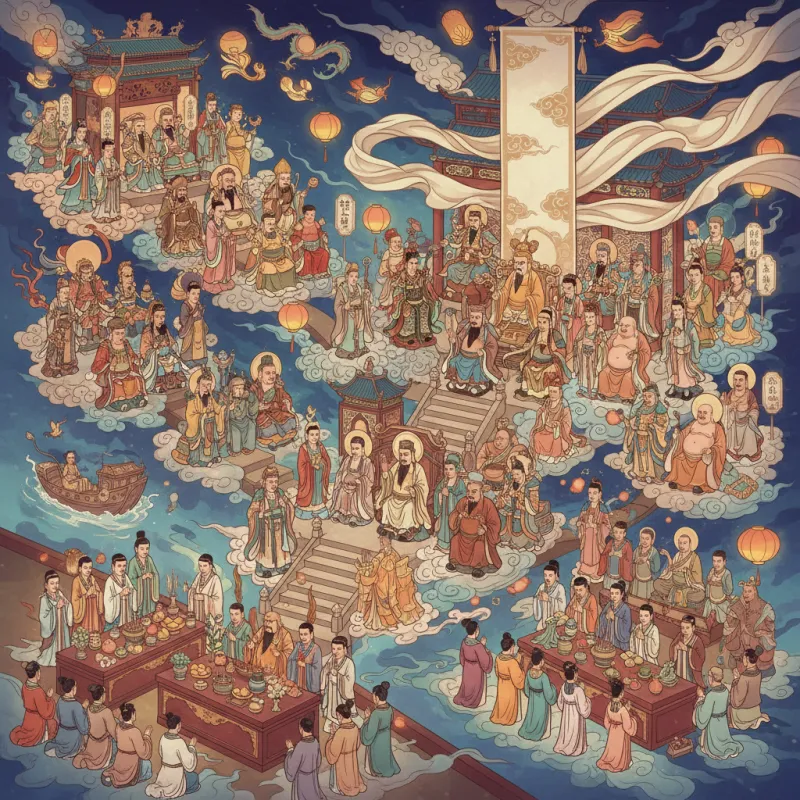
The temple keeper checks his phone, scrolls past the Gregorian date, and taps open a different calendar app — one that shows it's the 15th day of the third lunar month, the birthday of Xuanwu, the Dark Warrior of the North. He lights incense, arranges offerings of vegetarian dishes, and joins a dozen other worshippers who somehow knew to show up today. No Facebook event, no reminder notification. They just knew. This is how the Chinese religious calendar (农历 nónglì) works: a parallel temporal system where time is measured not in productivity metrics but in divine appointments, where every date carries spiritual weight, and where forgetting which god's birthday falls on which day is like forgetting your own mother's.
The Calendar as Divine Appointment Book
Western calendars mark holidays as exceptions — special days interrupting the normal flow of secular time. The Chinese religious calendar inverts this logic entirely. The default state is religious significance. Nearly every day belongs to someone: a deity's birthday, an ancestor's death anniversary, a cosmological transition point, or a period when certain spiritual activities become especially potent or dangerous. The calendar doesn't schedule breaks from ordinary life for religious observance; it schedules religious observances as ordinary life.
This system emerged from a worldview where the boundary between human and divine realms was permeable and required constant maintenance. You don't worship once a week and call it done. You maintain relationships with multiple deities across the year, showing up for their birthdays, observing their taboos, and requesting their assistance during their periods of heightened influence. Miss too many appointments, and you're not just being rude — you're leaving gaps in your spiritual infrastructure, like skipping oil changes until your engine seizes.
First Month: The Cosmic Reset
The first lunar month (正月 Zhēngyuè) functions as a spiritual New Year's resolution period, except the resolutions are mandatory and enforced by cosmic law. The 1st day — Chinese New Year or Spring Festival (春节 Chūn Jié) — initiates a comprehensive reset of household spiritual defenses. Families replace their door gods (门神 ménshén), those fierce guardian deities whose images protect entrances, because even divine protection degrades over time and needs renewal. Every altar receives fresh incense. Every deity statue gets dusted. The Kitchen God (灶神 Zàoshén), who spent the previous week reporting your family's behavior to the Jade Emperor, returns from heaven and needs to be welcomed back with sweet offerings — a spiritual bribe to ensure his next report is favorable.
The 9th day marks the birthday of the Jade Emperor (玉皇大帝 Yùhuáng Dàdì) himself, the supreme deity of the Daoist pantheon. Temples overflow with worshippers bearing elaborate offerings: whole roasted pigs, towers of fruit, expensive incense. This is the divine CEO's birthday, and everyone wants face time. The 15th day — Lantern Festival (元宵节 Yuánxiāo Jié) — closes the New Year period with a final burst of celebration, lanterns symbolizing the return of light and yang energy after winter's darkness.
Second and Third Months: Earth and Compassion
The second lunar month brings the birthday of Tudi Gong (土地公 Tǔdì Gōng), the local earth god, on the 2nd day. Every neighborhood has one, and unlike the distant Jade Emperor, Tudi Gong handles the mundane: business success, property disputes, finding lost items. His worship is practical, transactional, and intensely local. Offerings are modest — fruit, tea, sometimes a shot of baijiu — because Tudi Gong is essentially your spiritual neighborhood association president, not a cosmic bureaucrat.
The third month's major event falls on the 23rd: the birthday of Mazu (妈祖 Māzǔ), the sea goddess. Coastal communities explode with processions, boat parades, and offerings of seafood. Mazu's cult demonstrates how the calendar adapts to geography and occupation. Fishermen and sailors track her birthday with the same attention farmers give to agricultural deities. Miss Mazu's day, and you're sailing without insurance. The calendar isn't universal — it's personalized based on which gods govern your livelihood and location.
Fourth Through Sixth Months: The Buddha's Shadow
The fourth month's 8th day commemorates the Buddha's birthday (佛诞 Fó Dàn), a reminder that the Chinese religious calendar absorbed Buddhist observances without erasing Daoist ones. Temples offer bathing-the-Buddha ceremonies, where devotees pour scented water over small Buddha statues, a ritual cleansing that somehow also cleanses the participant. The calendar is syncretic by design, treating Buddhist and Daoist deities as different departments in the same cosmic bureaucracy.
The fifth month brings the Dragon Boat Festival (端午节 Duānwǔ Jié) on the 5th day, ostensibly commemorating the poet Qu Yuan's suicide but functioning as a broader exorcism ritual. Households hang mugwort and calamus over doors to repel evil spirits. The calendar marks this period as spiritually dangerous — a time when yang energy peaks and yin forces push back, creating cosmic friction that manifests as disease, bad luck, and malevolent spirits. The festival's activities aren't celebrations; they're defensive measures.
The sixth month's 19th day honors Guanyin (观音 Guānyīn), the Bodhisattva of Compassion, on one of her three annual birthday observances. Yes, three birthdays — because Guanyin's mythology includes her birth, enlightenment, and attainment of Bodhisattva status, each commemorated separately. This multiplication of observances reflects how popular deities accumulate more calendar real estate over time, their worship expanding to fill available dates.
Seventh Month: The Gates Open
The entire seventh month operates under different rules. The 15th day marks Ghost Festival (中元节 Zhōngyuán Jié), but the spiritual danger begins on the 1st, when the gates of the underworld open and hungry ghosts (饿鬼 èguǐ) flood into the mortal realm. For thirty days, the living must feed wandering spirits through roadside offerings, burn ghost money, and avoid activities that might attract unwanted attention: swimming, whistling at night, hanging clothes outside after dark. The calendar doesn't just mark this period — it restructures daily behavior around it.
This month reveals the calendar's function as a spiritual early warning system. Knowing that the seventh month is cosmically unstable allows communities to prepare, to take precautions, to avoid scheduling weddings or business launches during a period when spiritual interference is statistically likely. The calendar isn't superstition; it's risk management based on a different model of causality.
Eighth Through Twelfth Months: Harvest and Closure
The eighth month's 15th day — Mid-Autumn Festival (中秋节 Zhōngqiū Jié) — celebrates the harvest moon with mooncakes and family reunions, but also marks a transition point where yin energy begins overtaking yang. The ninth month's 9th day, Double Ninth Festival (重阳节 Chóngyáng Jié), involves climbing mountains to avoid misfortune, a practice rooted in the belief that ascending to high places during this cosmologically charged date provides protection.
The twelfth month focuses on year-end spiritual accounting. The 23rd or 24th day sends the Kitchen God back to heaven to file his annual report on your household's behavior. Families offer him sticky candy, hoping to literally gum up his mouth so he can't report their misdeeds clearly — a delightfully pragmatic approach to divine bureaucracy. The final days involve cleaning, settling debts, and preparing for the cycle to begin again.
Living by Divine Time
The Chinese religious calendar's genius lies in its distribution of spiritual labor across the entire year. Rather than concentrating religious observance into weekly services or annual holidays, it spreads divine interaction across 365 days, creating a continuous rhythm of worship, offering, and observance. This prevents spiritual neglect through sheer frequency — you can't forget about the gods when their birthdays arrive monthly.
Modern practitioners often use apps that overlay the lunar calendar onto Gregorian dates, sending notifications for upcoming deity birthdays and auspicious days. The technology changes, but the underlying logic persists: time is not neutral, dates carry power, and maintaining relationships with the divine requires showing up consistently, not just when you need something. The calendar is less a schedule than a relationship maintenance system, ensuring that the connections between human and divine realms stay active, reciprocal, and mutually beneficial.
For those interested in the practical aspects of worship, see Offering Etiquette: What to Bring to the Temple for guidance on appropriate gifts for different deities. Understanding The Hierarchy of Chinese Deities also helps clarify which gods require more elaborate observances and which accept simpler offerings. The calendar provides the when; these resources provide the how.
Related Reading
- A Practical Guide to Visiting Chinese Temples: What to Do and What Not to Do
- How to Pray at a Chinese Temple: A Practical Guide
- Setting Up a Chinese Home Altar: A Practical Guide
- How to Pray at a Chinese Temple: A Respectful Visitor's Guide
- He Xiangu: The Only Female Among the Eight
- Discovering Nature Spirits in Chinese Mythology: Guardians of the Earth and Sky
- Dragon Worship in China: The Most Powerful Animal Deity