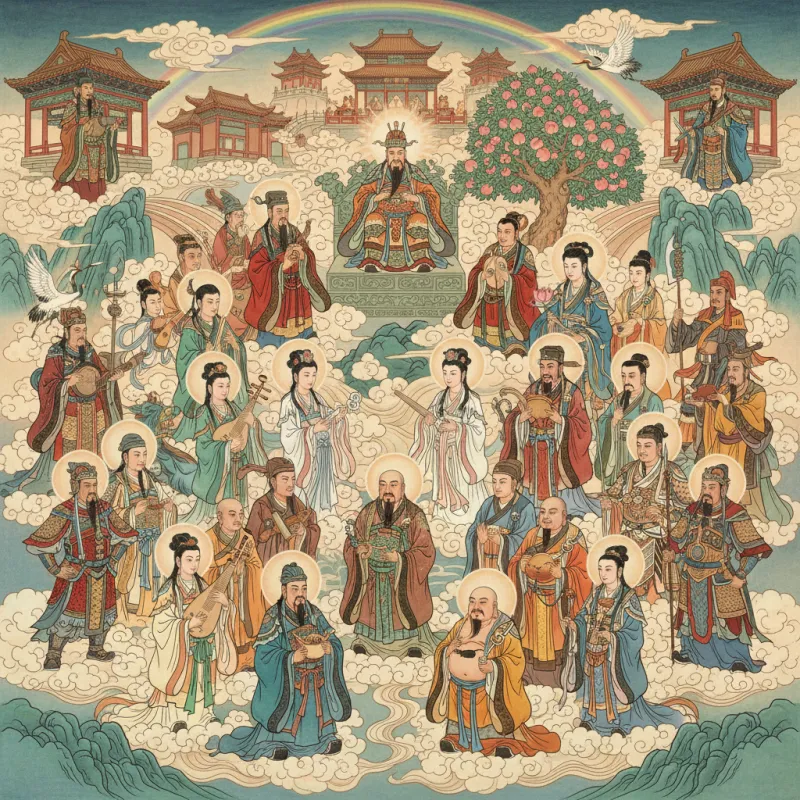
Picture this: a celestial bureaucrat stamps your reincarnation papers while a peach-stealing monkey wreaks havoc three heavens above, and somewhere in between, an immortal alchemist is trying to perfect a pill that grants eternal life. Welcome to the organized chaos of Chinese divine hierarchy, where gods clock in for work, immortals achieve their status through rigorous cultivation, and the line between myth and religious practice blurs into something far more interesting than Western audiences typically imagine.
The Bureaucracy of Heaven: Why Chinese Gods Have Job Descriptions
Here's what catches most people off guard: Chinese deities operate within a structured bureaucratic system that mirrors earthly government. The Jade Emperor (玉皇大帝, Yùhuáng Dàdì) doesn't just rule—he administers. He has departments, subordinates, and yes, paperwork. This isn't poetic metaphor; it's how millions of practitioners actually conceptualize the divine realm.
This bureaucratic model emerged during the Tang Dynasty (618-907 CE) when Daoism formalized its pantheon to compete with Buddhism's growing influence. The result? A celestial civil service where gods have specific portfolios. The City God (城隍, Chénghuáng) manages local affairs and judges the dead. The Kitchen God (灶君, Zàojūn) reports annually to the Jade Emperor about household behavior—which is why families traditionally smear honey on his image before the New Year, hoping to sweeten his report.
This practical approach to divinity reveals something profound about Chinese religious thought: the divine realm isn't separate from human concerns but rather an elevated extension of them. Gods aren't incomprehensible cosmic forces; they're powerful administrators you can petition, bribe with offerings, or even criticize when they fail to deliver.
Immortals vs. Gods: The Crucial Distinction Nobody Explains
Most English sources conflate Chinese "gods" and "immortals," but practitioners know better. Gods (神, shén) are born divine or appointed to their positions. Immortals (仙, xiān) are humans who achieved transcendence through cultivation practices—meditation, alchemy, martial arts, or moral perfection.
The Eight Immortals (八仙, Bāxiān) exemplify this distinction. Lü Dongbin (吕洞宾) was a Tang Dynasty scholar who failed the imperial examinations, met a Daoist master, and spent decades mastering internal alchemy. He wasn't born special; he worked for it. This matters because it means immortality is theoretically achievable, not predetermined. It's the ultimate self-improvement project.
The cultivation path appears throughout Chinese literature, most famously in Journey to the West (西游记, Xīyóu Jì), where Sun Wukong (孙悟空) the Monkey King achieves immortality multiple times through different methods—eating peaches of immortality, drinking heavenly wine, consuming immortality pills. His redundant immortality becomes a running joke, but it illustrates the various paths available: external alchemy (consuming substances), internal alchemy (cultivating qi), and spiritual merit.
The Three Pure Ones: Daoism's Philosophical Trinity
At the apex of Daoist cosmology sit the Three Pure Ones (三清, Sānqīng), beings so abstract they make the Jade Emperor look like middle management. The Celestial Worthy of Primordial Beginning (元始天尊, Yuánshǐ Tiānzūn), the Celestial Worthy of Numinous Treasure (灵宝天尊, Língbǎo Tiānzūn), and the Celestial Worthy of the Way and its Virtue (道德天尊, Dàodé Tiānzūn)—often identified with Laozi himself—represent the Dao's manifestation at different cosmic stages.
These aren't gods you petition for a promotion or good harvest. They're philosophical principles given form, representing the Dao before creation, during creation, and as transmitted to humanity. Most temples don't even feature them prominently because they're too transcendent for practical worship. This reveals Daoism's dual nature: a philosophical system concerned with ultimate reality and a practical religion addressing everyday needs. The Three Pure Ones satisfy the former; the City God handles the latter.
Buddhist Bodhisattvas: When Compassion Becomes Divine
Buddhism introduced a different model entirely. Bodhisattvas (菩萨, Púsà) are beings who achieved enlightenment but postponed nirvana to help others—think of them as cosmic social workers. Guanyin (观音, Guānyīn), the Bodhisattva of Compassion, became so popular in China that she underwent a gender transformation, shifting from the male Indian Avalokiteśvara to a female figure that resonated with Chinese devotional needs.
This wasn't theological confusion but cultural adaptation. Chinese practitioners needed a maternal divine figure, and Guanyin filled that role perfectly. She appears in thirty-three forms, responds to desperate prayers, and saves people from disasters. Her temples outnumber almost any other deity's, and her image appears everywhere from taxi dashboards to restaurant altars.
The localization of Buddhist figures demonstrates Chinese religion's pragmatic flexibility. Dizang (地藏, Dìzàng), or Ksitigarbha, vowed not to achieve Buddhahood until all hells are empty—a promise that resonates with Confucian filial piety since he's particularly associated with saving deceased parents from underworld suffering. These aren't foreign imports awkwardly grafted onto Chinese culture; they're fully integrated into the religious ecosystem, often syncretized with existing Daoist and folk deities.
The Underworld's Ten Courts: Death as Bureaucratic Process
If heaven is a bureaucracy, the Chinese underworld is its judicial branch. Yanluo Wang (阎罗王, Yánluó Wáng), derived from the Buddhist Yama, presides over ten courts where the dead face judgment for specific sins. The first court handles those who died prematurely, the second judges those who drowned or were murdered, and so on through increasingly specific infractions.
This system appears in the Jade Record (玉历宝钞, Yùlì Bǎochāo), a text that circulated widely during the Qing Dynasty (1644-1912) and terrified readers with detailed descriptions of punishments. Liars get their tongues pulled out. Corrupt officials are sawn in half. It's graphic, specific, and designed to enforce moral behavior through fear—though practitioners could mitigate punishments through merit accumulated during life or through descendants' offerings and prayers.
What's fascinating is how this underworld bureaucracy mirrors earthly legal systems, complete with appeals processes and sentence reductions for good behavior. The Chinese underworld isn't eternal damnation but temporary punishment followed by reincarnation—a cosmic rehabilitation program rather than permanent hell.
Folk Deities: Where Religion Meets Daily Life
Academic discussions of Chinese religion often focus on philosophical Daoism or monastic Buddhism, but most practitioners interact primarily with folk deities—figures who emerged from local legends, historical persons, or practical needs. Mazu (妈祖, Māzǔ), the goddess of the sea, began as Lin Moniang, a Song Dynasty woman from Fujian who reportedly saved her brothers from drowning through shamanic powers. After her death, sailors reported visions of her protecting ships, and her cult spread throughout coastal China and beyond.
These folk deities blur the line between history and mythology. Guan Yu (关羽, Guān Yǔ), the Three Kingdoms general, became Guan Di (关帝, Guān Dì), god of war, loyalty, and—surprisingly—wealth. His temples serve as both religious sites and business networking venues. He's simultaneously a historical figure you can read about in Romance of the Three Kingdoms and a deity who receives daily offerings from shop owners hoping for prosperity.
The Kitchen God mentioned earlier exemplifies how folk religion operates. Every household has one, he reports annually on family behavior, and his image is replaced each year. This isn't abstract theology but practical household management with divine oversight. It's religion as lived experience rather than doctrinal system.
The Immortal Hierarchy: Levels of Transcendence
Not all immortals are equal. Daoist texts describe multiple grades of immortality, from Ghost Immortals (鬼仙, Guǐxiān)—the lowest level, barely better than being dead—to Celestial Immortals (天仙, Tiānxiān) who dwell in heaven and possess vast powers. This hierarchy reflects the cultivation path's complexity and the idea that transcendence comes in degrees.
The Baopuzi (抱朴子), written by Ge Hong in the 4th century CE, details these levels and the practices required to achieve them. Earth Immortals (地仙, Dìxiān) live in mountains and forests, having achieved longevity but not full transcendence. Spirit Immortals (神仙, Shénxiān) can transform their bodies and travel vast distances instantly. Each level requires increasingly refined cultivation practices and moral perfection.
This graduated system makes immortality feel achievable rather than impossibly distant. You might not become a Celestial Immortal, but perhaps you could reach Earth Immortal status through dedicated practice. It's the spiritual equivalent of career advancement—ambitious but theoretically possible with enough effort and the right techniques.
Living Tradition: Why These Deities Still Matter
Here's what academic treatments often miss: these aren't museum pieces or quaint folklore. Millions of people across China, Taiwan, Southeast Asia, and Chinese diaspora communities actively worship these deities, make offerings, consult spirit mediums, and organize festivals. The Jade Emperor's birthday celebration on the ninth day of the first lunar month draws massive crowds to temples. Guanyin's three annual festivals fill pilgrimage sites with devotees.
This living tradition adapts continuously. Modern practitioners might light virtual incense through smartphone apps or watch temple ceremonies via livestream, but the underlying framework remains recognizable. The bureaucratic heaven, the cultivation path to immortality, the syncretism of Buddhist and Daoist figures—these concepts still structure how millions of people understand the divine realm and their relationship to it.
Understanding Chinese deities and immortals isn't just about mythology or religious studies. It's about recognizing a sophisticated system that addresses human needs for meaning, moral guidance, practical assistance, and transcendent possibility. These figures aren't relics of the past but active participants in an ongoing religious tradition that continues to evolve while maintaining its essential character—a celestial bureaucracy where gods work, humans can become immortals, and the divine realm remains intimately connected to earthly concerns.
Related Reading
- Unveiling the Rich Tapestry of Chinese Deities and Immortals
- Dizang Bodhisattva: The Buddha Who Chose Hell
- How to Pray at a Chinese Temple: A Respectful Visitor's Guide
- Sacred Mountain Pilgrimage: The Chinese Tradition of Climbing to Heaven