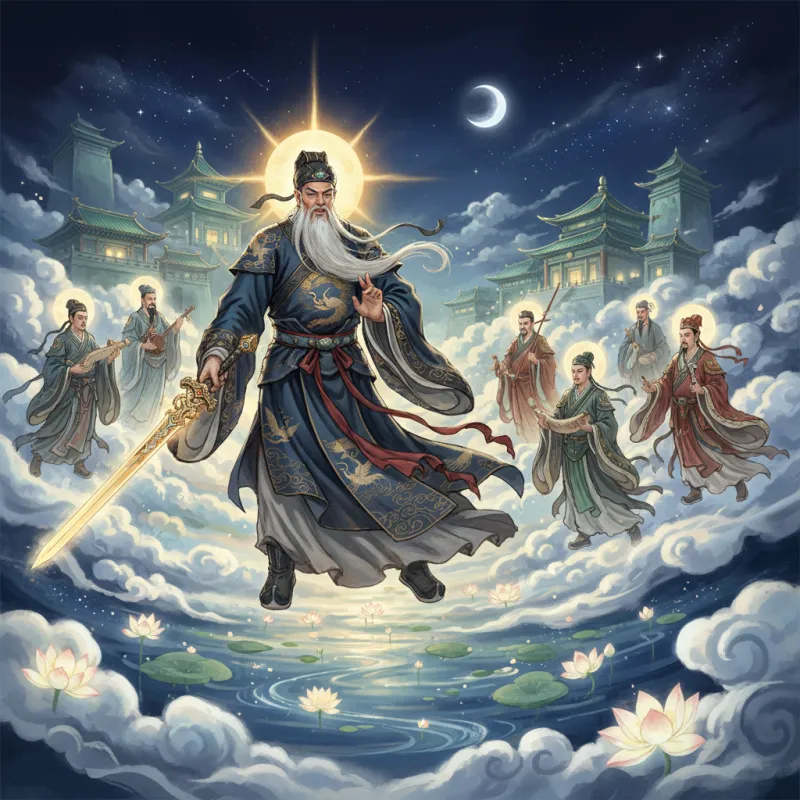
A scholar sits in a wine shop, watching the world pass by, when an old man offers him a pillow. He falls asleep and dreams an entire lifetime—glory, wealth, power, and eventual ruin—only to wake moments later, his wine still warm. This is the famous "Yellow Millet Dream" (黄粱梦, Huángliáng Mèng), and the dreamer is Lü Dongbin (吕洞宾, Lǚ Dòngbīn), who would become the most beloved of the Eight Immortals and earn the title "Sword Immortal" (剑仙, Jiànxiān). That single dream changed everything—he abandoned his pursuit of worldly success and devoted himself to the Dao, eventually achieving immortality and becoming one of Chinese culture's most enduring spiritual heroes.
The Man Behind the Legend
Unlike many immortals whose origins blur into pure mythology, Lü Dongbin has a surprisingly concrete historical footprint. Most sources place him in the late Tang Dynasty (618-907 CE), born in 798 CE in Yongle County, Shanxi Province. His given name was Lü Yan (吕岩), and "Dongbin" was his courtesy name. He came from a respectable family—his grandfather served as a county magistrate—and he himself was educated in the Confucian classics, preparing for the imperial examinations like any ambitious young scholar of his time.
But here's where it gets interesting: Lü Dongbin reportedly failed the imperial examinations multiple times. Some accounts say he passed at age 64, others that he never passed at all. Either way, this failure became the crack through which immortality entered. The examination system was brutal, and countless brilliant men spent their entire lives chasing official positions that never materialized. Lü Dongbin's story resonated precisely because it offered an alternative path—if the mortal world won't recognize your worth, transcend it entirely.
The pivotal moment came when he encountered Zhongli Quan (钟离权, Zhōnglí Quán), another of the Eight Immortals and Lü's eventual teacher. The Yellow Millet Dream was Zhongli Quan's teaching device, a compressed lifetime showing Lü the ultimate emptiness of worldly ambition. When Lü woke, he understood immediately and begged Zhongli Quan to accept him as a disciple. This wasn't just a career change—it was a complete ontological shift.
The Sword That Cuts Through Illusion
Lü Dongbin's signature weapon is his demon-slaying sword (斩妖剑, Zhǎnyāo Jiàn), but calling it merely a weapon misses the point entirely. In Daoist internal alchemy (内丹, Nèidān), the sword represents wisdom that cuts through delusion, desire, and the false self. When Lü Dongbin wields his blade against demons, he's not just fighting external monsters—he's battling the inner demons of greed, anger, and ignorance that prevent spiritual liberation.
The sword has a name: "Pure Yang" (纯阳, Chúnyáng), which also became one of Lü Dongbin's titles—Lü Chunyang. In Daoist cosmology, pure yang represents the refined, spiritual essence freed from the contamination of earthly yin. His sword doesn't just kill; it purifies and transforms. Stories describe him using it to subdue dragons, dispel evil spirits, and protect the innocent, but the deeper reading is always about spiritual cultivation.
What makes Lü Dongbin's martial prowess particularly fascinating is how it coexists with his scholarly nature. He's not a warrior who learned philosophy; he's a philosopher who mastered the sword. This combination—intellectual depth plus martial skill—became a template for the Chinese ideal of the complete person. You see this archetype everywhere in Chinese culture, from the scholar-generals of the Three Kingdoms to the warrior-monks of Shaolin, but Lü Dongbin might be its purest expression.
The Ten Trials and the Path to Immortality
Zhongli Quan didn't make things easy for his new student. According to legend, Lü Dongbin had to pass ten trials before achieving immortality, each designed to test his detachment from worldly concerns. These weren't physical challenges but psychological and moral tests that probed the depths of his character.
In one trial, his entire family suddenly died. In another, he was falsely accused of a crime. He was offered immense wealth, then had it stolen. A beautiful woman tried to seduce him. Someone he helped turned around and betrayed him. Each trial targeted a different attachment—to family, reputation, wealth, desire, gratitude. The point wasn't to make Lü Dongbin cold or unfeeling, but to ensure his equanimity couldn't be shaken by fortune's reversals.
What's remarkable is that these trials feel utterly contemporary. Strip away the Tang Dynasty setting, and you have a psychological profile of human vulnerability that still applies. We still struggle with the same attachments, the same ego wounds, the same inability to maintain perspective when life goes sideways. Lü Dongbin's trials aren't ancient history—they're a mirror.
After passing all ten trials, Lü Dongbin received the secrets of immortality from Zhongli Quan, including techniques of internal alchemy that would transform his mortal body into an immortal one. But immortality in the Daoist sense isn't just about living forever—it's about achieving a state of being that transcends the cycle of birth and death entirely.
The Wandering Immortal and His Earthly Missions
Here's what sets Lü Dongbin apart from many other immortals: he didn't ascend to heaven and stay there. Instead, he chose to remain in the human world, wandering in disguise, helping people, and spreading Daoist teachings. This makes him what's called a "hidden immortal" (隐仙, Yǐnxiān)—someone who has achieved transcendence but continues to move among mortals.
The stories of his earthly adventures are countless. He appears as a beggar, a drunk, a merchant, a scholar—always testing people's character and rewarding genuine virtue while exposing hypocrisy. In one famous tale, he visits a wine shop and drinks without paying, then reveals his identity and transforms the shop owner's water into wine as payment. In another, he helps a poor student pass the examinations, but only after the student demonstrates true humility and compassion.
This wandering aspect connects Lü Dongbin to a broader tradition of "crazy wisdom" figures in Chinese religion—beings who have transcended conventional morality and social norms, and whose seemingly bizarre behavior contains profound teachings. He's often depicted as slightly drunk, disheveled, and irreverent, more like a Zen master than a dignified sage. This accessibility is part of his enduring appeal—he's an immortal you could actually imagine meeting.
His relationship with He Xiangu, the only female member of the Eight Immortals, adds another dimension to his character. Some stories suggest romantic tension, others depict them as spiritual siblings. Either way, their interactions show Lü Dongbin as someone who has transcended desire without becoming inhuman—he appreciates beauty and companionship without being enslaved by them.
Lü Dongbin in Religious Practice and Popular Culture
Walk into almost any Daoist temple in China, Taiwan, Hong Kong, or overseas Chinese communities, and you'll likely find an altar to Lü Dongbin. He's not just a mythological figure—he's an active object of worship and devotion. Practitioners seek his aid for everything from spiritual cultivation to passing examinations to healing illnesses. His birthday, celebrated on the 14th day of the fourth lunar month, draws crowds of devotees.
The Quanzhen School (全真教, Quánzhēn Jiào) of Daoism, founded in the 12th century, claims Lü Dongbin as one of its patriarchs, placing him in a direct lineage of transmission from Laozi himself. This isn't just honorary—Quanzhen texts attribute specific teachings and practices to Lü Dongbin, particularly regarding internal alchemy and meditation techniques. The school's emphasis on integrating Confucian ethics, Buddhist meditation, and Daoist cultivation reflects Lü Dongbin's own synthetic approach.
In popular culture, Lü Dongbin appears everywhere. He's a character in countless novels, operas, films, and television series. The classic novel "Journey to the East" (东游记, Dōngyóu Jì) features him prominently, as do various adaptations of Eight Immortals stories. Modern fantasy novels and video games regularly include him as a powerful sword-wielding sage. His image—scholarly robes, long beard, sword on his back, often carrying a fly-whisk (拂尘, Fúchén)—is instantly recognizable.
What's fascinating is how adaptable his character proves to be. In some versions, he's a stern moral teacher. In others, he's a mischievous trickster. Some emphasize his martial prowess, others his scholarly wisdom, still others his alchemical knowledge. This flexibility allows each generation to find the Lü Dongbin they need—the version that speaks to their particular concerns and aspirations.
The Sword Immortal's Enduring Wisdom
So what can a Tang Dynasty immortal possibly teach us today? More than you might think. Lü Dongbin's core message—that worldly success is ultimately hollow, that true fulfillment comes from inner cultivation, that wisdom requires transcending ego—remains radically countercultural in our achievement-obsessed age. His Yellow Millet Dream is basically a warning against Instagram culture 1,200 years early.
But there's something deeper here too. Lü Dongbin represents the possibility of transformation at any point in life. He didn't start as a spiritual prodigy—he was a failed examination candidate, probably bitter and disappointed, who encountered the right teacher at the right moment and completely reinvented himself. That's a hopeful message: it's never too late, you're never too far gone, the path is always available.
His sword reminds us that spiritual cultivation isn't passive or purely internal. It requires cutting away—actively severing attachments, confronting demons (inner and outer), defending what matters. The Daoist path isn't about floating away on clouds; it's about engaging with reality from a place of clarity and power. Lü Dongbin achieved immortality not by escaping the world but by mastering it so completely that it no longer had power over him.
The Sword Immortal still wanders among us, according to believers. Maybe he's the stranger who offers unexpected wisdom, the teacher who appears when the student is ready, the moment of clarity that cuts through years of confusion. Whether you take that literally or metaphorically, the principle holds: transformation is always possible, wisdom is always available, and sometimes the greatest power comes from letting go of power entirely. That's the legacy of Lü Dongbin, and it's as sharp as ever.
Related Reading
- Exploring the Enigmatic World of Chinese Immortals and Deities
- He Xiangu: The Only Female Among the Eight
- The Eight Immortals: A Complete Guide
- Buddha in China: How Buddhism Was Transformed by Chinese Culture
- A Practical Guide to Visiting Chinese Temples: What to Do and What Not to Do
- Exploring the Rich Pantheon of Chinese Deities and Immortals in Daoism and Buddhism