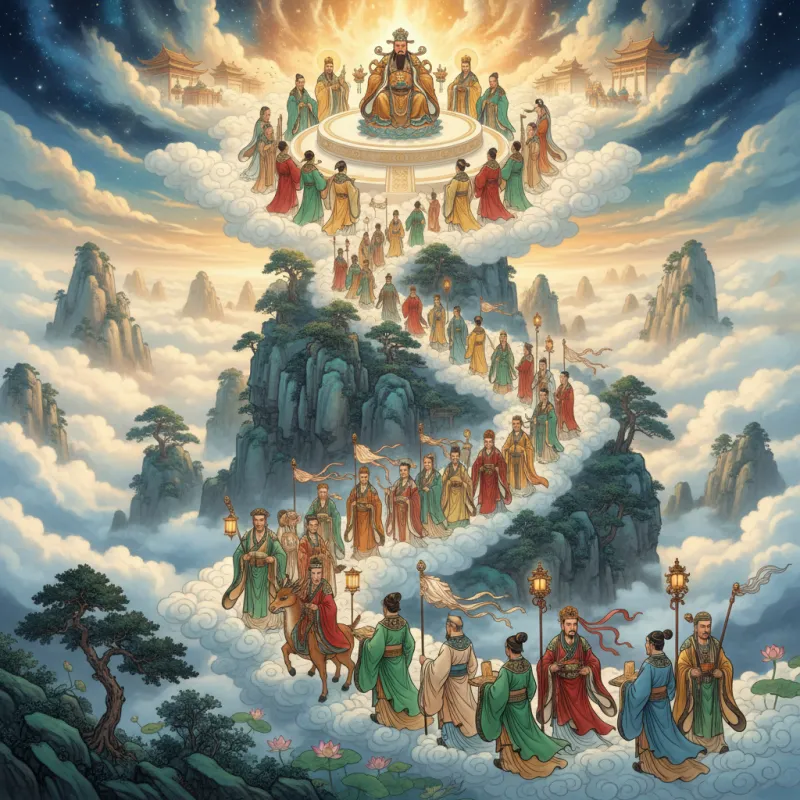
The stone steps are worn smooth by millions of feet. At 3 a.m., in the darkness before dawn, pilgrims begin their ascent of Mount Tai, carrying incense and offerings, their breath visible in the cold mountain air. Some are elderly, leaning on walking sticks. Others carry their aging parents on their backs. A few crawl on their knees, stopping at each step to bow. This is not tourism. This is chaosheng (朝圣, cháoshèng) — paying homage to the sacred — and every burning muscle, every gasping breath, every blistered foot is an offering.
Chinese pilgrimage culture is built on a simple theological principle: the gods live at the top of mountains, and if you want an audience with them, you climb. No shortcuts. No cable cars (though modern tourism has added them, to the dismay of traditionalists). The suffering is not incidental to the practice — it is the practice itself.
Why Mountains? The Vertical Axis of Chinese Cosmology
In Chinese religious thought, mountains are not merely elevated terrain. They are cosmic pillars connecting heaven and earth, places where the membrane between the human and divine worlds grows thin. The higher you climb, the closer you get to the celestial realm, and the more likely the gods are to hear your prayers.
This vertical cosmology appears throughout Chinese mythology. Mount Kunlun (昆仑山, Kūnlún Shān), the mythical axis mundi in the far west, was said to be the home of the Queen Mother of the West (西王母, Xī Wángmǔ) and the gateway to heaven. The Jade Emperor (玉皇大帝, Yù Huáng Dàdì) himself was believed to hold court on celestial peaks. Even in Daoist internal alchemy, the human body is mapped as a sacred mountain, with the head as the summit where spiritual transformation occurs.
Mountains also served practical religious functions. Buddhist monasteries and Daoist temples were built at high elevations partly for seclusion, but also because the altitude itself was considered spiritually potent. The air is thinner, the silence deeper, the view more expansive. Monks and hermits who meditated at these heights were thought to absorb celestial energy (qi, 气) more efficiently than those who practiced at sea level.
The Five Great Mountains and the Four Buddhist Peaks
Chinese pilgrimage centers on two overlapping systems of sacred mountains, each with its own theological significance.
The Five Great Mountains (五岳, Wǔyuè) are the ancient Daoist peaks that correspond to the five cardinal directions and five elements of Chinese cosmology:
- Mount Tai (泰山, Tài Shān) in the east (Shandong Province) — the most revered, associated with sunrise, birth, and imperial legitimacy
- Mount Hua (华山, Huà Shān) in the west (Shaanxi Province) — famous for its terrifying cliff-side paths and martial arts associations
- Mount Heng (衡山, Héng Shān) in the south (Hunan Province) — linked to fire and summer
- Mount Heng (恒山, Héng Shān) in the north (Shanxi Province) — yes, a different character, same pronunciation, associated with water and winter
- Mount Song (嵩山, Sōng Shān) in the center (Henan Province) — home to the Shaolin Temple and considered the axis of the five
These mountains were so important that Chinese emperors performed feng and shan sacrifices (封禅, fēngshàn) on Mount Tai to legitimize their rule, reporting their ascension to the throne directly to Heaven. The last emperor to perform this ritual was the Qing dynasty's Qianlong Emperor in the 18th century.
The Four Buddhist Sacred Mountains (四大佛教名山, Sì Dà Fójiào Míngshān) represent the earthly abodes of four major bodhisattvas:
- Mount Wutai (五台山, Wǔtái Shān) in Shanxi — home of Manjushri (文殊菩萨, Wénshū Púsà), the Bodhisattva of Wisdom
- Mount Emei (峨眉山, Éméi Shān) in Sichuan — associated with Samantabhadra (普贤菩萨, Pǔxián Púsà), the Bodhisattva of Practice
- Mount Putuo (普陀山, Pǔtuó Shān) in Zhejiang — the island sanctuary of Guanyin (观音菩萨, Guānyīn Púsà), the Goddess of Mercy
- Mount Jiuhua (九华山, Jiǔhuá Shān) in Anhui — where Ksitigarbha (地藏菩萨, Dìzàng Púsà), the Bodhisattva of the Underworld, is venerated
Serious pilgrims attempt to visit all five Daoist peaks or all four Buddhist mountains in their lifetime, though completing either circuit is considered a major spiritual achievement.
The Ritual Structure of Mountain Pilgrimage
A proper mountain pilgrimage follows a specific ritual sequence that transforms the physical act of climbing into a spiritual practice.
Preparation begins days or weeks before departure. Pilgrims purify themselves through fasting, sexual abstinence, and ritual bathing. They purchase incense, paper offerings, and sometimes special pilgrim clothing. Some groups organize collective pilgrimages, traveling together and chanting sutras or Daoist scriptures during the ascent.
The ascent typically begins in the pre-dawn hours. This timing is practical — climbing in the cool darkness avoids the midday heat — but also symbolic. Pilgrims want to reach the summit at sunrise, the moment when yang energy is strongest and the boundary between worlds is most permeable. On Mount Tai, watching the sunrise from the summit has been a sacred act for over two thousand years.
The climb itself is punctuated by ritual stops at temples, shrines, and stone inscriptions along the path. Pilgrims burn incense, make offerings, and kowtow (磕头, kētóu) — the full prostration where the forehead touches the ground. Some pilgrims perform "three steps, one bow" (三步一拜, sān bù yī bài), prostrating themselves every three steps for the entire ascent. This can turn a six-hour climb into a multi-day ordeal.
Summit rituals vary by mountain and tradition. At Mount Tai, pilgrims visit the Temple of the Azure Clouds (碧霞祠, Bìxiá Cí), dedicated to the goddess Bixia Yuanjun (碧霞元君, Bìxiá Yuánjūn), who grants children and protects women. At Buddhist mountains, pilgrims circumambulate the main temple, light incense before the bodhisattva's statue, and sometimes spend the night in monastery guesthouses to attend dawn prayers.
The descent is considered spiritually significant as well. You are returning to the mundane world carrying the blessings and merit accumulated during the climb. Some traditions require pilgrims to walk backward down the mountain, symbolically refusing to turn their back on the deity they just visited.
The Economics and Politics of Pilgrimage
Mountain pilgrimage has never been purely spiritual — it has always been entangled with commerce and power.
During the Ming and Qing dynasties, pilgrimage routes became major economic corridors. Inns, restaurants, and shops selling religious goods lined the paths. Porters carried wealthy pilgrims in sedan chairs. Local governments taxed pilgrims and regulated the trade in religious souvenirs. The mountains themselves became wealthy through donations, land holdings, and imperial patronage.
The Communist period (1949-1976) nearly destroyed this system. During the Cultural Revolution, Red Guards vandalized temples, smashed statues, and denounced pilgrimage as feudal superstition. Monks and nuns were forced to return to lay life. The mountains fell silent.
The revival began in the 1980s as China's economic reforms allowed limited religious practice. Temples were rebuilt, often with government funding, as officials recognized the tourism potential of sacred mountains. Today, places like Mount Wutai and Mount Emei are UNESCO World Heritage Sites, and millions of visitors arrive annually — though distinguishing genuine pilgrims from tourists is increasingly difficult.
This commercialization troubles traditionalists. Cable cars now carry visitors to summits that were once reached only through arduous climbing. Entrance fees can cost hundreds of yuan. Monks complain that the sacred atmosphere is drowned out by tour groups and souvenir hawkers. Yet the mountains remain spiritually alive for those who approach them with devotion. On any given morning, you will still find elderly pilgrims climbing in the darkness, refusing the cable car, insisting that the suffering is the point.
The Body as Offering
What makes Chinese mountain pilgrimage distinctive is its emphasis on physical suffering as spiritual currency. This is not metaphorical. The pain in your legs, the burning in your lungs, the exhaustion that makes each step an act of will — these are offerings to the gods, proof of your sincerity.
This theology of suffering has deep roots in both Buddhist and Daoist thought. Buddhism teaches that the body is a source of attachment and delusion, and that physical austerities can help break that attachment. Daoist practice emphasizes ku (苦, kǔ), "bitterness" or "hardship," as a necessary stage in spiritual refinement. The body must be tested, pushed to its limits, before transformation can occur.
Some pilgrims take this to extremes. They climb on their knees for the entire ascent, their legs bleeding through bandages. They carry heavy stones as additional penance. They fast for days before and during the climb. These practices are not officially encouraged by temples, but they are tolerated and even admired as expressions of extraordinary devotion.
The contrast with modern Western spirituality is striking. Contemporary wellness culture often frames spiritual practice as self-care, something that should feel good and nurturing. Chinese mountain pilgrimage operates on the opposite principle: spiritual progress requires discomfort, and the gods respect those who suffer for an audience with them.
Pilgrimage in the Digital Age
Chinese pilgrimage culture is adapting to the 21st century in unexpected ways. Social media has created new forms of pilgrimage documentation and competition. Pilgrims post photos of themselves at summit temples, share their climbing times, and compare the number of mountains they have visited. WeChat groups organize collective pilgrimages and share tips on the best routes and ritual practices.
Some temples now accept digital donations through Alipay and WeChat Pay. You can light a "virtual incense stick" on a temple's website, though most serious practitioners still insist on the physical act. Live-streaming services allow people who cannot make the climb to watch summit rituals in real-time, raising theological questions about whether virtual participation carries spiritual merit.
Yet the core practice remains unchanged. Every year, millions of Chinese people still climb sacred mountains in the traditional way — on foot, in the darkness, carrying offerings, enduring pain. They do this because they believe the gods are listening, and because some truths can only be learned through the burning of muscles and the testing of will.
The mountains are patient. They have been receiving pilgrims for thousands of years, and they will continue to receive them for thousands more. The stone steps, worn smooth by countless feet, are a record of devotion that no digital technology can replicate. As long as people believe that heaven is above and that the gods reward those who climb toward them, the pilgrimage will continue.
For those interested in the deities who reside on these sacred peaks, explore our guide to mountain deities and their domains. And if you are planning your own pilgrimage, our article on temple etiquette and offerings provides essential guidance for approaching these sacred spaces with proper respect.
Related Reading
- Daoist Temples: Where to Go, What to Expect, and How Not to Embarrass Yourself
- Chinese Temple Architecture: What Every Symbol Means
- The Most Sacred Temples in China You Can Visit
- Exploring the Rich Tapestry of Chinese Deities and Immortals in Temples
- 10 Most Sacred Daoist Temples in China You Can Visit
- A Practical Guide to Visiting Chinese Temples: What to Do and What Not to Do
- Unraveling the Mystique of Chinese War Gods in the Daoist and Buddhist Pantheon
- The Eight Immortals: China's Most Beloved Supernatural Team