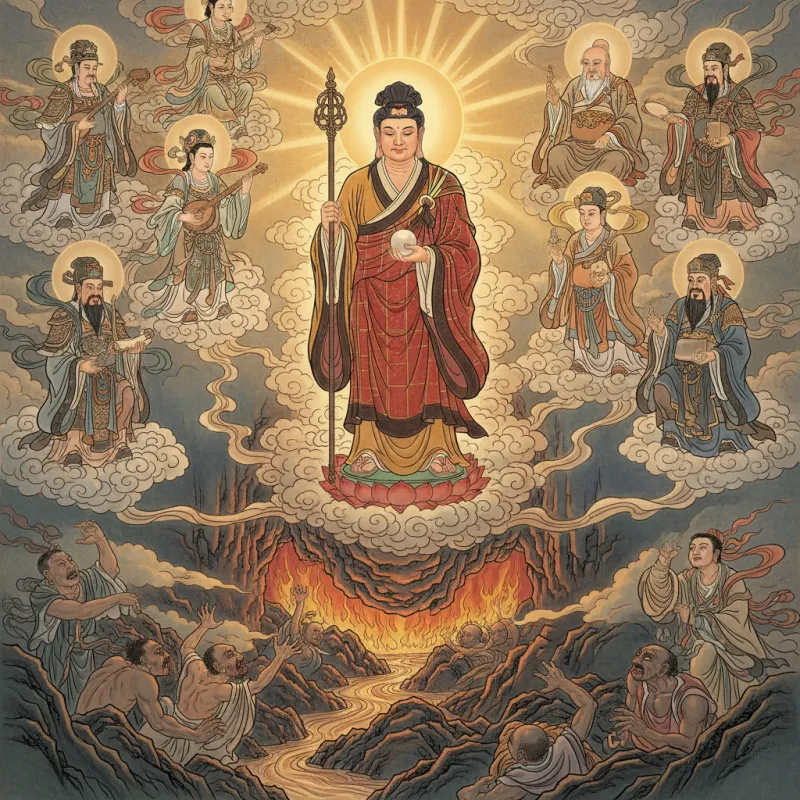
There's a Buddhist figure who made a promise so extreme that even other bodhisattvas probably thought he was overdoing it. Dizang Bodhisattva (地藏菩萨, Dìzàng Púsà) — Ksitigarbha in Sanskrit — stood at the threshold of Buddhahood and said, essentially, "No thanks, I'll take hell instead." Not as punishment. As a job. His vow has echoed through Chinese Buddhism for over a millennium: "地狱不空,誓不成佛" (Dìyù bù kōng, shì bù chéng fó) — "Until hell is empty, I vow not to become a Buddha."
Let that sink in. Hell, by design, is never empty. It's a cosmic recycling center for karmic debt. Beings cycle through, suffer their sentences, and new ones arrive. Dizang knew this. He volunteered anyway.
The Bodhisattva Who Chose the Worst Assignment
Most bodhisattvas get the glamorous gigs. Guanyin (观音, Guānyīn) responds to prayers from her island paradise. Wenshu (文殊, Wénshū) dispenses wisdom from his mountain throne. Dizang? He's down in the underworld, negotiating with hell kings and comforting the damned. If the Buddhist pantheon had a union, Dizang would be filing complaints.
The origins of his cult trace back to the Dizang Pusa Benyuan Jing (地藏菩萨本愿经, Dìzàng Púsà Běnyuàn Jīng) — the Sutra of the Past Vows of Earth Store Bodhisattva — which arrived in China around the 7th century CE. The text describes Dizang's previous lives, each one building toward his impossible vow. In one incarnation, he was a Brahmin girl whose mother had slandered the Three Jewels and fallen into hell. The girl made offerings and meditated until she could descend into the underworld herself, find her mother, and secure her release. That experience — witnessing hell's machinery firsthand — planted the seed.
In another life, he was a king who saw his friend fall into evil ways. Instead of abandoning him, the king vowed to save all beings from hell, even if it took eons. These weren't abstract promises made in comfortable meditation halls. They were vows forged in the presence of suffering so intense that most beings would flee.
Hell's Bureaucracy and Dizang's Jurisdiction
Chinese Buddhism didn't just import Indian cosmology — it merged it with indigenous beliefs about the afterlife, creating a hell system that would make Kafka weep. The result is Diyu (地狱, Dìyù), a sprawling underworld with eighteen levels, each administered by a hell king (阎罗王, Yánluó Wáng, from the Sanskrit Yama). These aren't demons. They're cosmic civil servants processing karmic debt with bureaucratic precision.
Dizang operates within this system, but he's not part of the management structure. He's more like a defense attorney who shows up at every trial, a chaplain who visits every cell. The Dizang Jing describes him appearing in hell realms "as numerous as the sands of the Ganges," manifesting wherever beings suffer. He doesn't override the hell kings' judgments — karma must be resolved — but he provides comfort, teaches the dharma, and occasionally negotiates reduced sentences for those who show genuine remorse.
This is where Dizang differs from Guanyin, who often intervenes with miraculous rescues. Dizang's compassion is grittier, more procedural. He's there for the long haul, working within the system's constraints. If Guanyin is emergency services, Dizang is hospice care combined with legal aid.
The Monk Who Became Dizang's Avatar
In 794 CE, a Korean monk named Kim Gyo-gak (金乔觉, Jīn Qiáojué) arrived at Mount Jiuhua (九华山, Jiǔhuá Shān) in Anhui Province. He was 24 years old, a prince who'd renounced his throne to seek enlightenment. He found a cave on the mountain and meditated there for decades, living on a diet that would horrify modern nutritionists — mostly rice mixed with white clay from the mountain soil.
Local stories say he was so dedicated that he once meditated through an entire winter without moving, and when spring came, mice had nested in his robes. When he finally emerged, his presence was so serene that people began bringing him offerings. He refused most of them, accepting only enough to survive.
Kim Gyo-gak died in 794 CE at age 99. Here's where it gets strange: his body didn't decay. Three years after his death, his disciples opened his tomb and found him sitting in meditation posture, perfectly preserved, his face still lifelike. In Chinese Buddhist tradition, this is a sign of extraordinary spiritual attainment. But there was something else — people noticed he bore a striking resemblance to traditional depictions of Dizang Bodhisattva.
The conclusion was obvious: Dizang had manifested in human form. Mount Jiuhua became his earthly headquarters, one of the Four Sacred Mountains of Chinese Buddhism. Kim Gyo-gak's preserved body — now covered in gold leaf — still sits in a temple on the mountain, a physical anchor for Dizang's presence in the world.
Dizang's Iconography: Reading the Symbols
Walk into any Chinese Buddhist temple and you can spot Dizang immediately. He's the one who looks like a monk, not a celestial being. While other bodhisattvas wear elaborate jewelry and flowing robes, Dizang typically appears in simple monastic garments, his head shaved. This is deliberate — he's emphasizing his role as a teacher and guide, not a distant deity.
In his left hand, he holds a wish-fulfilling jewel (如意宝珠, rúyì bǎozhū) that glows with light to illuminate the darkness of hell. In his right hand, he carries a ringed staff (锡杖, xīzhàng) — a monk's walking stick with metal rings that jingle. The practical purpose was to warn small creatures of a monk's approach so they wouldn't be accidentally stepped on. The symbolic purpose? The sound of those rings is said to wake beings from delusion and announce Dizang's arrival in the hell realms.
Often, he's accompanied by two attendants: Daoming (道明, Dàomíng) and Minjong (闵公, Mǐngōng). These were historical figures — the father and son who first supported Kim Gyo-gak when he arrived at Mount Jiuhua. Their presence in Dizang's iconography is a reminder that his cult has roots in actual human relationships, not just abstract theology.
Sometimes you'll see Dizang seated on a lion-like creature called Dixing (谛听, Dìtīng) — a divine beast that can distinguish truth from lies and good from evil. This companion helps Dizang navigate hell's complexities, identifying which beings are ready for liberation and which need more time to work through their karma.
The Ghost Festival and Dizang's Busiest Season
The seventh month of the lunar calendar is when the gates of hell open and ghosts roam the earth. It's called the Ghost Festival (中元节, Zhōngyuán Jié), and it's Dizang's Super Bowl. Temples hold elaborate ceremonies, families make offerings to deceased relatives, and Dizang is invoked constantly to protect the living from wandering spirits and to ease the suffering of the dead.
I've attended these ceremonies. They're not somber affairs — they're loud, smoky, chaotic events with chanting monks, burning incense, and tables piled with food offerings. Paper money gets burned by the stack. Elaborate paper houses, cars, and even paper smartphones go up in flames, transmitted to the spirit world through fire. The assumption is that hell operates on an economy, and deceased relatives need cash.
Dizang's role during this month is to supervise the temporary release of souls, ensure they don't cause trouble, and guide them back to the underworld when the gates close. It's like being a prison warden during a month-long furlough program. The Yulanpen Jing (盂兰盆经, Yúlánpén Jīng) — the Ullambana Sutra — provides the scriptural basis for these practices, describing how offerings made during this period can relieve the suffering of ancestors trapped in hell.
Why Dizang's Vow Matters Beyond Buddhism
Here's what strikes me about Dizang's vow: it's not strategic. From a purely rational standpoint, it's a terrible decision. He could become a Buddha, achieve ultimate liberation, and help beings from that exalted state. Instead, he's chosen to stay in the muck, doing the hardest, most thankless work in the cosmos.
This is compassion without calculation. It's not about efficiency or optimal outcomes. It's about solidarity with the suffering. Dizang's vow says: "I won't transcend this mess until everyone can transcend it with me." In a religious tradition often criticized for being world-denying or escapist, Dizang represents the opposite impulse — a refusal to escape while others remain trapped.
Compare this to Amitabha Buddha, who created the Pure Land as a refuge where beings can practice without the distractions and dangers of samsara. That's compassion through architecture — building a better place. Dizang's compassion is through presence — showing up in the worst place and staying there.
Modern Chinese Buddhism has embraced Dizang as a patron of social work. Temples dedicated to him often run hospices, provide end-of-life care, and support prisoners. The logic is clear: if Dizang works in hell, his followers should work in hell's earthly equivalents — prisons, hospitals, disaster zones. His vow has become a template for engaged Buddhism, a reminder that enlightenment isn't about escaping the world's suffering but about diving deeper into it.
The Impossible Math of an Empty Hell
Let's address the obvious problem: hell will never be empty. Buddhist cosmology describes infinite worlds with infinite beings creating infinite karma. For every soul Dizang liberates, countless others arrive. His vow is mathematically impossible.
Maybe that's the point.
The vow isn't meant to be completed. It's meant to be lived. Dizang's commitment isn't contingent on success — it's absolute regardless of outcome. This is the bodhisattva path taken to its logical extreme: compassion without exit strategy, service without retirement plan.
There's a Zen koan quality to it. The moment you ask "When will hell be empty?" you've missed the point. The question isn't about the destination. It's about the willingness to stay, to keep working, to refuse the comfort of transcendence while others suffer. Dizang's vow is less a goal and more a stance — a way of being in relationship to suffering that doesn't depend on fixing it.
In Chinese popular religion, this has translated into Dizang becoming the deity people turn to when situations seem hopeless. Terminal illness. Wrongful imprisonment. Addiction. The cases where other bodhisattvas might seem too celestial, too removed. Dizang gets it. He's chosen to work in hopeless situations. That's his specialty.
Dizang in Contemporary Practice
Walk through any Chinese cemetery and you'll see Dizang's influence. Small shrines dot the grounds, places where families can pray for deceased relatives. The assumption is that most people don't go straight to the Pure Land or immediate rebirth — they spend time in intermediate states, working through karmic residue. Dizang is the advocate during this process.
In Taiwan, some temples have created elaborate hell museums — walk-through exhibits depicting the eighteen levels of hell with disturbing realism. Animatronic sinners get sawed in half, boiled in oil, and torn apart by demons. It's religious education through horror show. At the exit, there's always a statue of Dizang, reminding visitors that even in these nightmare realms, compassion is present.
Modern practitioners often recite the Dizang Jing for deceased relatives, especially during the 49-day period after death when the deceased's next rebirth is determined. The sutra is long — it takes several hours to chant in full — but it's considered one of the most powerful texts for helping the dead. The logic is that Dizang's vow creates a kind of spiritual safety net. Even if you've accumulated terrible karma, even if you're headed for hell, Dizang will be there.
This has made him particularly popular among people dealing with guilt — those who feel they've failed their parents, neglected their duties, or made irreversible mistakes. Dizang's presence in hell suggests that no one is beyond help, no situation is beyond redemption. Not because karma is erased, but because someone is willing to walk through it with you.
The bodhisattva who chose hell reminds us that compassion isn't about fixing everything. Sometimes it's just about showing up in the darkness and staying there, for as long as it takes, for as many beings as need it. Hell isn't empty. It never will be. And Dizang is still there, keeping his impossible promise, one suffering being at a time.
Related Reading
- Buddha in China: How Buddhism Was Transformed by Chinese Culture
- The Four Heavenly Kings: Guardians at Every Temple Gate
- Buddhist Deities in Chinese Culture: How India's Gods Became Chinese
- Guanyin: The Goddess of Mercy Who Hears Every Cry
- Meet the Eight Immortals: Profiles of China's Favorite Supernatural Squad
- How to Pray at a Chinese Temple: A Respectful Visitor's Guide
- The Daoist Pantheon: A Bureaucracy of Gods