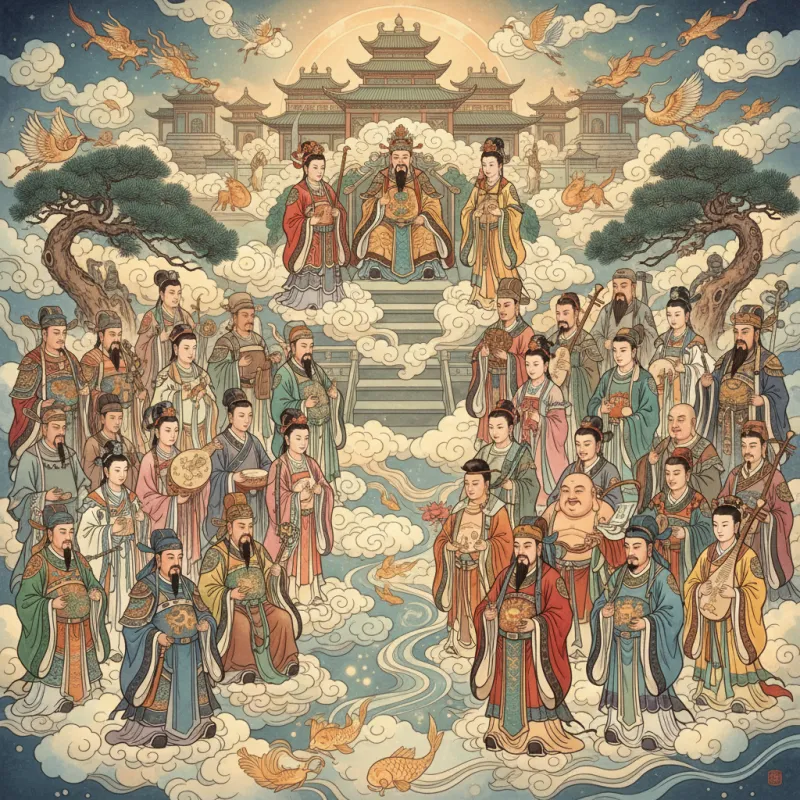
The Chinese Divine Hierarchy: A Complete Guide to Heaven, Earth, and the Underworld
Imagine a cosmos organized not unlike a vast imperial bureaucracy — with ministers, magistrates, inspectors, and a supreme emperor sitting at its apex, all of them managing the affairs of heaven, earth, and the dead with the meticulous attention of career civil servants. This is, in essence, how traditional Chinese religion conceives of the divine world. It is a spiritual architecture of breathtaking complexity and remarkable coherence, spanning thousands of years of Daoist theology, Buddhist philosophy, and grassroots folk belief. Gods can be promoted or demoted. Celestial officials file reports. The dead are processed through bureaucratic courts before rebirth. And the whole magnificent structure is held together not by dogma enforced from a single church, but by the lived religious practice of billions of people across centuries. Welcome to the Chinese divine hierarchy — one of the most intricate, fascinating, and misunderstood cosmologies in human history.
The Structure of the Chinese Cosmos: An Overview
Before diving into specific deities, it helps to understand the basic architecture of the Chinese spiritual universe. Traditional Chinese cosmology divides existence into three broad realms:
- 天 (Tiān) — Heaven, the celestial realm where immortals, gods, and divine bureaucrats reside
- 地 (Dì) — Earth, the mortal world, watched over by local earth gods and nature deities
- 冥界 (Míngjiè) — The Underworld, where the souls of the dead are judged and processed before reincarnation
Within these three realms, the divine beings are organized in a hierarchy that mirrors the imperial Chinese government almost exactly. This parallel was not accidental. As Chinese civilization developed its administrative apparatus — with its examinations, ranks, ministries, and imperial court — the religious imagination naturally mapped that structure onto the heavens. Gods have offices. They have subordinates. They receive petitions from mortals and file reports to their superiors. They can be rewarded with promotion or punished with demotion. The Jade Emperor sits at the top as the supreme sovereign, much as the Son of Heaven sat atop the earthly imperial order.
Crucially, this hierarchy is not the product of a single religion. It represents thousands of years of synthesis between 道教 (Dàojiào) — Daoism, 佛教 (Fójiào) — Buddhism, and the ancient substrate of 民间信仰 (Mínjiān Xìnyǎng) — folk religion. These three streams have flowed together so thoroughly that most Chinese worshippers throughout history have drawn from all of them simultaneously, visiting a Daoist temple in the morning, making offerings at a Buddhist shrine in the afternoon, and consulting their local earth god in the evening without any sense of contradiction.
The Three Pure Ones: The Supreme Daoist Trinity
At the very pinnacle of Daoist cosmology — above even the Jade Emperor in theological terms — stand 三清 (Sān Qīng), the Three Pure Ones. These three supreme deities represent the highest expressions of the 道 (Dào) — the Way, the ineffable principle underlying all reality. They are:
Yuanshi Tianzun: The Primordial Heavenly Worthy
元始天尊 (Yuánshǐ Tiānzūn), the Celestial Worthy of Original Beginning, is the most exalted of the three. He represents the primordial state of the Dao before creation, the original breath of the universe before it differentiated into heaven and earth. He dwells in the 玉清境 (Yùqīng Jìng), the Jade Pure Realm, and holds in his hand a pearl representing undifferentiated cosmic potential. In iconography, he is typically depicted as an ancient, serene figure radiating golden light, seated on a lotus throne above the clouds.
Lingbao Tianzun: The Numinous Treasure Worthy
灵宝天尊 (Língbǎo Tiānzūn), the Celestial Worthy of Numinous Treasure, is associated with the period when the Dao began to differentiate into yin and yang, and when the sacred scriptures of Daoism came into being. He dwells in the 上清境 (Shàngqīng Jìng), the Upper Pure Realm, and is depicted holding the 如意 (rúyì), a ceremonial scepter representing divine authority and the fulfillment of wishes.
Daode Tianzun: The Moral Virtue Worthy
道德天尊 (Dàodé Tiānzūn), the Celestial Worthy of the Way and Its Virtue, is the divine form of 老子 (Lǎozǐ), the legendary philosopher credited with writing the 道德经 (Dàodé Jīng), the founding text of Daoist philosophy. He dwells in the 太清境 (Tàiqīng Jìng), the Grand Pure Realm, and is the most accessible of the three to human practitioners. His identification with the historical Laozi — said to have lived in the sixth century BCE and to have written one of the most profound philosophical texts in human history — gives this deity a fascinating dual nature as both transcendent divinity and earthly sage.
Theologically, the Three Pure Ones are so exalted that they exist beyond the concerns of ordinary human affairs. They do not typically receive petitions or answer prayers in the way more accessible gods do. They represent ultimate principles rather than divine administrators. This is why, in practical religious life, most worship is directed at lower-ranking deities, with the Three Pure Ones honored more as cosmic principles than as interactive divine personalities.
The Jade Emperor and the Heavenly Court
If the Three Pure Ones represent transcendent cosmic principles, 玉皇大帝 (Yùhuáng Dàdì), the Jade Emperor, is the god who actually runs things. He is the supreme administrator of the universe, the divine counterpart of the Chinese emperor on earth, and arguably the most important deity in popular Chinese religion.
The Jade Emperor's heavenly palace, 凌霄宝殿 (Língxiāo Bǎodiàn), the Palace of Numinous Mist, is conceived as a celestial version of the Forbidden City in Beijing — vast, ornate, and bustling with official activity. Here, the Jade Emperor presides over a court of divine ministers and officials who manage every aspect of cosmic and earthly affairs. The heavenly bureaucracy includes ministries responsible for weather, agriculture, human destiny, morality, and the affairs of the underworld. There are celestial generals commanding divine armies, inspectors who travel through the mortal realm reporting on human behavior, and a vast apparatus for processing prayers and petitions that flow up from earth.
The Jade Emperor's birthday is celebrated on the ninth day of the first lunar month — one of the most important festivals in the Chinese religious calendar, particularly in Taiwan and among overseas Chinese communities. The festivities can be spectacular, involving elaborate offerings, fireworks, and operas performed for the divine audience.
The Heavenly Court's Key Ministers
The Jade Emperor does not govern alone. His court includes several critically important divine officials:
太白金星 (Tàibái Jīnxīng), the Golden Star of Venus, serves as the Jade Emperor's most trusted ambassador and diplomatic envoy. He is depicted as a kindly old man with white eyebrows and beard, and he appears repeatedly in Chinese mythology as a messenger between heaven and earth — including the famous moment in Journey to the West (西游记, Xīyóu Jì) when he is sent to invite the Monkey King 孙悟空 (Sūn Wùkōng) to take up a post in heaven.
雷公 (Léigōng) and 电母 (Diànmǔ) — the Duke of Thunder and the Goddess of Lightning — manage the celestial weather department, dispensing storms that punish evildoers and bring life-giving rain to farmers.
太岁 (Tàisuì), the Grand Duke Jupiter, governs the flow of years and is associated with fate and fortune. People born in years that conflict with the current Taisui's position are said to face special challenges and may seek ritual protection at temples.
The genius of the heavenly bureaucracy concept is its practicality: it gave ordinary Chinese people a model for interacting with the divine that was culturally familiar. You petitioned a god the way you petitioned a magistrate — with proper ritual, appropriate offerings, and respectful language. If a lower-ranking god failed to deliver results, you could, in theory, complain to his superiors.
The Three Pure Ones vs. The Jade Emperor: A Theological Puzzle
One of the genuinely fascinating complexities of the Chinese divine hierarchy is the relationship between the Three Pure Ones and the Jade Emperor. Strictly speaking, in Daoist theology, the Three Pure Ones outrank the Jade Emperor — they represent more fundamental cosmic principles. Yet in popular religion and in the imperial cult, the Jade Emperor was treated as the supreme ruler. This tension was never really resolved, and different religious traditions handle it differently. Daoist priests generally maintain the supremacy of the Three Pure Ones, while ordinary folk worshippers tend to treat the Jade Emperor as the top god. This kind of productive ambiguity is characteristic of Chinese religion's capacity to hold multiple frameworks simultaneously without demanding doctrinal resolution.
The Eight Immortals: Heaven's Most Beloved Characters
No element of the Chinese divine hierarchy has captured popular imagination more completely than 八仙 (Bā Xiān), the Eight Immortals. These eight figures — each with a distinct personality, special power, and symbolic attribute — are among the most recognizable icons of Chinese culture. They appear on ceramics, paintings, temple decorations, and folk art across the Chinese-speaking world.
The Eight Immortals are:
汉钟离 (Hàn Zhōnglí), the fat, jovial former Han dynasty general who carries a magical fan capable of reviving the dead and is the leader of the group.
吕洞宾 (Lǚ Dòngbīn), arguably the most popular of the eight — a Daoist scholar and swordsman whose double-edged sword slays demons and cuts through ignorance. He is the patron of barbers and is said to wander the earth helping the poor. Many Daoist traditions claim him as their founder or patron.
铁拐李 (Tiě Guǎi Lǐ), "Iron-Crutch Li," depicted as a ragged beggar with an iron crutch and a gourd containing magical medicine. His story is poignant: he left his body to make a spiritual journey, but his disciple cremated the body prematurely, forcing his spirit to inhabit the corpse of a lame beggar.
曹国舅 (Cáo Guójiù), uncle to a Song dynasty empress, who carries castanets and represents nobility's renunciation of worldly power.
蓝采和 (Lán Cǎihé), an androgynous youth who carries a flower basket and is the patron of florists, often associated with youthful joy.
何仙姑 (Hé Xiāngū), the only female immortal in the group, carrying a lotus flower representing purity and carrying a ladle for distributing food.
韩湘子 (Hán Xiāngzǐ), grand-nephew of the Tang dynasty literary giant Han Yu, who plays a magical flute that causes flowers to bloom.
张果老 (Zhāng Guǒ Lǎo), an elderly Immortal who rides his donkey backwards and is associated with longevity.
The Eight Immortals are famous for a beloved mythological episode: 八仙过海,各显神通 (Bā Xiān Guò Hǎi, Gè Xiǎn Shéntōng) — "The Eight Immortals crossing the sea, each showing their special power." Rather than traveling by cloud as gods normally would, each immortal threw their magical attribute onto the waves and rode it across the ocean — the fan, the sword, the crutch, the lotus, and so on. The phrase has entered the Chinese language as a proverb for individuals each contributing their unique talents to a shared endeavor.
Buddhist Deities in Chinese Religion
The arrival and gradual sinification of Buddhism — a process spanning roughly from the Han dynasty (206 BCE–220 CE) through the Tang (618–907 CE) — brought an entirely new pantheon into the Chinese religious world. Rather than displacing native deities, Buddhist figures were gradually absorbed and given distinctly Chinese characteristics. The result is a rich overlapping layer of Buddhist divinity woven throughout the larger Chinese spiritual framework.
Guanyin: The Compassionate Bodhisattva
观音 (Guānyīn), known in Sanskrit as Avalokiteśvara, is almost certainly the most beloved religious figure in all of Chinese culture. Originally depicted as a male bodhisattva in Indian Buddhism, Guanyin underwent a remarkable gender transformation in Chinese tradition, becoming a compassionate goddess figure who hears the cries of the suffering world — her name literally means "She Who Perceives the Sounds [of the World]."
Guanyin is the Bodhisattva of Compassion, a being who has achieved the capacity for buddhahood but delays final enlightenment in order to remain in the world helping all sentient beings reach liberation. In Chinese popular religion, she is invoked for protection in childbirth, for the wellbeing of sailors, for healing, and for general compassion and mercy. Her imagery — serene, white-robed, often holding a willow branch and a vase of pure water — is among the most iconic in Chinese art.
Milefo: The Laughing Buddha
弥勒佛 (Mílè Fó), the Maitreya Buddha, is the Buddha of the Future, who will appear in the world when the teachings of the current Buddha (Śākyamuni) have completely faded. In Chinese temples, however, he is almost always depicted not as a serene future savior but as a rotund, laughing figure whose enormous belly and infectious grin have made him a universal symbol of happiness and good fortune in Chinese culture. This distinctly Chinese Milefo is based on a historical monk named 布袋 (Bùdài), "Cloth Sack," who lived during the Later Liang dynasty and was posthumously identified as Maitreya's manifestation.
The Four Heavenly Kings and Weituo
四大天王 (Sì Dà Tiānwáng), the Four Heavenly Kings, guard the four cardinal directions and are placed at the entrance of virtually every Chinese Buddhist temple. Each carries a distinctive attribute: one holds a pipa (lute) representing wind; one holds a sword representing clouds; one holds an umbrella representing rain; and one holds a snake or dragon representing thunder. Together they protect the dharma and control the weather.
韦驮 (Wéituó), the divine guardian Skanda, stands just inside temple gates, his armor gleaming, protecting the Buddhist community from evil. In most temples, his back faces the entrance, while he faces inward toward the main hall — perpetually on guard.
Folk Gods: The Deities of Everyday Life
While cosmic deities manage the universe, Chinese religious life has always maintained a rich tradition of highly accessible, practical folk gods who handle the concerns of daily life. These deities are beloved precisely because they are close — present in the home, the marketplace, the kitchen — and responsive to ordinary human needs.
The God of Wealth: Caishen
财神 (Cáishén), the God of Wealth, is one of the most universally worshipped deities in the Chinese world, and his relevance has only increased in a modern era of commercial enterprise. In fact, there are several different Caishen figures, reflecting regional and traditional variations. The most common is 赵公明 (Zhào Gōngmíng), a fierce military general who rides a black tiger and carries a golden staff. Despite his martial appearance, he is invoked for financial prosperity, successful business, and good fortune in commercial ventures.
The fifteenth day of the first lunar month — 元宵节 (Yuánxiāo Jié), the Lantern Festival — involves Caishen rituals, as does the fifth day of the lunar new year, when businesses traditionally open and invite the God of Wealth to enter. The custom of giving 红包 (hóngbāo), red envelopes filled with money, during Chinese New Year is connected to this complex of wealth-bringing rituals. In the digital age, WeChat's digital red envelope feature — which processes billions of yuan during the Lunar New Year — is a direct continuation of this ancient practice.
The Kitchen God: Zao Jun
灶君 (Zào Jūn), the Kitchen God, also known as 灶王爷 (Zàowáng Yé), is perhaps the most intimate of all Chinese deities — a divine civil servant whose portrait hangs in the kitchen of every traditional Chinese household. His job is to monitor the family's behavior throughout the year and report to the Jade Emperor just before the New Year. The report he delivers will determine the family's fortune for the coming year.
The genius of the Kitchen God theology lies in the ritual that surrounds his annual departure. On the twenty-third day of the twelfth lunar month — 小年 (Xiǎonián), the Little New Year — families bid the Kitchen God farewell by burning his paper image (sending him to heaven) and offering him sweet foods, particularly 糖瓜 (tángguā), sticky malt candy. The sticky sweetness serves a dual purpose: to sweeten his words to the Jade Emperor, and to stick his mouth shut so he cannot report any misdeeds. It is a remarkably pragmatic approach to divine management.
A new portrait is pasted up on New Year's Eve, welcoming the Kitchen God back to his post. This cycle of departure, heavenly report, and return structures one of the most intimate connections between household life and the divine order.
The Door Gods: Menshen
门神 (Ménshen), the Door Gods, are the fierce armored warriors whose images are pasted on the front doors of homes and businesses throughout China at New Year. Their presence wards off evil spirits and protects the household. The most common Door Gods are based on historical figures: 秦琼 (Qín Qióng) and 尉迟恭 (Yùchí Gōng), two generals who served the Tang dynasty Emperor Taizong.
According to legend, Emperor Taizong was haunted by nightmares in which the ghosts of those he had killed in battle tormented him. His generals Qin Qiong and Yuchi Gong volunteered to stand guard outside his bedchamber every night to protect him. Moved by their devotion but unwilling to exhaust these loyal officers, the emperor had their portraits painted and placed on the palace doors — achieving the same protective effect without wearing out his men. The custom spread throughout Chinese society, and the painted generals on every doorway today are their enduring legacy.
Nature Deities: Dragons, Mountains, and the Sea
Chinese religion has always maintained a rich tradition of nature deities reflecting the deep human engagement with the natural world that agriculture and geography demanded. These are not romantic abstractions but practical, powerful entities with specific domains.
The Dragon Kings
龙王 (Lóng Wáng), the Dragon Kings, rule the four seas and all bodies of fresh water. Unlike the dragons of European tradition — malevolent fire-breathers to be slain by heroes — Chinese dragons 龙 (lóng) are benevolent, water-associated creatures whose favor brings rain, prosperity, and good fortune. Each of the four seas has its king: 东海龙王 (Dōnghǎi Lóngwáng), 南海龙王 (Nánhǎi Lóngwáng), 西海龙王 (Xīhǎi Lóngwáng), and 北海龙王 (Běihǎi Lóngwáng).
The Dragon Kings appear repeatedly in Chinese mythology and literature, perhaps most memorably in Journey to the West, where the Dragon King of the East Sea reluctantly provides the Monkey King Sūn Wùkōng with his iconic 如意金箍棒 (Rúyì Jīngū Bàng), the magical staff. When droughts threatened agricultural communities, elaborate rituals were performed at dragon temples to petition the Dragon King for rain — a practice that continued in many regions into the twentieth century.
The Earth God: Tu Di Gong
土地公 (Tǔdì Gōng), the Earth God, is among the most local and personal of all Chinese deities. Every neighborhood, every village, every field has its own Tu Di Gong — a small, grandfatherly figure who watches over that specific patch of earth and its inhabitants. His shrines are everywhere in Chinese communities: tiny niches in walls, small red temples at roadsides, simple altars in the corner of shop floors. He is the most democratic of gods — close, approachable, and deeply embedded in daily life.
Tu Di Gong reports to the underworld bureaucracy about the souls of those who die in his district, helping to explain how the underworld administration knows when someone has died. He is the lowest rung in the divine hierarchy in terms of cosmic power, but arguably the most immediately present deity in ordinary Chinese life.
Mountain Gods and Sacred Peaks
China's 五岳 (Wǔ Yuè), the Five Sacred Mountains, are each presided over by powerful divine figures. 泰山 (Tàishān) in Shandong — the most sacred of the five — has been a site of imperial sacrifice since at least the Qin dynasty. Its presiding deity, the 碧霞元君 (Bìxiá Yuánjūn), the Princess of the Azure Clouds, is one of the most important female deities in Chinese popular religion, beloved particularly by mothers praying for their children's safety.
The Underworld: Chinese Conceptions of Hell
If heaven mirrors the imperial court, the Chinese underworld mirrors the judicial system — and it is, in its own way, just as organized, just as bureaucratic, and just as complicated. 冥界 (Míngjiè), the underworld, is not a place of simple punishment but a complex processing system through which souls pass on their journey toward rebirth.
The Ten Courts of Hell
The most elaborately developed Chinese underworld theology involves 十殿阎王 (Shí Diàn Yánwáng), the Ten Courts of Hell, each presided over by a divine judge. 阎王 (Yánwáng), known in Sanskrit as Yama — the King of Hell — is the most famous of these judges, but in the Chinese system, he presides over only the fifth court, with overall administrative authority.
Each court handles specific categories of sins and administers specific punishments. Sinners who cheated in business affairs face different courts than those who were disrespectful to their parents. The punishments described in Chinese underworld texts are vivid and sometimes gruesome — grinding, cutting, boiling — though these are understood as purificatory rather than purely retributive, cleansing the soul for eventual rebirth.
The entire system is supervised by 阎罗王 (Yánluó Wáng), who consults the 生死簿 (Shēngsǐ Bù), the Register of Life and Death, which records every individual's lifespan, deeds, and destiny. This register also appears in the Journey to the West, when the Monkey King infiltrates the underworld and crosses out his own name, achieving immortality.
Meng Po: The Lady of Forgetting
After completing their journey through the courts of hell and receiving appropriate purification, souls are prepared for reincarnation. The final figure they encounter before rebirth is 孟婆 (Mèng Pó), the Lady of Forgetting. This ancient, kindly woman serves every departing soul a bowl of 孟婆汤 (Mèngpó Tāng), the Soup of Oblivion, which causes them to forget their previous life entirely. This is not cruelty but mercy — allowing the soul to begin fresh, unburdened by the memories of past suffering.
The concept of Meng Po has seen an extraordinary revival in contemporary Chinese popular culture, appearing in novels, films, games, and internet memes. The image of the old woman at the bridge of forgetting has become a touchstone for discussions of memory, loss, and the nature of the self.
Ghost Month and the Hungry Ghosts
Not all the dead make it smoothly through the underworld processing system. 饿鬼 (è guǐ), hungry ghosts — souls who died without proper burial rites, who have no living descendants to make offerings, or who died violently or unjustly — are believed to wander the world unable to find rest. During the seventh lunar month — 鬼月 (Guǐ Yuè), Ghost Month — the gates of the underworld are said to open, and these restless souls are permitted to wander the earth.
The 盂兰盆节 (Yúlánpén Jié), the Festival of Hungry Ghosts, on the fifteenth day of the seventh month involves burning paper offerings (money, clothing, food, and in modern times even paper smartphones and luxury cars) to provide for the wandering dead, and releasing paper lanterns onto water to guide them. It is one of the most vivid and beautiful festivals in the Chinese calendar, combining genuine religious feeling with spectacular visual display.
The Syncretic Genius: How Daoism, Buddhism, and Folk Religion Blend
One of the most distinctive and intellectually fascinating aspects of Chinese religion is the degree to which its three main currents — Daoism, Buddhism, and folk belief — have flowed together into a single, syncretic whole. This blending is not confusion or inconsistency; it is a sophisticated religious achievement that has served Chinese civilization for millennia.
The Chinese term 三教合一 (Sān Jiào Hé Yī), "the unity of three teachings," describes this synthesis. The "three teachings" in question are sometimes listed as Daoism, Buddhism, and Confucianism (儒家, Rújiā) — but in practice, the synthesis extends to include the vast substrate of folk religious practice that underlies all three.
How does this blending work in practice? Consider the case of 妈祖 (Māzǔ), the Goddess of the Sea. She is believed to have been a historical woman named 林默 (Lín Mò) who lived on Meizhou Island in Fujian Province in the tenth century and died young, thereafter becoming a powerful protective spirit for sailors. She was officially incorporated into the imperial religious system over the Song, Yuan, Ming, and Qing dynasties, receiving increasingly grand titles. She is worshipped in Daoist temples and Buddhist temples alike. Her cult involves folk religious practices that predate both institutional traditions. She is simultaneously a deified human, a bodhisattva (according to some traditions), a Daoist immortal (according to others), and an earth goddess in the folk tradition. None of these categorizations are considered contradictory by her worshippers.
The philosopher 钱穆 (Qián Mù) observed that Chinese religion operates more like a "religious culture" than a religion in the Western sense — there is no single creed, no single institution, no single text that defines membership. Instead, there is a vast shared imaginative world, populated by gods and immortals and ancestors, within which individuals and communities navigate their own spiritual lives.
Buddhist concepts like karma (因果 (Yīnguǒ)), reincarnation (轮回 (Lúnhuí)), and the bodhisattva ideal have been so thoroughly absorbed into Chinese religious culture that they now underpin institutions — like the underworld court system — that are largely Daoist in formal structure. Daoist ideas about immortality and the cultivation of the body have influenced Buddhist practice in China. And folk religious practices — the veneration of ancestors, the propitiation of local spirits, the seeking of divine favors through offerings — provide the living substrate within which both institutional traditions operate.
Worship Practices Today: The Living Tradition
Chinese religion is emphatically not a museum exhibit. It is a living, breathing, adapting tradition practiced by hundreds of millions of people across China, Taiwan, Hong Kong, Southeast Asia, and Chinese diaspora communities worldwide. Contemporary worship practices range from the deeply traditional to the strikingly modern, but the underlying logic remains continuous with centuries of practice.
Temple Worship
Visiting a Chinese temple — whether Daoist, Buddhist, or folk — follows a recognizable pattern. Worshippers purchase 香 (xiāng), incense sticks, at the entrance, light them, and offer them in the temple's central incense burner while bowing and making silent petitions. Most temples house multiple deities, and worshippers may make offerings to several in a single visit: Guanyin for compassion and healing, Caishen for financial matters, the local earth god for household protection.
鞠躬 (jūgōng) — bowing — and 叩头 (kòutóu) — full prostration — are the primary bodily forms of respect. The number of bows matters: three bows is standard, while nine bows represents a higher degree of reverence. Burning 纸钱 (zhǐqián), paper money and paper goods, is perhaps the most visually striking practice to outsiders — enormous quantities of paper offerings are burned in temple furnaces or outdoor pits, the smoke carrying these symbolic gifts to the divine realm.
占卜 (zhānbǔ), divination, remains central to Chinese temple practice. 签筒 (qiāntǒng), bamboo-tube divination, involves shaking a cylinder of numbered bamboo sticks until one falls out, then consulting a corresponding oracle text. 筊杯 (jiǎobēi), crescent-shaped wooden blocks, are thrown before a deity to receive yes or no answers to specific questions.
Ancestor Veneration
祭祖 (Jì Zǔ), ancestor veneration, is arguably the oldest and most universally practiced element of Chinese religious life — predating both Daoism and Buddhism and operating as an independent tradition that both incorporated. The domestic ancestor shrine — with photographs or tablets bearing the names of deceased family members — is the spiritual center of many Chinese homes. Offerings of food, incense, and paper goods are made regularly, and major festivals like 清明节 (Qīngmíng Jié), the Tomb Sweeping Festival in early April, involve family visits to graves to clean and make offerings.
This practice is not simply sentiment. It reflects a theological conviction that the bonds between the living and the dead remain active, that ancestors can influence the fortunes of their descendants and require continued care and nourishment in return. The family is conceived as extending in both directions through time — to living members, to deceased ancestors, and to unborn future generations — and the living have obligations to all of them.
New Year Rituals and the Calendar of Worship
The 农历 (Nónglì), the lunar calendar, structures Chinese religious life throughout the year in a rhythm of festivals, deity birthdays, auspicious and inauspicious days, and seasonal observances. The 春节 (Chūnjié), Spring Festival or Lunar New Year, is the most elaborate — involving the Kitchen God's departure and return, offerings to heaven and the ancestors, the welcoming of the Gods of Wealth, and the placing of new Door God images.
But the religious calendar extends far beyond New Year. The second lunar month brings the birthday of 土地公 (Tǔdì Gōng), celebrated particularly in Taiwan and Fujian. The third month brings the birthday of 妈祖 (Māzǔ), marked by spectacular processions and performances. The ninth month brings the birthday of the Jade Emperor. Each major deity has a birthday, and temple festivals on those days can draw enormous crowds, with elaborate theatrical performances, processions of divine images, and community feasting.
Contemporary Adaptations
Chinese religion has proven remarkably adaptable to modernity. In contemporary China, despite decades of official secularism and the disruptions of the Cultural Revolution (1966–1976), which saw temples destroyed and religious practice suppressed, religious life has experienced a dramatic revival since the 1980s. New temples are being built throughout China. Incense sales have boomed. The internet has become a vehicle for religious practice, with worshippers making virtual offerings and participating in online divination.
In Taiwan, which preserved Chinese folk religious traditions through the twentieth century with extraordinary richness, festivals like the 大甲妈祖绕境 (Dàjiǎ Māzǔ Rào Jìng), the Dajia Mazu Pilgrimage, draw millions of participants over several days of walking procession — an extraordinary demonstration of living religious devotion.
In diaspora communities from San Francisco's Chinatown to the Chinese temples of Penang, Singapore, and Vietnam, these traditions have taken root in new soils, adapting to local circumstances while maintaining remarkable continuity with their origins. 关帝庙 (Guāndì Miào), temples to 关帝 (Guāndì) — the deified general **关羽 (Gu