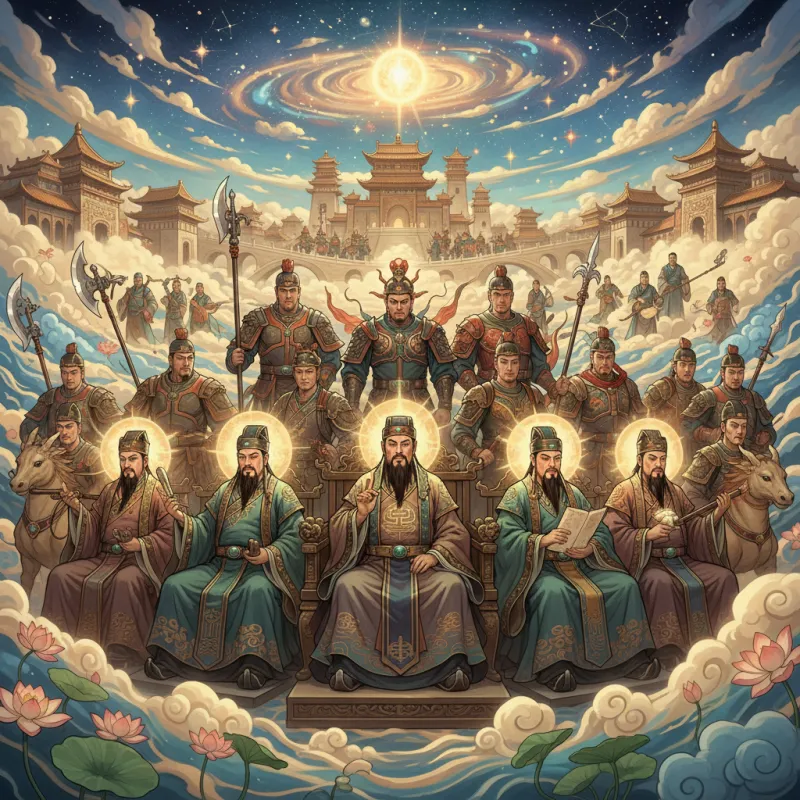
When lightning splits the sky and thunder shakes the earth, Chinese folk tradition doesn't see random meteorology — it sees an execution. Somewhere, a celestial general has just signed a death warrant, and the Thunder Ministry has carried out the sentence. This isn't metaphor. In the cosmology that shaped imperial China for over a millennium, heaven maintains an active military force, complete with ranks, weapons, and explicit authorization to kill.
The Celestial Bureaucracy's Armed Wing
The Jade Emperor (玉皇大帝 Yùhuáng Dàdì) doesn't rule through charisma. He rules through infrastructure, and infrastructure requires enforcement. While scholars debate the finer points of Daoist philosophy, the common people who actually practiced Daoism understood something more immediate: heaven has cops, and those cops have weapons.
The celestial military structure mirrors earthly government because that's exactly what it was designed to do. During the Song Dynasty (960-1279 CE), when the Daoist pantheon crystallized into its recognizable form, China was obsessed with bureaucratic organization. The celestial realm became a perfected version of the imperial system — every deity had a rank, every rank had responsibilities, and the whole apparatus was backed by armed force.
This wasn't abstract theology. Temple murals across China depict these warriors in explicit detail: armor styles that match specific dynasties, weapons that real soldiers carried, facial expressions that convey unmistakable menace. The message was clear — heaven's authority is enforced the same way earthly authority is enforced, through the credible threat of violence.
Lei Gong and the Thunder Ministry
The Ministry of Thunder (雷部 Léi Bù) operates as heaven's special forces unit, handling cases that require immediate, overwhelming force. Its commander, Lei Gong (雷公 Léi Gōng), appears in temple art as a blue-skinned figure with a bird's beak, wielding a hammer and chisel. The hammer strikes, the chisel directs the lightning, and someone on earth dies screaming.
Lei Gong doesn't act on whim. The Thunder Ministry operates under strict protocols — celestial bureaucrats must file the proper documentation before thunder gods can strike. But once authorization comes through, execution is swift and public. Lightning deaths were interpreted as divine punishment, and communities would investigate what crime the victim had committed to deserve heaven's wrath.
The ministry's second-in-command, Dian Mu (電母 Diàn Mǔ), the Lightning Mother, uses mirrors to illuminate targets for Lei Gong's strikes. She's often depicted as less wrathful than her superior, occasionally showing mercy by missing intentionally. But mercy is the exception. The Thunder Ministry's primary function is retribution, and it fulfills that function with industrial efficiency.
Historical records document how this belief shaped behavior. During the Ming Dynasty (1368-1644 CE), magistrates would sometimes delay executions during thunderstorm season, fearing that heaven might preempt earthly justice and strike the condemned before the official sentence could be carried out. The Thunder Ministry wasn't a distant abstraction — it was an active participant in the justice system.
The Four Heavenly Kings
While the Thunder Ministry handles punishment, the Four Heavenly Kings (四大天王 Sì Dà Tiānwáng) serve as heaven's border patrol. Borrowed from Buddhist cosmology but thoroughly integrated into Daoist practice, these four generals guard the cardinal directions and prevent demons from entering the celestial realm.
Each king commands an army of supernatural soldiers and specializes in specific threats. Vaishravana (多聞天王 Duōwén Tiānwáng), Guardian of the North, holds a pagoda that traps demons. Virudhaka (增長天王 Zēngzhǎng Tiānwáng), Guardian of the South, wields a sword that cuts through illusions. Dhritarashtra (持國天王 Chíguó Tiānwáng), Guardian of the East, plays a pipa that disrupts demonic magic. Virupaksha (廣目天王 Guǎngmù Tiānwáng), Guardian of the West, controls a serpent and pearl that symbolize his authority over water-dwelling threats.
Temple placement reflects their function — statues of the Four Heavenly Kings typically stand in the entrance hall, facing outward. They're not there to welcome worshippers. They're there to prevent anything malevolent from following worshippers inside. The symbolism is military, not hospitable.
Marshal Wen and the Plague Demons
Marshal Wen (溫元帥 Wēn Yuánshuài) commands heaven's most disturbing division — the plague demons. Yes, plague demons. In Daoist cosmology, diseases aren't random biological events. They're weapons deployed by celestial generals against populations that have collectively earned divine punishment.
Marshal Wen controls five plague demons, each responsible for different categories of disease. During epidemics, communities would perform elaborate rituals to appease Marshal Wen, essentially negotiating with heaven's biological warfare division to call off the attack. The rituals weren't metaphorical — they involved specific offerings, precise timing, and formal petitions written in bureaucratic language.
This might seem cruel until you understand the underlying logic. In a world without germ theory, epidemics needed explanation. The Daoist answer provided both explanation and agency — diseases came from heaven, which meant heaven could be negotiated with. Marshal Wen became a target for prayer not despite his role in causing plague, but because of it. Only the general who deployed the weapon could recall it.
The cult of Marshal Wen peaked during the Ming and Qing dynasties, when epidemic disease ravaged Chinese cities with regularity. His temples offered something modern medicine couldn't — a sense of control through ritual action. Whether the rituals worked is beside the point. They provided psychological relief in situations where no other relief existed.
Nezha: The Rebel General
Not all celestial warriors fit neatly into heaven's hierarchy. Nezha (哪吒 Nézhā) represents the chaotic element in heaven's military — the prodigy who's too powerful to control and too useful to eliminate. His story, popularized in the Ming Dynasty novel Fengshen Yanyi (封神演義 Fēngshén Yǎnyì), reads like a case study in divine child soldiers.
Born with supernatural powers, Nezha killed a dragon prince at age seven, committed suicide to spare his parents divine retribution, was resurrected in a lotus body by his teacher, then attempted to murder his own father. Eventually recruited into heaven's service, he became one of its most effective warriors — and one of its most unstable.
Nezha's weapons reflect his nature: the Universe Ring, Wind Fire Wheels, Fire-tipped Spear, and Armillary Sash. He fights with the recklessness of someone who's already died once and doesn't fear dying again. Temple depictions show him as a youth with three heads and six arms, riding wheels of fire — the visual language of barely controlled violence.
His popularity in folk religion reveals something important about how people understood celestial warriors. They weren't saints. They were weapons. Nezha's psychological instability didn't disqualify him from service — it made him more effective. Heaven's military, like earthly militaries, valued results over mental health.
The Celestial Military in Practice
These weren't abstract theological concepts. The celestial military shaped daily life in imperial China. When lightning struck a building, communities investigated what sin had been committed there. When epidemics spread, temples performed rituals to negotiate with Marshal Wen. When children misbehaved, parents invoked Nezha as both warning and aspiration — powerful but dangerous.
The system also provided social control. The belief that heaven actively monitored and punished wrongdoing reinforced moral behavior more effectively than any earthly law enforcement could. You might evade the magistrate, but you couldn't evade Lei Gong. The Thunder Ministry had perfect surveillance and absolute authority.
Modern scholars often treat these beliefs as quaint superstition, but that misses their sophistication. The celestial military provided a comprehensive framework for understanding misfortune, disease, and death. It offered agency in situations where humans had none. And it created a moral universe where justice, however delayed, was inevitable.
The Warriors We Needed
The celestial warriors of Daoism reflect the world that created them — violent, hierarchical, and obsessed with order. They're not the gentle immortals of philosophical Daoism, seeking harmony with the Dao. They're the enforcers of the Jade Emperor's bureaucratic heaven, maintaining cosmic order through force.
But they also reveal something deeper about Chinese religious imagination. These deities weren't distant or abstract. They were immediate, active, and terrifyingly real. When thunder rolled, Lei Gong was working. When plague struck, Marshal Wen had deployed his demons. When demons threatened, the Four Heavenly Kings stood guard.
This wasn't primitive thinking. It was sophisticated theology that addressed real human needs — the need to understand suffering, the need to feel protected, the need to believe that justice existed somewhere, even if only in heaven. The celestial warriors provided all three.
Today, their temples still stand across China and the Chinese diaspora. The incense still burns. The prayers still rise. Because even in a world with germ theory and meteorology, people still need to believe that someone, somewhere, is fighting on their behalf. The celestial warriors serve that need, just as they have for over a thousand years.
Related Reading
- The Mountain Gods: Nature Deities in the Daoist Pantheon — Shenxian Perspective
- The Jade Emperor: Ruler of Heaven
- The Complete Guide to Chinese Gods and Immortals
- The Three Pure Ones: Supreme Deities of Taoism
- The Three Pure Ones: Supreme Deities of Daoism — Shenxian Perspective
- The Lantern Festival: When Gods Walk Among Mortals
- Unveiling the Rich Tapestry of Chinese Deities and Immortals
- Buddhist Deities in Chinese Culture: How India's Gods Became Chinese