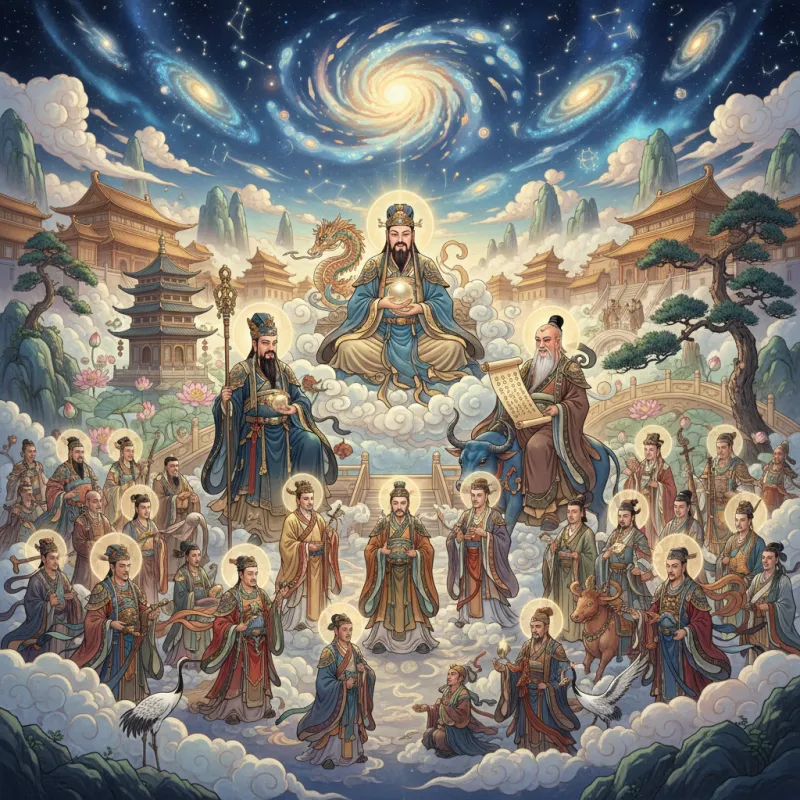
Most Daoist temples arrange their main altar the same way: three statues, seated side by side, representing beings so fundamental they existed before existence had a name. The Yuanshi Tianzun (元始天尊 Yuánshǐ Tiānzūn) sits in the center, flanked by Lingbao Tianzun (靈寶天尊 Língbǎo Tiānzūn) on his left and Daode Tianzun (道德天尊 Dàodé Tiānzūn) on his right. Together they form the Sanqing (三清 Sānqīng) — the Three Pure Ones — and they represent something Western theology struggles to articulate: deities who are not creators, not rulers, but living embodiments of cosmic principles that precede creation itself.
Beyond Personhood: What the Three Pure Ones Actually Are
The Three Pure Ones occupy a conceptual space that makes most religious frameworks uncomfortable. They are not gods in the sense of beings who made decisions and created the universe. They are not abstract principles either, since they have forms, names, and receive worship. The best way to understand them: they are the Dao (道 Dào) itself, differentiated into three aspects so human minds can approach the incomprehensible.
Yuanshi Tianzun — the Celestial Worthy of the Primordial Beginning — represents the Dao in its original, undifferentiated state. Before yin and yang separated, before the ten thousand things emerged, there was this: pure potential, the cosmic womb from which everything would eventually unfold. He holds a pearl or sphere in most depictions, symbolizing the primordial unity that contains all possibilities.
Lingbao Tianzun — the Celestial Worthy of Numinous Treasure — embodies the Dao as it begins to manifest, the moment when potential becomes kinetic. He represents the sacred texts, the transmission of cosmic knowledge, the bridge between the formless and the formed. In his hands he typically holds a ruyi scepter or sacred texts, tools of manifestation and teaching.
Daode Tianzun — the Celestial Worthy of the Way and its Virtue — is the Dao fully expressed in the phenomenal world. Most people know him by another name: Laozi (老子 Lǎozǐ), the semi-legendary author of the Daodejing (道德經 Dàodéjīng). He represents the Dao as it can be lived, practiced, and embodied by actual beings in actual time. He often holds a fan, symbolizing the gentle, non-coercive nature of true power.
The Hierarchy Problem: Why the Jade Emperor Reports to Nobody
Here is where things get interesting for anyone trying to map Chinese cosmology onto familiar religious structures. The Jade Emperor administers heaven, judges souls, commands celestial bureaucrats, and generally runs the day-to-day operations of the cosmos. But he does not outrank the Three Pure Ones. He cannot. They exist on a different axis entirely.
Think of it this way: a president governs a country, but does not govern the laws of thermodynamics. The laws of thermodynamics are not "above" the president in any administrative sense — they simply operate on a different level of reality. The Three Pure Ones are like that. They do not issue commands to the Jade Emperor because commands imply a temporal, administrative relationship. The Three Pure Ones simply ARE the conditions under which the Jade Emperor's authority is possible.
This is why Daoist temples place the Three Pure Ones in the highest position but rarely depict them doing anything. They do not need to act. Their existence is their function. The Jade Emperor must constantly adjudicate, delegate, and manage. The Three Pure Ones just sit there, being the fundamental structure of reality. It is a much better gig.
Historical Development: How Three Became One (Sort Of)
The Three Pure Ones did not spring fully formed from ancient Chinese religion. They evolved, and tracking that evolution reveals how Daoism itself developed from a philosophical tradition into an organized religion.
Early Daoist texts like the Daodejing and Zhuangzi (莊子 Zhuāngzǐ) do not mention the Three Pure Ones at all. They talk about the Dao as an impersonal principle, not as deities with names and iconography. The personification came later, during the Eastern Han dynasty (25-220 CE) and accelerated during the Six Dynasties period (220-589 CE), when Daoism was competing with Buddhism for institutional legitimacy and popular support.
Buddhism had its cosmic Buddhas — Vairocana, Amitabha, Akshobhya — beings who represented different aspects of enlightenment and occupied different cosmic realms. Daoism responded by developing its own supreme trinity, but with a crucial difference: the Three Pure Ones are not separate beings who achieved some exalted state. They are three faces of the same ultimate reality, the Dao itself looking at you from three angles.
By the Tang dynasty (618-907 CE), the Three Pure Ones were firmly established in Daoist liturgy and temple architecture. The Shangqing (上清 Shàngqīng) and Lingbao (靈寶 Língbǎo) scriptural traditions, which emerged during the Six Dynasties period, provided the theological framework and ritual practices that made the Three Pure Ones central to Daoist worship.
The Three Realms: Where the Pure Ones Dwell
Each of the Three Pure Ones presides over a celestial realm, and these realms are not just heavenly real estate — they represent stages of spiritual refinement and cosmic evolution.
Yuanshi Tianzun dwells in the Jade Pure Realm (玉清境 Yùqīng Jìng), the highest heaven, where the Dao exists in its most rarefied, undifferentiated form. This is not a place you visit. It is barely a place at all — more like the mathematical point from which all space unfolds.
Lingbao Tianzun occupies the Upper Pure Realm (上清境 Shàngqīng Jìng), where the Dao begins to take form as sacred knowledge and cosmic law. This is where the celestial bureaucracy gets its operating instructions, where the fundamental patterns that govern reality are stored and transmitted.
Daode Tianzun resides in the Great Pure Realm (太清境 Tàiqīng Jìng), the lowest of the three pure heavens but still far above the ordinary celestial realms where the Jade Emperor and other administrative deities work. This is where the Dao becomes accessible to cultivators, where immortals study and practice, where the abstract becomes concrete enough to be useful.
These three realms mirror the three dantian (丹田 dāntián) — energy centers in the human body that Daoist internal alchemy practices work to refine. The upper dantian in the head corresponds to Yuanshi Tianzun, the middle dantian in the chest to Lingbao Tianzun, and the lower dantian in the abdomen to Daode Tianzun. The macrocosm and microcosm reflect each other, as they always do in Daoist thought.
Worship and Practice: How to Approach the Unapproachable
Here is the paradox: the Three Pure Ones are so exalted, so fundamental, that they barely interact with human affairs — yet Daoists worship them constantly. How do you pray to the laws of physics?
The answer lies in understanding what Daoist worship actually does. You do not petition the Three Pure Ones for favors. You do not ask them to intervene in your life. Instead, you align yourself with them. You attune your being to the cosmic principles they embody. Worshiping the Three Pure Ones is less like asking a king for help and more like tuning a radio to the right frequency.
Daoist rituals directed toward the Three Pure Ones focus on purification, meditation, and the recitation of sacred texts. The goal is not to get their attention — you already have it, since they are the ground of your existence — but to clarify your own perception so you can recognize the Dao operating in and through you.
The most important ritual text associated with the Three Pure Ones is the Lingbao Wuliang Duren Shangpin Miaojing (靈寶無量度人上品妙經 Língbǎo Wúliàng Dùrén Shàngpǐn Miàojīng), usually shortened to the Duren Jing (度人經 Dùrén Jīng) or "Scripture of Salvation." Reciting this text is believed to harmonize the practitioner with the cosmic order the Three Pure Ones represent, and to generate merit that can save not just the reciter but all beings.
The Daode Tianzun Exception: When a Pure One Walks the Earth
Of the three, only Daode Tianzun has a terrestrial biography. The tradition identifies him with Laozi, the sage who supposedly wrote the Daodejing before riding a water buffalo west through the Hangu Pass and disappearing from history. This identification creates a fascinating theological wrinkle: one of the supreme cosmic principles incarnated as a human being, wrote a short book, and left.
The hagiographies of Laozi, compiled during the Han dynasty and elaborated in later centuries, describe him as having been born old (hence the name Laozi, "Old Master"), gestating in his mother's womb for decades or even centuries. Some versions claim he was born from his mother's left armpit. These are not meant as literal biology — they are mythic ways of saying that Daode Tianzun's incarnation as Laozi was not an ordinary birth but a deliberate manifestation of the Dao in human form.
This makes Daode Tianzun the most accessible of the Three Pure Ones. You can read his book. You can visit places associated with his life. You can study his teachings and try to embody them. Yuanshi Tianzun and Lingbao Tianzun remain forever in their celestial realms, but Daode Tianzun walked the same earth you walk, breathed the same air, and left instructions.
Why Three? The Logic of Cosmic Differentiation
The number three appears constantly in Daoist cosmology, and it is not arbitrary. The Daodejing itself says: "The Dao gives birth to one, one gives birth to two, two gives birth to three, and three gives birth to the ten thousand things." This is not numerology — it is a description of how complexity emerges from simplicity.
The Dao (zero, or the void before counting begins) manifests as primordial unity (one). That unity differentiates into yin and yang (two). The interaction of yin and yang produces a third thing — not a compromise between them, but something new that contains both and transcends both (three). From this triadic structure, infinite complexity unfolds.
The Three Pure Ones embody this process. Yuanshi Tianzun is the one, the undifferentiated unity. Lingbao Tianzun is the two, the moment of differentiation when the Dao begins to express itself in multiplicity. Daode Tianzun is the three, the synthesis that makes the ten thousand things possible. They are not three gods. They are one Dao, showing you how it becomes everything else.
Living With the Three Pure Ones
You do not need to be a Daoist priest to benefit from understanding the Three Pure Ones. Their existence points to something important: the universe operates according to principles that precede and transcend any particular being's will, including yours. You cannot negotiate with gravity. You cannot petition entropy to make an exception. But you can align yourself with these forces, work with them instead of against them, and find freedom in that alignment.
The Three Pure Ones sit in their temples, silent and still, reminding you that the deepest power is not the power to act but the power to be. The Celestial Masters may command armies, the Jade Emperor may judge souls, but the Three Pure Ones simply exist — and their existence makes everything else possible. That is the kind of power worth contemplating.
Related Reading
- Queen Mother of the West: Goddess of Immortality
- The Daoist Pantheon: A Bureaucracy of Gods
- The Daoist Pantheon: A Who's Who of Chinese Gods
- The Complete Guide to Chinese Gods and Immortals
- The Jade Emperor: Ruler of Heaven
- The Kitchen God: Heaven's Spy in Every Chinese Home
- Animal Deities in Chinese Religion: When Foxes, Snakes, and Turtles Become Gods
- Nüwa Repairs the Sky: The Goddess Who Saved the World