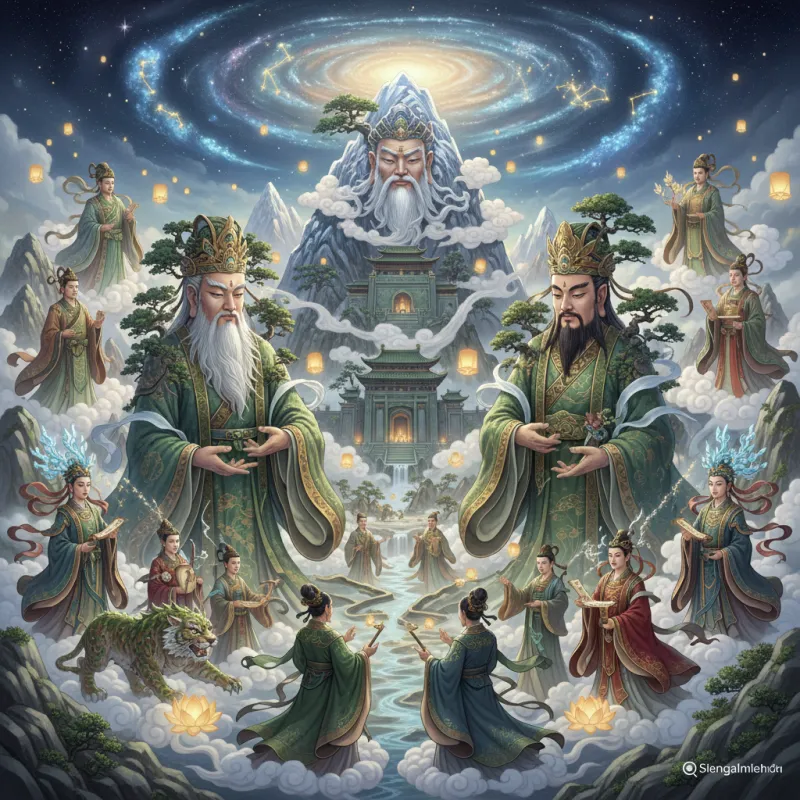
When the Tang Dynasty emperor Xuanzong climbed Mount Tai in 725 CE to perform the Feng-Shan sacrifices, he wasn't just honoring a mountain — he was negotiating with a divine bureaucrat whose jurisdiction covered life, death, and everything that happened on the eastern quarter of the known world. The mountain god of Tai Shan held more administrative power over human souls than most celestial officials. This wasn't metaphor. This was how the system worked.
The Five Sacred Peaks and Their Divine Administrators
The Five Great Mountains (五岳 Wǔyuè) form the skeletal structure of China's sacred geography. These aren't the tallest peaks — Mount Everest doesn't make the list — they're the most spiritually and politically significant. Each mountain god governs a cardinal direction and maintains order over a vast territorial jurisdiction.
Mount Tai (泰山 Tài Shān) in Shandong dominates the east. Its god, the Great Emperor of the Eastern Peak (东岳大帝 Dōngyuè Dàdì), controls human longevity and the bureaucracy of the dead. When you die, your soul reports to Mount Tai for judgment. The Department of Mount Tai (泰山府君 Tàishān Fǔjūn) processes souls with the efficiency of a well-run customs office. Seventy-two emperors performed sacrifices here — that's how seriously the political establishment took this mountain's divine authority.
Mount Hua (华山 Huà Shān) in Shaanxi guards the west. Known for its terrifying cliff paths and sheer granite faces, Mount Hua's god oversees martial prowess and the transformation of base metals into gold. Daoist alchemists specifically sought this mountain's blessing. The Western Peak Emperor (西岳大帝 Xīyuè Dàdì) has a reputation for being stern and unforgiving — appropriate for a mountain where one misstep means a thousand-foot fall.
Mount Heng (衡山 Héng Shān) in Hunan holds the south. Its god regulates fire, summer heat, and the life force that animates all living things. The Southern Peak Emperor (南岳大帝 Nányuè Dàdì) is associated with the vermillion bird and the element of fire. Buddhist temples and Daoist monasteries coexist on this mountain more peacefully than anywhere else in China — the mountain god apparently doesn't care about sectarian disputes.
Mount Heng (恒山 Héng Shān) — yes, same pronunciation, different character — in Shanxi protects the north. The Northern Peak Emperor (北岳大帝 Běiyuè Dàdì) controls water, winter, and the dark mysteries of the underworld. This mountain has the coldest spiritual temperature of the five. Its god is associated with the black tortoise and snake, symbols of longevity and hidden knowledge.
Mount Song (嵩山 Sōng Shān) in Henan occupies the center. The Central Peak Emperor (中岳大帝 Zhōngyuè Dàdì) acts as coordinator and mediator among the other four. The Shaolin Temple sits on this mountain, which tells you something about its importance as a spiritual crossroads. The central position gives this god authority over earth itself — agriculture, stability, and the literal ground beneath your feet.
The Bureaucratic Structure Below the Peaks
Each of the Five Great Mountains employs thousands of lesser mountain gods, earth spirits (土地神 tǔdìshén), and administrative deities. The hierarchy mirrors the imperial bureaucracy so closely that it's sometimes hard to tell whether the celestial system inspired the earthly one or vice versa. Probably both influenced each other in a feedback loop spanning millennia.
Below the Five Peak Emperors come the regional mountain gods — deities governing famous but secondary peaks. Mount Wutai (五台山 Wǔtái Shān) in Shanxi, sacred to Manjushri Bodhisattva, has its own mountain god who coordinates with Buddhist authorities. Mount Emei (峨眉山 Éméi Shān) in Sichuan, associated with Samantabhadra Bodhisattva, operates similarly. These mountains have split jurisdictions — the Buddhist bodhisattvas handle spiritual cultivation and enlightenment, while the mountain gods manage the physical territory and local populations.
Then come the county-level mountain gods, each responsible for a specific peak or range within a prefecture. These deities report upward through the chain of command and downward to the village earth gods. A farmer praying for rain might start with his local earth god, who forwards the request to the county mountain god, who passes it up to the regional deity, who might — if the request has merit and proper offerings were made — bring it to the attention of one of the Five Peak Emperors.
The Mountain God's Actual Job Description
What does a mountain god do all day? The job is more complex than you'd think. First, they maintain the physical integrity of the mountain itself — preventing landslides, managing water flow, ensuring the forests stay healthy. This isn't passive. In Daoist cosmology, mountains are living organisms with qi (气) circulation systems. The mountain god actively regulates this flow.
Second, they govern all spirits, animals, and humans within their jurisdiction. Every ghost, fox spirit, tree demon, and wandering immortal on that mountain answers to the mountain god. When the Journey to the West mentions local deities helping or hindering the pilgrims, these are usually mountain gods doing their jobs — maintaining order in their territories.
Third, they process administrative requests from both heaven and earth. A celestial official might order a mountain god to produce a specific medicinal herb for an immortal's cultivation. A human magistrate might petition the mountain god to reveal the location of a criminal hiding in the forests. The mountain god has to balance these competing demands while maintaining cosmic harmony.
Fourth, they serve as witnesses and record-keepers. Mountain gods observe everything that happens in their domains and report significant events upward. They're the surveillance system of the spirit world, though their reports focus on moral and spiritual violations rather than mere criminal activity.
The Lady of Mount Tai and Gender in Mountain Divinity
Most of the Five Peak Emperors are male, but the divine hierarchy includes powerful female mountain deities. The most famous is Bixia Yuanjun (碧霞元君), the Lady of Mount Tai, also called the Princess of the Azure Clouds. Her cult became so popular during the Ming and Qing dynasties that she arguably overshadowed the male Great Emperor of the Eastern Peak in popular devotion.
Bixia Yuanjun specializes in childbirth, children's health, and women's concerns. Millions of women have climbed Mount Tai to pray at her temples. Her jurisdiction overlaps with the mountain god's but focuses on different aspects — she handles the intimate, domestic, life-giving functions while the male deity manages death, judgment, and cosmic order. This division of labor reflects broader patterns in Chinese religious thought about complementary gender roles in maintaining universal balance.
Other mountains have female deities as primary or secondary rulers. The Queen Mother of the West (西王母 Xīwángmǔ) governs the Kunlun Mountains, though her status transcends the normal mountain god hierarchy — she's more like a cosmic empress who happens to live on a mountain. The relationship between the Queen Mother and the standard mountain bureaucracy remains deliberately ambiguous in the texts.
Mountain Gods in Literature and Popular Culture
The Investiture of the Gods (封神演义 Fēngshén Yǎnyì) provides detailed accounts of how various mountain gods received their appointments. Many were virtuous humans or defeated demons who earned their positions through merit or as consolation prizes after losing celestial battles. The novel treats mountain god appointments like government postings — some are prestigious, others are backwater assignments for minor figures.
Journey to the West features mountain gods constantly. They show up to provide information, offer assistance, or complain about the chaos Sun Wukong causes in their territories. The novel portrays them as middle-management bureaucrats — competent at their jobs but not particularly powerful compared to major demons or celestial warriors. When a serious threat appears, mountain gods typically call for backup from higher authorities rather than handling it themselves.
Strange Tales from a Chinese Studio (聊斋志异 Liáozhāi Zhìyì) includes numerous stories of mountain gods interacting with humans — sometimes romantically, sometimes as judges, sometimes as tricksters. Pu Songling's stories suggest that mountain gods have considerable autonomy in how they interpret and enforce celestial regulations. Some are strict legalists, others are flexible pragmatists, and a few are corrupt officials who can be bribed.
The Decline and Persistence of Mountain God Worship
The Communist period officially discouraged mountain god worship as feudal superstition, and many mountain temples were destroyed or converted to other uses during the Cultural Revolution. But the practice never completely disappeared. It went underground, merged with tourism, or disguised itself as cultural heritage preservation.
Today, mountain god worship is experiencing a revival. Temples on the Five Great Mountains receive millions of visitors annually. Some come as tourists, but many still burn incense and make offerings. The distinction between religious devotion and cultural tourism blurs deliberately — it's safer to claim you're appreciating traditional culture than to admit you're asking a mountain god to cure your mother's illness.
The environmental movement has given mountain god worship unexpected relevance. The idea that mountains are sacred living entities deserving protection and respect aligns well with ecological consciousness. Some environmental activists in China explicitly invoke mountain god traditions to argue for conservation policies. The mountain gods, it turns out, are excellent advocates for their own territories.
The Theological Problem of Mountain God Authority
Here's a question the texts never quite resolve: where does a mountain god's authority come from? Are they appointed by the Jade Emperor (玉皇大帝 Yùhuáng Dàdì) and therefore derive power from heaven? Or do they emerge naturally from the mountain itself, with heaven merely recognizing and organizing pre-existing spiritual forces?
Different texts give different answers. The bureaucratic model suggests appointment from above — mountain gods are celestial officials assigned to territorial posts. But older, more animistic traditions suggest mountains generate their own gods through accumulated spiritual power. A mountain that has existed for millions of years, witnessed countless events, and absorbed the prayers of generations naturally develops consciousness and authority.
The practical answer is probably both. The Daoist pantheon excels at incorporating contradictions. A mountain god might emerge naturally from the mountain's spiritual essence and then receive official appointment from heaven, legitimizing what already existed. This dual origin explains why mountain gods seem simultaneously wild and bureaucratic, ancient and contemporary, autonomous and subordinate.
The mountain gods remain essential to understanding how Daoist cosmology organizes space and power. They're not decorative additions to the pantheon — they're the foundation of how divine authority maps onto physical geography. Every mountain is a government office. Every peak is a throne. And the gods who sit on those thrones have been watching, recording, and judging for far longer than any human dynasty.
Related Reading
- The Jade Emperor: Ruler of Heaven
- Celestial Masters and Heavenly Generals: Daoism's Divine Warriors — Shenxian Perspective
- The Daoist Pantheon: A Bureaucracy of Gods
- The Three Pure Ones: Supreme Deities of Taoism
- Queen Mother of the West: Goddess of Immortality
- Creation Myths in Chinese Religion: How Gods Made the World
- How to Pray at a Chinese Temple: A Respectful Visitor's Guide
- Exploring the Enigmatic World of Chinese Immortals and Deities