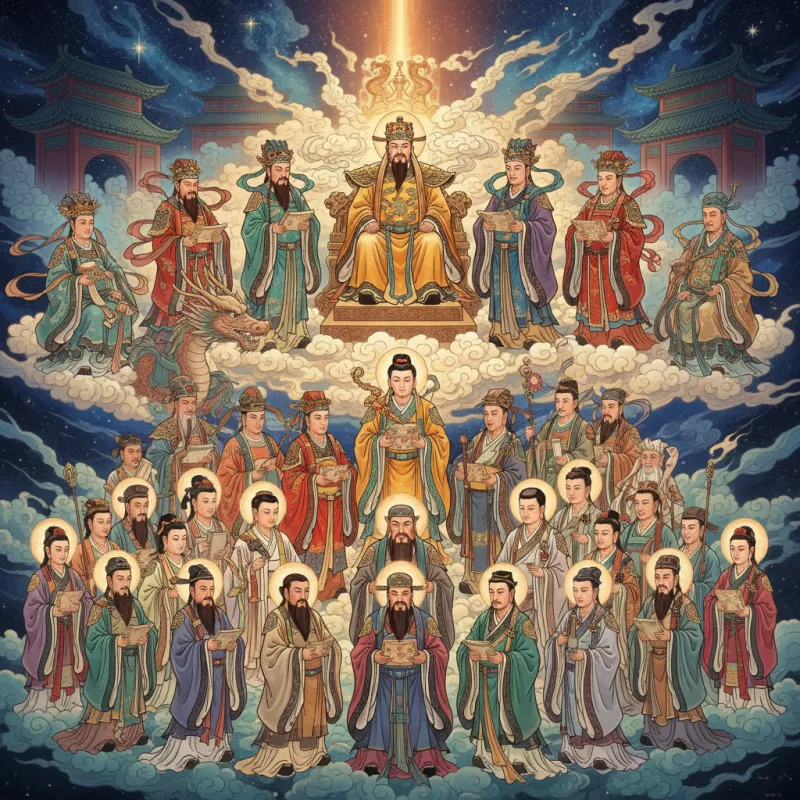
When the Tang Dynasty bureaucrat Zhang Guo died in 742 CE, he didn't retire to some ethereal paradise. He got a job. Specifically, he was appointed to the Department of Thunder in the celestial civil service, where he would spend eternity processing paperwork related to storms and divine retribution. This wasn't unusual. In the Daoist cosmos, death doesn't mean escape from bureaucracy—it means joining the ultimate bureaucracy, one so vast and complex it makes the IRS look like a lemonade stand.
The Celestial Civil Service Exam
The Daoist pantheon operates on a principle that would have made Max Weber weep with joy: heaven is a government office. Not a metaphorical one—an actual bureaucracy with departments, hierarchies, performance reviews, and yes, paperwork. The system emerged during the Han Dynasty (206 BCE - 220 CE) when Daoist theologians looked at the imperial administration and thought, "You know what? The gods probably work like this too."
They weren't being poetic. The celestial bureaucracy has ministries for everything: the Department of Epidemics, the Bureau of Time and Seasons, the Office of Wandering Ghosts, the Ministry of Thunder (where our friend Zhang Guo ended up). Each deity is essentially a civil servant with a specific portfolio. The God of Wealth doesn't just vaguely bless prosperity—he manages the cosmic treasury and approves funding requests. The Kitchen God files annual reports on every household's behavior, complete with supporting documentation.
This wasn't just theological speculation. It had real-world implications. When a drought struck, local officials didn't just pray—they filed formal complaints with the Dragon King's office, sometimes even "demoting" ineffective rain gods by removing their titles. The 16th-century novel Journey to the West captures this perfectly when Sun Wukong storms heaven and discovers that even the Peach Garden of Immortality has a facilities manager.
The Jade Emperor: CEO of the Cosmos
At the top of this divine org chart sits the Jade Emperor (玉皇大帝, Yùhuáng Dàdì), and here's where things get interesting: he's not the most powerful deity. He's the most administrative one. Think of him less as Zeus and more as the Secretary-General of the United Nations—powerful because of his position, not his raw divine might.
The Jade Emperor earned his position through merit, not birth. According to the Jade Emperor Scripture, he spent 3,200 cosmic epochs (each lasting millions of years) cultivating virtue and wisdom before being elected to the position by the other deities. Yes, elected. Heaven has a selection process. The Jade Emperor serves as the chief executive, coordinating between different departments, mediating disputes, and ensuring the cosmos runs smoothly. He's less concerned with creation myths and more focused on making sure the Department of Reincarnation isn't experiencing processing delays.
His palace, the Lingxiao Dian (凌霄殿, Hall of Divine Mists), functions like the Oval Office meets the Forbidden City. Deities line up for audiences, present petitions, and receive assignments. The Investiture of the Gods (封神演义, Fengshen Yanyi), a 16th-century novel, depicts the Jade Emperor conducting what amounts to a massive hiring spree after a celestial war, appointing 365 gods to various positions based on their qualifications and past performance.
The Three Pure Ones: Beyond Management
Here's where the Daoist system reveals its sophistication. Above the Jade Emperor—or more accurately, outside the entire bureaucratic structure—exist the Three Pure Ones (三清, Sānqīng). They're not administrators. They're not even really "gods" in the conventional sense. They're cosmic principles that happen to have personalities.
Yuanshi Tianzun (元始天尊, Yuánshǐ Tiānzūn), the Celestial Worthy of Primordial Beginning, represents the state before existence—pure potential, the Dao before it manifests. He doesn't govern; he simply is. Think of him as the source code of reality, while the Jade Emperor is the operating system.
Lingbao Tianzun (灵宝天尊, Língbǎo Tiānzūn), the Celestial Worthy of Numinous Treasure, embodies the Dao as it begins to differentiate into yin and yang, energy and matter. He's associated with the sacred texts and teachings that allow beings to understand cosmic principles. If Yuanshi is the source code, Lingbao is the documentation.
Daode Tianzun (道德天尊, Dàodé Tiānzūn), the Celestial Worthy of the Way and its Virtue, is the Dao as it manifests in the world. He's often identified with Laozi, the legendary author of the Daodejing, suggesting that the historical sage was actually an avatar of this cosmic principle. He's the user interface—the way humans can interact with the underlying reality.
The Three Pure Ones don't issue commands or manage departments. They exist in the Sanqing Heaven (三清天), beyond the administrative realm entirely. They're consulted, not commanded. The Jade Emperor might run heaven, but the Three Pure Ones are what heaven runs on.
Departmental Chaos: The Ministry of Thunder
Let's get specific. The Thunder Department (雷部, Léi Bù) perfectly illustrates how this bureaucracy functions—and how gloriously complicated it gets. The department isn't run by one thunder god but by an entire committee. Lei Gong (雷公), the Duke of Thunder, handles the actual thunder. Dian Mu (电母), the Mother of Lightning, manages the lightning. Yun Tong (云童), the Cloud Youth, is responsible for clouds. Yu Shi (雨师), the Rain Master, handles precipitation.
But wait, there's more. The Dragon Kings of the Four Seas also have jurisdiction over rain, leading to jurisdictional disputes that would make any government lawyer salivate. When a region needs rain, who gets the work order—the Rain Master or the local Dragon King? The answer depends on the type of rain, the region, and apparently, who filed the paperwork first.
The Journey to the West includes a subplot where the Dragon King of the Jing River is executed for releasing rain at the wrong time and in the wrong amount—he violated his work order. Not "wrong" in a moral sense, but wrong according to the specifications issued by the Department of Thunder. He was literally fired (and beheaded) for not following the memo.
Career Advancement in the Afterlife
Here's what makes this system fascinating from a social perspective: it's meritocratic. Sort of. Deities can be promoted, demoted, or even fired. Guan Yu (关羽), the famous Three Kingdoms general, started as a historical figure, was deified as a local protector god, got promoted to God of War, and eventually became Guan Di (关帝), one of the most powerful deities in the pantheon. His career trajectory took about 1,500 years, but still—he worked his way up.
Conversely, gods who fail at their jobs get demoted. During droughts, emperors would sometimes strip rain gods of their titles, essentially putting them on administrative leave until they improved their performance. The 19th-century scholar Gu Yanwu documented cases where local magistrates would chain up statues of ineffective gods and leave them in the sun until it rained—divine performance improvement plans.
This system reflects a deeply pragmatic worldview. The gods aren't worshipped because they're inherently worthy but because they're useful. They have jobs to do. If they don't do them, they face consequences. It's transactional, yes, but it's also oddly egalitarian. Even the Jade Emperor could theoretically be replaced if he mismanaged heaven badly enough.
The Bureaucracy of Salvation
The most mind-bending aspect of this system appears in the Department of Reincarnation, overseen by the Ten Kings of Hell (十殿阎王, Shí Diàn Yánwáng). When someone dies, they don't face a simple judgment. They go through a ten-stage review process, with each king examining different aspects of their life and assigning appropriate punishments or rewards. It's like having ten different judges review your case, each with specialized jurisdiction.
But here's the twist: the system has appeals processes. Families can hire Daoist priests to file petitions on behalf of deceased relatives, essentially submitting paperwork to reduce sentences or expedite reincarnation. The Jade Record (玉历宝钞, Yùlì Bǎochāo), a popular religious text, includes detailed instructions on how to navigate the afterlife bureaucracy, complete with which offerings to present to which officials.
This isn't corruption—it's how the system is designed to work. Merit can be transferred, debts can be paid, and sentences can be commuted through proper channels. It's bureaucracy all the way down, even in death. The Underworld Judges operate with the same procedural rigor as any earthly court, just with higher stakes.
Why This Matters
The Daoist bureaucratic pantheon reveals something profound about Chinese religious thought: the divine and the mundane aren't separate realms. They're the same system operating at different scales. When Chinese emperors claimed the Mandate of Heaven (天命, Tiānmìng), they weren't just using religious language for political legitimacy. They were asserting that earthly government and celestial government were part of the same administrative structure, with the emperor serving as the liaison between them.
This explains why Chinese religion never developed a strong church-state separation. How could it? The state was already part of the religious structure. The emperor performed sacrifices not as a religious leader but as a government official fulfilling his bureaucratic duties to his celestial superiors.
It also explains the Chinese approach to religious pluralism. If heaven is a bureaucracy, then different religious traditions are just different departments or different ways of filing paperwork. Buddhism, Daoism, and folk religion coexist because they're all part of the same administrative system, just handling different portfolios. The Buddhist Bodhisattvas aren't foreign gods invading the pantheon—they're consultants brought in for specialized projects.
The Daoist pantheon isn't a mythology in the Western sense. It's a working model of cosmic governance, one that assumes the universe operates on the same principles as a well-run (or sometimes poorly-run) government office. And honestly? Given the state of the universe, that might be the most realistic theology ever devised.
Related Reading
- Celestial Masters and Heavenly Generals: Daoism's Divine Warriors — Shenxian Perspective
- The Complete Guide to Chinese Gods and Immortals
- The Mountain Gods: Nature Deities in the Daoist Pantheon — Shenxian Perspective
- The Jade Emperor: Ruler of Heaven
- Queen Mother of the West: Goddess of Immortality
- He Xiangu: The Only Female Among the Eight
- Meet the Eight Immortals: Profiles of China's Favorite Supernatural Squad
- Maitreya: The Laughing Buddha