Guanyin: Complete Guide to China Most Beloved Bodhisattva
⏱️ 26 min read⏱️ 25 min read⏱️ 24 min readGuanyin: Complete Guide to China's Most Beloved Bodhisattva
Introduction: The Goddess of Mercy
Among all the deities venerated in Chinese religious culture, none commands more universal devotion than Guanyin (觀音, Guānyīn), the Bodhisattva of Compassion. From humble village temples to grand monasteries, from fishing boats to imperial palaces, Guanyin's serene image has offered solace to countless believers for over fifteen centuries. This remarkable figure transcends sectarian boundaries, appearing in Buddhist temples, Daoist shrines, and folk religious contexts alike.
The name Guanyin is a shortened form of Guanshiyin (觀世音, Guānshìyīn), meaning "Perceiver of the World's Sounds"—referring specifically to the cries of those who suffer. This bodhisattva embodies the Buddhist ideal of infinite compassion, having vowed to remain in the world until all sentient beings achieve enlightenment. Yet Guanyin's story in China is far more complex than a simple transmission of Indian Buddhism, representing instead a fascinating cultural transformation that made this deity uniquely Chinese.
Origins: From Avalokiteśvara to Guanyin
Guanyin originated from the Sanskrit Buddhist figure Avalokiteśvara, a male bodhisattva who appears prominently in Mahayana Buddhist texts. When Buddhism entered China during the Han Dynasty (206 BCE–220 CE), Avalokiteśvara came with it, initially depicted as a princely male figure with mustache and masculine features.
The earliest Chinese translation of the name appeared in the Lotus Sutra (法華經, Fǎhuá Jīng), one of the most influential Buddhist texts in East Asia. The 25th chapter, known as the "Universal Gateway of Guanshiyin Bodhisattva" (觀世音菩薩普門品, Guānshìyīn Púsà Pǔmén Pǐn), describes how the bodhisattva manifests in thirty-three different forms to save beings from seven disasters and three poisons. This text became the scriptural foundation for Guanyin worship in China.
During the Tang Dynasty (618–907 CE), something extraordinary occurred: Guanyin began to be depicted with increasingly feminine features. By the Song Dynasty (960–1279 CE), the transformation was complete—Guanyin had become predominantly female in Chinese religious art and popular imagination. This gender transformation, unique to East Asian Buddhism, reflects the Chinese cultural association of compassion and mercy with feminine qualities, as well as the influence of indigenous goddess worship traditions.
The Legend of Princess Miaoshan
The most popular origin story explaining Guanyin's feminine form centers on Princess Miaoshan (妙善, Miàoshàn), a legend that emerged during the Song Dynasty. According to this narrative, Miaoshan was the youngest daughter of King Miaozhuang (妙莊王, Miàozhuāng Wáng). Despite her father's wishes for her to marry, she insisted on becoming a Buddhist nun.
Enraged by her disobedience, the king subjected her to harsh labor at Baique Temple (白雀寺, Báiquè Sì), hoping to break her spirit. When she persevered with supernatural assistance—animals helping her with chores—the king ordered the temple burned. Miaoshan extinguished the flames with her bare hands but was subsequently executed.
Her spirit descended to hell, where her presence transformed the underworld into a paradise, disrupting the cosmic order. The King of Hell, Yanluo Wang (閻羅王, Yánluó Wáng), quickly sent her back to the living world. She was reborn on Fragrant Mountain (香山, Xiāng Shān), where she cultivated herself for nine years.
When her father fell gravely ill, only medicine made from the eyes and arms of one without anger could cure him. Miaoshan willingly sacrificed her own eyes and arms. Upon learning that his savior was his daughter, the king repented deeply. Moved by her filial piety and compassion, the Buddha transformed Miaoshan into the Thousand-Armed, Thousand-Eyed Guanyin (千手千眼觀音, Qiānshǒu Qiānyǎn Guānyīn).
This legend brilliantly synthesizes Buddhist compassion with Confucian filial piety (孝, xiào), making Guanyin deeply resonant with Chinese cultural values. The story's setting at Fragrant Mountain, identified with Mount Putuo (普陀山, Pǔtuó Shān) in Zhejiang Province, established this location as Guanyin's primary pilgrimage site in China.
The Thirty-Three Manifestations
According to the Lotus Sutra, Guanyin can manifest in thirty-three different forms (三十三應身, sānshísān yìngshēn) to meet the needs of different beings. These transformations demonstrate the bodhisattva's skillful means (方便, fāngbiàn) in saving sentient beings. The forms include:
- Buddha form, for those ready to be saved by a Buddha
- Pratyekabuddha form, for those who seek solitary enlightenment
- Brahma form, for celestial beings
- Layperson forms, for ordinary people
- Monk and nun forms, for monastics
- Elder and householder forms, for family leaders
- Official forms, for government servants
- Demon and spirit forms, even for non-human beings
This theological flexibility allowed Guanyin to be all things to all people, appearing in whatever form would be most effective for delivering beings from suffering. In Chinese popular religion, this concept expanded further, with Guanyin appearing as a fish-basket maiden (魚籃觀音, Yúlán Guānyīn), a white-robed figure (白衣觀音, Báiyī Guānyīn), or even as a child-giving goddess (送子觀音, Sòngzǐ Guānyīn).
Iconography and Artistic Representations
Guanyin's visual representations in Chinese art are remarkably diverse, yet certain forms have become canonical:
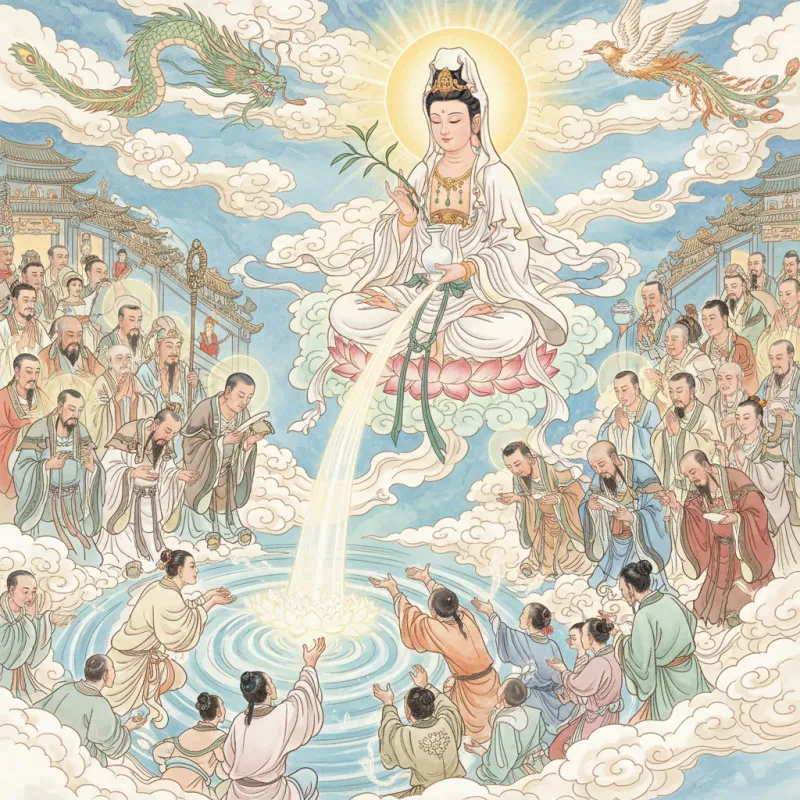
White-Robed Guanyin (白衣觀音, Báiyī Guānyīn): The most common depiction shows Guanyin in flowing white robes, seated in the "royal ease" posture (遊戲坐, yóuxì zuò) with one leg pendant. White symbolizes purity and compassion. This form often appears seated on a lotus throne or rocky outcrop, sometimes with a willow branch (楊柳, yángliǔ) in one hand and a vase of pure water (淨瓶, jìngpíng) in the other.
Thousand-Armed Guanyin (千手觀音, Qiānshǒu Guānyīn): This spectacular form displays multiple arms radiating from the central figure, each hand holding a different implement—weapons, lotus flowers, prayer beads, or ritual objects. Each hand represents a different method of saving beings, while the eyes in each palm symbolize the wisdom that guides compassionate action. The famous statue at Dazu Rock Carvings in Sichuan Province exemplifies this form's grandeur.
Water-Moon Guanyin (水月觀音, Shuǐyuè Guānyīn): Depicted contemplating the moon's reflection in water, this form represents the Buddhist teaching of emptiness and illusion. The Song Dynasty painter Zhou Jichang created masterful examples of this iconography, showing Guanyin in a bamboo grove beside a tranquil pool.
Child-Giving Guanyin (送子觀音, Sòngzǐ Guānyīn): Holding an infant or surrounded by children, this form became especially popular among women praying for offspring. This manifestation shows how Guanyin absorbed functions of earlier Chinese fertility goddesses.
South Sea Guanyin (南海觀音, Nánhǎi Guānyīn): Associated with Mount Putuo, this form shows Guanyin standing on ocean waves or a sea creature, protecting sailors and fishermen. The massive 108-meter statue at Nanshan Temple in Hainan represents this maritime aspect.
Sacred Sites and Pilgrimage
Mount Putuo (普陀山, Pǔtuó Shān), one of China's Four Sacred Buddhist Mountains, serves as Guanyin's primary earthly abode. Located on an island in Zhejiang Province's Zhoushan Archipelago, Putuo has been a pilgrimage destination since the Tang Dynasty. Legend states that a Japanese monk attempted to bring a Guanyin statue back to Japan, but the bodhisattva refused to leave, causing the ship to become stuck near Putuo. The monk built a temple there, establishing the island's sacred status.
The mountain hosts numerous temples, with Puji Temple (普濟寺, Pǔjì Sì), Fayu Temple (法雨寺, Fǎyǔ Sì), and Huiji Temple (慧濟寺, Huìjì Sì) forming the three major monasteries. Pilgrims perform the "three-step-one-bow" (三步一拜, sānbù yī bài) prostration practice, demonstrating extreme devotion. The island's caves, particularly Chaoyin Cave (潮音洞, Cháoyīn Dòng) and Fanyin Cave (梵音洞, Fànyīn Dòng), are believed to be places where devoted practitioners might glimpse Guanyin's true form.
Other significant Guanyin sites include Fragrant Mountain (香山, Xiāng Shān) near Beijing, associated with the Princess Miaoshan legend, and numerous local temples throughout China where Guanyin serves as the principal deity.
Worship Practices and Rituals
Guanyin worship encompasses both formal monastic rituals and popular devotional practices. The bodhisattva's birthday falls on the 19th day of the second lunar month, with two other festivals on the 19th of the sixth and ninth months commemorating enlightenment and renunciation respectively. These occasions draw massive crowds to temples.
Chanting and Mantras: Devotees recite Guanyin's name, "Namo Guanshiyin Pusa" (南無觀世音菩薩, Nánmó Guānshìyīn Púsà), meaning "Homage to Guanshiyin Bodhisattva." The six-syllable mantra "Om Mani Padme Hum" (唵嘛呢叭咪吽, Ǎn Mání Bāmī Hōng), though originally associated with Avalokiteśvara in Tibetan Buddhism, is also used in Chinese Guanyin worship. The Great Compassion Dharani (大悲咒, Dàbēi Zhòu), an 84-line incantation, is considered especially powerful for protection and healing.
Offerings: Worshippers present incense, flowers, fruit, and vegetarian food. Water offerings in small cups symbolize Guanyin's pure water that cleanses suffering. Some devotees offer willow branches, referencing Guanyin's iconographic attribute.
Divination: Many temples provide divination sticks (求籤, qiúqiān) where believers shake a container until one stick falls out, then receive an interpretive poem addressing their concerns. This practice, while not strictly Buddhist, has become integral to popular Guanyin worship.
Vegetarianism: Serious devotees often adopt vegetarian diets (吃素, chīsù), particularly on Guanyin's festival days, as an expression of compassion for all living beings.
Guanyin in Chinese Literature and Culture
Guanyin appears throughout Chinese literature, most famously in Journey to the West (西遊記, Xīyóu Jì), the 16th-century novel by Wu Cheng'en. In this classic, Guanyin serves as the patron and protector of the monk Xuanzang's pilgrimage to India, recruiting Sun Wukong (the Monkey King) and other disciples to serve as guardians. The bodhisattva repeatedly intervenes to rescue the pilgrims from demons and disasters, demonstrating both compassion and supernatural power.
In The Plum in the Golden Vase (金瓶梅, Jīn Píng Méi) and other Ming-Qing novels, characters invoke Guanyin's name during crises, reflecting the deity's integration into everyday life. Poetry throughout Chinese history references Guanyin as a symbol of mercy, purity, and salvation.
The phrase "Guanyin's heart" (觀音心腸, Guānyīn xīncháng) entered common usage to describe someone exceptionally compassionate. Conversely, "Buddha's face, snake's heart" (佛口蛇心, Fókǒu shéxīn) criticizes hypocrisy by contrasting Guanyin's benevolence with hidden malice.
Syncretism: Guanyin in Daoist and Folk Religion
Guanyin's popularity transcended Buddhist boundaries, becoming incorporated into Daoist and folk religious contexts. In Daoist temples, Guanyin sometimes appears alongside indigenous deities, demonstrating Chinese religion's syncretic nature. Some Daoist texts identify Guanyin as Cihang Zhenren (慈航真人, Cíháng Zhēnrén), a Daoist immortal who achieved enlightenment and became a bodhisattva.
In folk religion, Guanyin merged with various local goddesses and protective deities. Coastal communities particularly venerate Guanyin as a maritime protector, sometimes conflating the bodhisattva with Mazu (媽祖, Māzǔ), the Daoist sea goddess. This syncretism reflects Chinese religious pragmatism—believers care less about theological purity than about accessing divine assistance.
The child-giving function represents another syncretic development, as Guanyin absorbed roles previously held by indigenous fertility goddesses. Women seeking pregnancy would visit Guanyin temples, sometimes taking home small clay figurines of children (泥娃娃, ní wáwa) blessed by the bodhisattva, promising to return with offerings after successful childbirth.
Modern Devotion and Global Influence
Guanyin worship remains vibrant in contemporary China despite decades of religious restriction. The reform era has seen temple restoration and renewed pilgrimage activity. Mount Putuo receives millions of visitors annually, while urban temples maintain active Guanyin devotion. Modern Chinese people, even those not formally Buddhist, often maintain household Guanyin images and invoke the bodhisattva during difficulties.
The diaspora has spread Guanyin worship globally. Chinese communities worldwide maintain Guanyin temples, from San Francisco's Tin How Temple to Singapore's Kwan Im Thong Hood Cho Temple. The bodhisattva has also attracted non-Chinese devotees drawn to the figure's universal message of compassion.
Contemporary artists continue creating Guanyin images, from traditional sculptures to modern interpretations. The 108-meter Guanyin statue at Nanshan Temple in Hainan, completed in 2005, demonstrates continued investment in monumental religious art. Digital media has enabled new forms of devotion, with apps providing daily Guanyin mantras and online communities sharing devotional practices.
Conclusion: The Enduring Appeal of Infinite Compassion
Guanyin's transformation from an Indian male bodhisattva to China's most beloved goddess represents one of religious history's most remarkable cultural adaptations. This figure succeeded in China precisely because it could absorb and reflect Chinese values—filial piety, feminine compassion, practical assistance with worldly problems—while maintaining Buddhist theological depth.
The bodhisattva's promise to hear every cry of suffering and manifest in whatever form necessary to provide help offers believers a deeply personal relationship with the divine. Whether as a sophisticated Buddhist teaching about emptiness and compassion or as a motherly figure who grants children and protects sailors, Guanyin remains accessible to all.
In an era of rapid change and persistent suffering, Guanyin's message of infinite compassion continues to resonate. The image of the serene bodhisattva, willow branch in hand, ready to sprinkle pure water that cleanses all afflictions, provides comfort to millions. As long as beings suffer, the tradition holds, Guanyin will remain in the world, perceiving their cries and manifesting salvation. This promise ensures that China's Goddess of Mercy will continue inspiring devotion for generations to come.
About the Author
Immortal Scholar — A specialist in buddhist figures and Chinese cultural studies.
Related Articles
Dizang Wang: The Bodhisattva Who Vowed to Empty Hell
The Bodhisattva Who Vowed to Empty Hell...
Maitreya and the Laughing Buddha: Future Buddha in Chinese Culture
Future Buddha in Chinese Culture...
Exploring the Rich Tapestry of Chinese Deities and Immortals in Buddhism and Daoism
Discover the fascinating world of Chinese deities and their impact on culture....
Dizang: The Bodhisattva Who Empties Hell
The Bodhisattva Who Empties Hell...