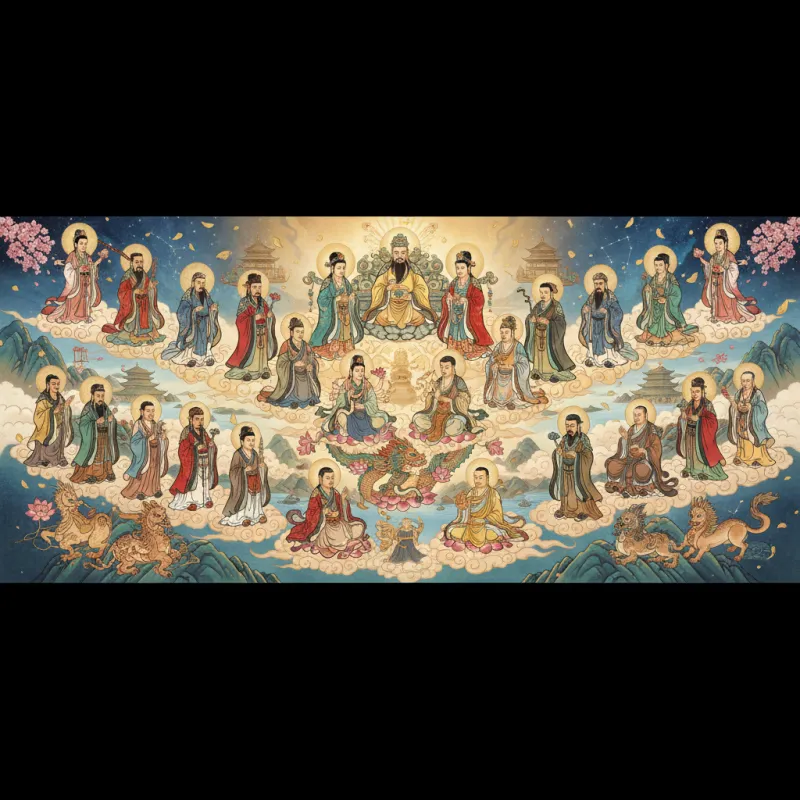
Picture this: A peasant farmer in Tang Dynasty China kneels before two altars in his modest home. On the left, incense curls toward a statue of Guanyin (观音), the Buddhist bodhisattva of compassion. On the right, offerings of wine and fruit honor the Eight Immortals (八仙, Bāxiān), those rowdy Daoist heroes who achieved transcendence through alchemy and virtue. To modern eyes, this might seem contradictory—mixing Buddhist and Daoist figures like shuffling two different decks of cards. But to that farmer, and to millions of Chinese across centuries, these weren't competing systems. They were complementary paths up the same mountain, each deity serving a specific need in the vast cosmic bureaucracy that governed everything from rainfall to reincarnation.
This is the reality of Chinese religious life: messy, syncretic, and utterly practical. The pantheon of Chinese deities and immortals isn't a neat theological system—it's a living, breathing marketplace of divine power where Buddhist bodhisattvas share temple space with Daoist immortals, and both might rub shoulders with deified historical figures. Understanding this world requires abandoning Western categories of "religion" and embracing something far more interesting.
The Daoist Immortals: Rebels, Alchemists, and Cosmic Bureaucrats
Daoism gave China its immortals (仙, xiān)—beings who transcended death through cultivation practices, alchemical experiments, or sheer moral virtue. Unlike the distant, abstract deities of some traditions, Daoist immortals often started as humans with very human flaws. Take Lü Dongbin (吕洞宾), one of the Eight Immortals, who failed the imperial examinations and turned to Daoist cultivation out of frustration. Or Han Xiangzi (韩湘子), nephew of the famous Tang Dynasty scholar Han Yu, who chose the wandering life of an immortal over bureaucratic success.
The Eight Immortals embody this accessibility. They're not solemn saints but a ragtag crew: a crippled beggar (Li Tieguai, 李铁拐), a gender-fluid youth (Lan Caihe, 蓝采和), an old woman with a cane (He Xiangu, 何仙姑). Each achieved immortality through different means—some through alchemy, others through meditation or moral perfection. Their stories, popularized in Ming Dynasty novels and operas, show that transcendence wasn't reserved for monks in mountain caves. Anyone could become an immortal with the right combination of practice, luck, and cosmic timing.
But Daoism also developed a vast celestial bureaucracy that would make any imperial administrator proud. At the top sits the Jade Emperor (玉皇大帝, Yùhuáng Dàdì), who governs heaven like an emperor governs earth—complete with ministries, departments, and endless paperwork. Below him are countless gods managing everything from thunder to smallpox. This bureaucratic heaven reflects a distinctly Chinese worldview: the cosmos operates like a well-run (or sometimes poorly-run) government, and you can petition the gods just like you'd petition a magistrate.
Buddhist Bodhisattvas: Compassion Meets Chinese Soil
When Buddhism arrived in China during the Han Dynasty (around 1st century CE), it brought its own pantheon of enlightened beings. But something fascinating happened: these Indian Buddhist figures transformed as they took root in Chinese soil. The most dramatic example is Guanyin (观音, Guānyīn), originally the male bodhisattva Avalokiteśvara. In China, Guanyin gradually became female—or perhaps more accurately, transcended gender entirely—embodying a particularly Chinese understanding of compassion as nurturing and maternal.
Guanyin's popularity in China exceeds almost any other Buddhist figure, and for good reason. She's accessible, merciful, and responds to desperate prayers with immediate help. Unlike the remote Buddha figures absorbed in meditation, Guanyin actively intervenes in human affairs. Drowning at sea? Call on Guanyin. Struggling with infertility? Guanyin might grant you a child. This practical, responsive quality made her beloved across all social classes, from emperors to fishermen.
Other bodhisattvas found their niches too. Dizang (地藏, Dìzàng, Sanskrit: Kṣitigarbha) became the lord of the underworld, vowing not to achieve Buddhahood until all hells are empty—a promise that resonates with Chinese concerns about ancestral spirits and proper burial rites. Wenshu (文殊, Wénshū, Sanskrit: Mañjuśrī) and Puxian (普贤, Pǔxián, Sanskrit: Samantabhadra) represent wisdom and practice respectively, often flanking Buddha statues in Chinese temples. Each bodhisattva offers a different path, a different kind of help, creating a diverse portfolio of divine assistance.
The Syncretic Reality: When Traditions Blur
Here's where it gets really interesting. By the Song Dynasty (960-1279 CE), the boundaries between Daoist and Buddhist figures had become wonderfully blurred. Temples might house both traditions under one roof. Deities borrowed attributes from each other. Folk religion absorbed both into a practical system focused less on theological purity and more on results.
Consider the Four Heavenly Kings (四大天王, Sì Dà Tiānwáng), originally Buddhist guardian deities from India. In Chinese temples, they stand at the entrance wielding weapons and looking fierce—but their iconography and function overlap significantly with Daoist protective deities. Or look at the City God (城隍, Chénghuáng), a purely Chinese creation that combines Daoist cosmology with Buddhist karmic justice and Confucian bureaucratic order. The City God judges souls after death, maintains order in the spirit world, and reports to higher celestial authorities—a perfect synthesis of all three traditions.
This syncretism wasn't theological confusion; it was theological sophistication. Chinese religious practitioners understood that different traditions offered different tools for different problems. Need help passing the imperial exams? Pray to Wenchang (文昌), the Daoist god of literature. Worried about karmic consequences? Better consult Buddhist teachings on cause and effect. Want protection from demons? Both traditions have options, so why not use both?
Immortality Through Cultivation: The Daoist Path
The Daoist pursuit of immortality (长生, chángshēng) deserves special attention because it's so distinctly Chinese. Unlike Buddhist enlightenment, which seeks escape from the cycle of rebirth, Daoist immortality aims to perfect and preserve the physical body indefinitely. This involves complex practices: alchemical elixirs (often dangerously toxic), breathing exercises (qigong, 气功), sexual cultivation techniques, dietary restrictions, and meditation.
The quest for immortality produced both profound insights and spectacular failures. Emperors died from mercury poisoning after consuming "immortality pills." Alchemists accidentally invented gunpowder while trying to create the elixir of life. Yet the underlying philosophy—that humans can transform themselves through disciplined practice—profoundly influenced Chinese medicine, martial arts, and self-cultivation traditions that continue today.
Internal alchemy (内丹, nèidān) eventually replaced external alchemy's dangerous chemical experiments. Instead of ingesting cinnabar and lead, practitioners cultivated their internal energies, transforming jing (精, essence) into qi (气, vital energy) into shen (神, spirit). This process, described in texts like the Cantong Qi (参同契) from the Han Dynasty, created a sophisticated map of spiritual transformation that parallels Buddhist meditation practices while maintaining a distinctly Daoist flavor.
The Pantheon in Popular Culture: Novels and Opera
Much of what ordinary Chinese people knew about deities and immortals came not from religious texts but from popular literature. The Ming Dynasty novel Journey to the West (西游记, Xīyóu Jì) features a wild cast including the Jade Emperor, Buddha, Guanyin, and various Daoist immortals, all interacting in a cosmic adventure story. The novel treats the pantheon with both reverence and humor—gods can be petty, bureaucratic, and occasionally incompetent, just like earthly officials.
Investiture of the Gods (封神演义, Fēngshén Yǎnyì), another Ming novel, tells how various heroes and villains from the Shang-Zhou transition became deified, creating a detailed mythology of how the celestial bureaucracy was staffed. These stories weren't just entertainment; they were religious education, teaching people which gods controlled what domains and how to properly approach them.
Opera and local theater traditions spread these stories even further. Illiterate peasants who never read a religious text could watch operas about the Eight Immortals crossing the sea or Guanyin rescuing sailors from storms. This performative tradition kept the pantheon alive and relevant, adapting stories to local concerns and contemporary issues.
Living Traditions: Deities and Immortals Today
Despite decades of modernization and political upheaval, Chinese deities and immortals remain remarkably alive in contemporary practice. Temples across China, Taiwan, Hong Kong, and overseas Chinese communities continue to honor both Buddhist and Daoist figures. Guanyin's birthday (the 19th day of the second lunar month) draws massive crowds. The Eight Immortals appear on everything from restaurant decorations to New Year paintings, their images promising longevity and good fortune.
What's striking is how these figures adapt to modern needs while maintaining their essential characters. Guanyin receives prayers about job interviews and visa applications alongside traditional requests for children and healing. The God of Wealth (财神, Cáishén)—a Daoist deity—gets special attention from businesspeople and stock traders. Even young, educated Chinese who consider themselves non-religious might still burn incense before exams or consult temple fortune sticks when facing major decisions.
The pantheon's flexibility is its strength. Unlike rigid monotheistic systems, Chinese religious practice allows people to engage with whichever deities or immortals suit their current needs. This isn't superficial shopping for divine favors—it's a sophisticated understanding that the sacred manifests in multiple forms, each offering different paths to the same ultimate reality. Whether you approach through Daoist cultivation, Buddhist compassion, or folk religious pragmatism, you're climbing that same mountain the Tang Dynasty farmer understood so well.
For more on specific Buddhist figures in Chinese tradition, explore Guanyin's transformation in Chinese Buddhism or discover how Buddhist and Daoist practices merged in Chinese temples.
Related Reading
- Maitreya: The Laughing Buddha
- Dizang: The Bodhisattva Who Empties Hell
- Guanyin: The Goddess of Mercy
- Exploring the Rich Tapestry of Chinese Deities and Immortals in Buddhism and Daoism
- Unveiling the Mystique of Chinese Animal Spirits in Daoist and Buddhist Beliefs
- Unveiling the Rich Tapestry of Chinese Deities and Immortals
- Unveiling the Rich Tapestry of Chinese Deities and Immortals in Folk Religion