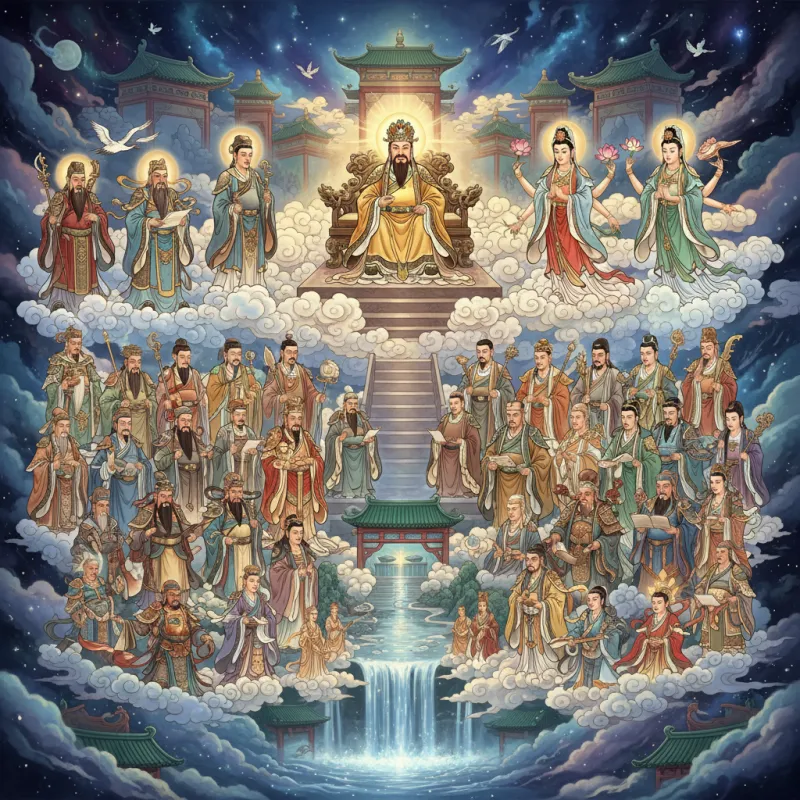
Picture this: a deity files a complaint about territorial jurisdiction, another submits a performance review for promotion, and somewhere in the celestial archives, an immortal clerk stamps documents with a jade seal. This isn't a parody—it's how Chinese heaven actually works. While Western paradise promises harps and clouds, the Chinese celestial realm runs on paperwork, hierarchies, and the occasional bureaucratic scandal.
The Logic Behind Celestial Bureaucracy
The Chinese didn't imagine heaven as an escape from earthly concerns—they projected their most successful organizational model upward. During the Han Dynasty (206 BCE - 220 CE), when the imperial bureaucracy reached unprecedented sophistication, the celestial hierarchy crystallized into its recognizable form. If a merit-based civil service could govern millions of mortals, why wouldn't the cosmos operate the same way?
This wasn't mere anthropomorphism. It reflected a profound philosophical assumption: order, not chaos, governs reality. The Daoist concept of the Dao (道) as natural law found its administrative expression in heaven's departments. Even the Buddhist influence, arriving via the Silk Road, adapted to this framework—bodhisattvas became celestial officials, karma became a cosmic accounting system.
The Journey to the West (西遊記, Xī Yóu Jì), written by Wu Cheng'en in the 16th century, satirizes this system brilliantly. Sun Wukong (孫悟空) receives the title "Keeper of the Heavenly Horses"—a glorified stable boy position—and nearly destroys heaven when he realizes he's been bureaucratically insulted. The novel's humor works precisely because readers recognized the celestial court as a mirror of Ming Dynasty officialdom, complete with its pomposity and politics.
The Power Structure: Who Really Runs Heaven?
Here's where it gets complicated. The Jade Emperor (玉皇大帝, Yù Huáng Dà Dì) sits on the throne, but his authority isn't absolute. In Daoist cosmology, the Three Pure Ones (三清, Sān Qīng)—Yuanshi Tianzun (元始天尊), Lingbao Tianzun (靈寶天尊), and Daode Tianzun (道德天尊, often identified with Laozi)—represent primordial cosmic forces that predate the Jade Emperor. They're like constitutional principles that even the emperor must respect.
The Queen Mother of the West (西王母, Xī Wáng Mǔ) commands her own power base, controlling the Peaches of Immortality and presiding over female immortals. She's not the Jade Emperor's wife in most traditions—she's an independent sovereign whose authority derives from ancient shamanic roots predating organized Daoism. When Sun Wukong crashes her Peach Banquet in Journey to the West, he's not just stealing fruit; he's violating the celestial social calendar that maintains cosmic harmony.
Then there's Guan Yu (關羽), the deified general from the Three Kingdoms period (220-280 CE), who became a god through popular acclaim rather than cosmic appointment. His temples outnumber those of many "official" deities, proving that in Chinese religion, grassroots devotion can override bureaucratic hierarchy. He's simultaneously a Buddhist guardian, a Daoist deity, and a Confucian exemplar of loyalty—a celestial triple threat.
Departments and Jurisdictions
The celestial administration divides reality into manageable portfolios. Lei Gong (雷公), the Thunder Duke, doesn't just make noise—he executes heaven's punishments, striking down the wicked with lightning. His wife, Dianmu (電母), the Lightning Mother, illuminates targets so Lei Gong doesn't miss. It's cosmic quality control.
Feng Bo (風伯), the Wind Earl, and Yu Shi (雨師), the Rain Master, coordinate weather patterns. Farmers prayed to them for centuries, and local officials held them accountable during droughts. In the Investiture of the Gods (封神演義, Fēng Shén Yǎn Yì), these positions are filled by mortals who died during the Shang-Zhou transition (11th century BCE), suggesting that celestial appointments reward earthly service—or compensate for tragic deaths.
The Department of Literature under Wenchang Wang (文昌王) might seem quaint until you remember that imperial examinations determined social mobility for over a millennium. Students burned incense to Wenchang before exams, and his celestial bureaucrats supposedly recorded every scholar's merit. When the examination system ended in 1905, Wenchang's worship declined—proof that celestial relevance depends on earthly institutions.
Yanluo Wang (閻羅王), ruler of the underworld, manages the afterlife's ten courts, each specializing in specific sins. The Journey to the West depicts him as harried and overworked, frantically checking his registers when Sun Wukong erases his own death date. Even death operates on paperwork in this system.
Promotion, Demotion, and Divine Politics
Deities aren't born—they're appointed. The Investiture of the Gods describes how Jiang Ziya (姜子牙), armed with the Fengshen Bang (封神榜, List of Deified Gods), assigns celestial positions to fallen warriors. Some receive prestigious posts; others get minor roles. The novel suggests that even in death, your career trajectory matters.
Historical figures routinely ascend to godhood through imperial decree. The Tang Dynasty emperor canonized Guan Yu as a deity in 1614—yes, 1614, over 1,300 years after Guan Yu's death. The Qing Dynasty promoted him further. These weren't metaphorical honors; they were official appointments in the celestial bureaucracy, complete with temples (offices) and priests (staff).
Demotion happens too. Local gods who fail to answer prayers might find their temples demolished or their titles revoked. The Strange Tales from a Chinese Studio (聊齋誌異, Liáo Zhāi Zhì Yì) by Pu Songling includes stories of minor deities desperately trying to fulfill their quotas, like celestial middle managers facing performance reviews.
Corruption exists even in heaven. The Journey to the West features celestial officials accepting bribes, covering up scandals, and forming factions. When Sun Wukong rebels, he exposes heaven's dysfunction—the bureaucracy has become so complex that nobody can effectively govern it. Sound familiar?
The Underworld Connection
Heaven's bureaucracy extends downward. The Ten Courts of Hell process souls with terrifying efficiency, each court specializing in particular sins. The First Court sorts souls; the Second Court punishes thieves; the Fifth Court handles financial crimes. It's like a cosmic justice system with specialized divisions.
Dizang Wang (地藏王, Kṣitigarbha in Sanskrit) vowed not to achieve Buddhahood until hell is empty—an impossible task that makes him the underworld's eternal civil servant. His compassion operates within bureaucratic constraints; he can advocate for souls but can't override the system. Even mercy requires proper channels.
The City God (城隍, Chéng Huáng) serves as the local administrator, reporting to higher celestial authorities while managing earthly affairs. Every major city had a City God temple where officials reported their governance—a literal interface between human and divine bureaucracy. When a new magistrate took office, he'd ceremonially inform the City God, acknowledging dual accountability.
Why This Matters Beyond Mythology
The celestial bureaucracy reveals how Chinese culture processes power, order, and justice. It's not escapist fantasy—it's political philosophy in mythological form. The system assumes that hierarchy, properly managed, creates harmony. It validates meritocracy while acknowledging that even merit-based systems can become corrupt.
This worldview shaped Chinese governance for millennia. Emperors claimed the Mandate of Heaven, but that mandate could be revoked for misrule. Officials studied Confucian classics to serve both earthly and cosmic order. The celestial bureaucracy wasn't separate from politics—it was the ultimate political model.
Modern readers might see this as quaint, but consider: we still organize reality into departments, jurisdictions, and hierarchies. We still believe that proper administration can solve cosmic-scale problems. The Chinese simply made that assumption explicit, populating heaven with the same officials, paperwork, and politics that governed earth.
When you read Journey to the West or watch a Chinese fantasy drama, you're not just seeing mythology—you're seeing a civilization's deepest assumptions about how order emerges from chaos, how power should be structured, and why even immortals need a good filing system. The celestial bureaucracy endures because it reflects something true about how humans organize meaning, whether in heaven, earth, or the space between.
Related Reading
- Celestial Warriors: The Mightiest Fighters in Chinese Heaven
- The Heavenly Court: How Chinese Mythology Organized the Universe Like a Government Office
- The Jade Emperor: Supreme Ruler of the Chinese Heavens
- Exploring the Rich Tapestry of Chinese Deities and Immortals in the Heavenly Court
- Sun Wukong: The Great Sage Who Challenged Heaven — Shenxian Perspective
- Sun Wukong as a Real Deity: Temples and Worship of the Monkey God
- Types of Immortals (仙): A Classification Guide
- Unveiling the Rich Tapestry of Chinese Deities and Immortals