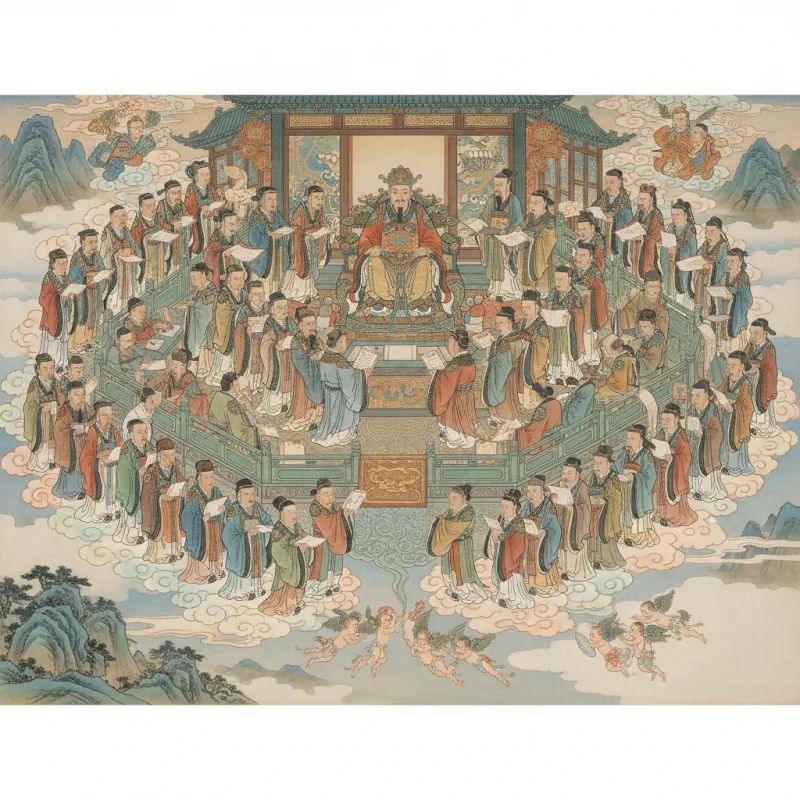
Picture this: A deity files a formal complaint because another god's dragon violated airspace regulations. The case goes to the Department of Thunder, which forwards it to the Ministry of Water, which kicks it back citing jurisdictional issues. Meanwhile, three immortals wait in the celestial lobby for their promotion paperwork to clear. This isn't satire—this is exactly how Chinese mythology describes heaven.
The Heavenly Court (天庭, tiāntíng) operates like the world's most elaborate government office, complete with bureaucratic red tape, interdepartmental turf wars, and a org chart that would make any HR department weep. While Western mythologies gave their gods personalities and drama, Chinese mythology gave them job descriptions and performance reviews.
The Imperial Template
Chinese heaven mirrors the structure of imperial government so precisely that you could swap the characters between heaven and earth without changing the organizational chart. This wasn't accidental—it was ideological. If the emperor ruled by the Mandate of Heaven (天命, tiānmìng), then heaven itself must operate on the same principles that legitimized earthly rule.
The system crystallized during the Tang Dynasty (618-907 CE), when Daoist theologians formalized the celestial hierarchy. They weren't being creative—they were being literal. The Jade Emperor (玉皇大帝, Yùhuáng Dàdì) became heaven's Son of Heaven, complete with a cabinet of ministers, each overseeing specific cosmic departments. The Department of Thunder (雷部, léibù) handled weather and punishment. The Department of Epidemics (瘟部, wēnbù) managed disease. The Department of Wealth (财部, cáibù) controlled prosperity.
Every deity had a rank, a title, and a clearly defined scope of authority. The God of Literature (文昌帝君, Wénchāng Dìjūn) couldn't interfere with military matters—that was the domain of Guan Yu (关羽, Guān Yǔ), who received his celestial promotion centuries after his death. Crossing jurisdictional lines required formal petitions and approval from higher authorities.
Paperwork in Paradise
The most distinctly Chinese aspect of heaven? The documentation. Chinese mythology is obsessed with record-keeping in a way that would make Kafka proud. The Department of Destiny (命部, mìngbù) maintains files on every human life—birth dates, death dates, karmic debts, future prospects. When Sun Wukong (孙悟空, Sūn Wùkōng) in Journey to the West wants to become immortal, he doesn't seek enlightenment—he breaks into the celestial archives and erases his name from the death registry.
This isn't played for laughs. The novel treats it as a legitimate bureaucratic hack. Heaven's power rests not in divine omnipotence but in administrative control. Destroy the records, disrupt the system.
The City God (城隍, Chénghuáng) system exemplifies this perfectly. Every Chinese city had a City God who reported to regional deities, who reported to provincial authorities, who reported to the Jade Emperor. These gods filed monthly reports on local affairs, maintained population registers, and processed the souls of the deceased. When someone died, their soul appeared before the City God for an initial hearing before being forwarded to the Ten Courts of Hell for final judgment—a process that involved multiple levels of review, appeals, and documentation.
The Promotion System
Chinese deities aren't born—they're promoted. This might be the most radical departure from other mythological systems. Gods earn their positions through merit, just like imperial officials earned theirs through civil service examinations.
Guan Yu started as a mortal general in the Three Kingdoms period (220-280 CE). His loyalty and martial prowess earned him posthumous honors, then temple worship, then official recognition as a god of war, then elevation to the Heavenly Court. By the Ming Dynasty (1368-1644 CE), he held multiple celestial titles and commanded divine armies. His career trajectory reads like a resume.
The same applies to local deities. A virtuous magistrate might become a City God after death. A filial son might join the Department of Filial Piety. Even demons could reform and receive minor administrative positions—heaven needed staff at all levels.
This system had profound implications. It meant heaven was meritocratic (in theory), that virtue led to advancement, and that the cosmic order rewarded the same qualities the imperial system claimed to value. It also meant heaven was always hiring, which explained why new gods kept appearing in the pantheon. They weren't theological innovations—they were personnel decisions.
Interdepartmental Conflicts
The bureaucratic model created uniquely Chinese mythological problems. What happens when two departments claim jurisdiction over the same issue? Journey to the West and Investiture of the Gods (封神演义, Fēngshén Yǎnyì) are full of such conflicts.
When drought strikes, is it the Department of Thunder's responsibility or the Dragon Kings' (龙王, Lóngwáng) domain? The Dragon Kings control water, but the Thunder Department controls weather. Cue celestial meetings, formal complaints, and the Jade Emperor mediating disputes like a cosmic middle manager.
The novel Investiture of the Gods literally depicts a war to staff heaven's bureaucracy. After the Shang Dynasty falls, the souls of fallen warriors and officials are assigned celestial positions based on their earthly deeds and deaths. The entire conflict becomes a divine HR initiative—heaven needed to fill 365 key positions, and the war provided qualified candidates. It's mythology as recruitment drive.
The Heavenly Court's Influence
This bureaucratic heaven shaped Chinese religious practice in ways Western readers often miss. When Chinese people pray, they're not pleading with capricious gods—they're filing petitions with the appropriate department. Offerings aren't bribes; they're the ritual equivalent of application fees.
Temple architecture reflects this. Major temples have multiple halls for different deities, organized by function and rank, like visiting different government offices. You don't pray to just anyone—you identify which deity has jurisdiction over your problem and submit your request through proper channels.
The system also explains Chinese syncretism. Buddhism entered China and didn't replace existing deities—it added new departments. The Buddha became another high-ranking official, Bodhisattvas joined the celestial administration, and Buddhist hells merged with Daoist underworld bureaucracy. The system was designed to absorb new elements through administrative integration.
Even modern Chinese folk religion maintains this structure. The Kitchen God (灶神, Zàoshén) still files annual reports on household behavior. People burn paper money and goods for deceased relatives, who need resources to navigate the afterlife bureaucracy. The logic remains: heaven runs on paperwork, and you need to work within the system.
Why This Matters
The bureaucratic heaven reveals something essential about Chinese cosmology: the universe operates on principles of order, hierarchy, and moral accountability. Unlike Greek gods who acted on whim or Norse gods doomed by fate, Chinese deities work within a system. They have bosses, colleagues, and procedures to follow.
This reflects a fundamentally different worldview. The cosmos isn't chaotic or arbitrary—it's organized, rational, and responsive to proper procedure. Injustice happens not because gods are cruel but because the system has flaws, which means the system can be reformed, appealed, or in extreme cases, overthrown. Even heaven must follow its own rules.
The Heavenly Court isn't just mythology—it's political philosophy disguised as religion. It legitimized imperial rule by projecting earthly government onto cosmic reality, but it also constrained that rule by suggesting even heaven operates through bureaucratic checks and balances. The Jade Emperor himself can be petitioned, criticized, and theoretically replaced if he fails in his duties.
That's the real genius of the system. By making heaven bureaucratic, Chinese mythology made it comprehensible, navigable, and ultimately accountable. The universe might be vast and complex, but like any good government office, it has a system—and if you understand the system, you can work within it.
For more on the celestial hierarchy, see The Jade Emperor: Heaven's Reluctant Bureaucrat. To understand how this system processes souls, check out The Ten Courts of Hell: China's Afterlife Justice System.
Related Reading
- The Jade Emperor: Supreme Ruler of the Chinese Heavens
- Sun Wukong: The Great Sage Who Challenged Heaven — Shenxian Perspective
- Exploring the Rich Tapestry of Chinese Deities and Immortals in the Heavenly Court
- The Heavenly Court: How Chinese Heaven Is Organized
- Celestial Warriors: The Mightiest Fighters in Chinese Heaven
- Exploring the Enigmatic World of Chinese Immortals and Deities
- Ancient Chinese Underworld Deities: Guardians of Death and Afterlife Realms
- The Complete Guide to Chinese Gods and Immortals