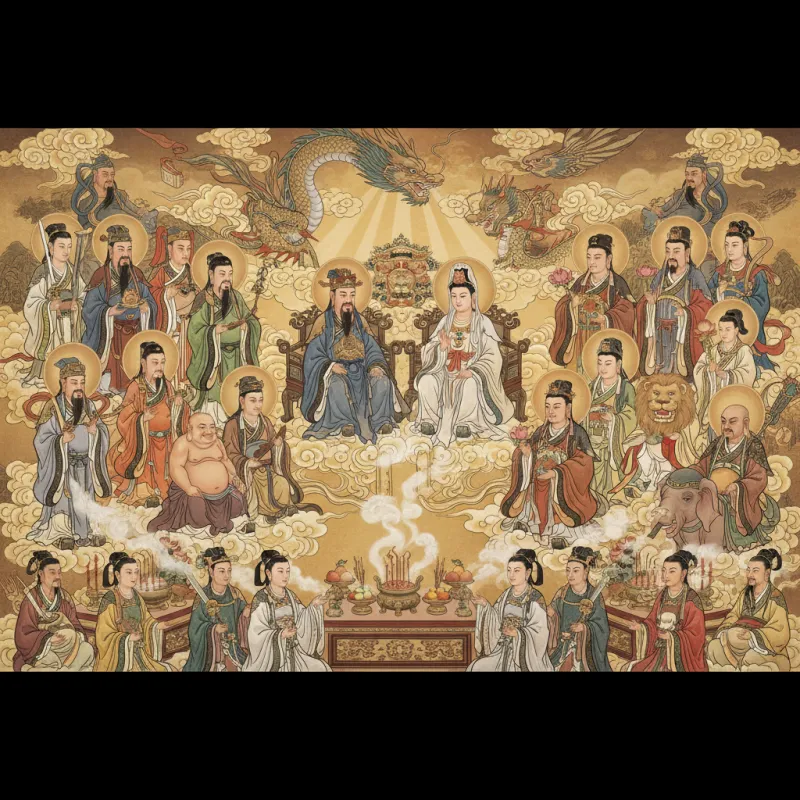
The old Daoist master once told me that if you want to understand Chinese religion, forget everything you know about gods. "Our immortals," he said, lighting incense before a statue of Lü Dongbin, "earned their divinity. They were human once, just like us." This fundamental difference—that divinity can be achieved rather than merely worshipped—shapes every ritual, every offering, every prayer whispered in temples from Beijing to Singapore. The pantheon of Chinese deities and immortals isn't a fixed hierarchy handed down from on high. It's a living, breathing cosmos where kitchen gods rub shoulders with cosmic Buddhas, where historical generals become war deities, and where an eighth-century poet-official can transform into an immortal patron of scholars and swordsmen.
The Fluid Boundary Between Human and Divine
Chinese religious thought operates on a principle that would scandalize most Western theologians: the boundary between mortal and immortal is permeable. The Eight Immortals (八仙, bāxiān), perhaps the most beloved figures in Chinese folk religion, exemplify this perfectly. Lü Dongbin (吕洞宾) was a Tang Dynasty scholar who failed the imperial examinations before encountering a Daoist master. Zhongli Quan (钟离权) was a Han Dynasty general. Lan Caihe (蓝采和) was a street performer. Each achieved immortality through cultivation, moral virtue, or divine intervention—not through birth or cosmic appointment.
This stands in stark contrast to the Buddhist pantheon, where figures like Guanyin (观音, Guānyīn) represent transcendent bodhisattvas who chose to delay their own enlightenment to save others. Yet even here, the Chinese adaptation is telling. Guanyin, originally the male bodhisattva Avalokiteśvara from Indian Buddhism, underwent a gender transformation in Chinese culture, becoming the compassionate "Goddess of Mercy" who appears in thirty-three different forms. The most popular origin story claims she was Princess Miaoshan (妙善), a Chinese woman who achieved enlightenment through extreme filial piety and self-sacrifice.
Ritual Architecture: How Worship Actually Works
Walk into any traditional Chinese temple and you'll notice something immediately: there's no single altar, no central focus of worship. Instead, you'll find multiple shrines, each dedicated to different deities, arranged according to a cosmic hierarchy that locals navigate with practiced ease. The main hall typically houses the primary deity—perhaps the Jade Emperor (玉皇大帝, Yùhuáng Dàdì) in a Daoist temple or Shakyamuni Buddha in a Buddhist one. But side halls and smaller shrines accommodate dozens of other figures, from local earth gods to specialized deities governing everything from wealth to childbirth.
The ritual practice reflects this multiplicity. A typical worshipper doesn't pray to just one deity. They might start at the incense burner outside, lighting three sticks (representing heaven, earth, and humanity), then proceed systematically through the temple, offering prayers and sometimes spirit money at each shrine. The prayers themselves are remarkably practical. People don't ask for abstract spiritual enlightenment—they request specific interventions: help passing an exam, healing a sick relative, success in business, a good marriage match.
This transactional quality bothers some Western observers, who see it as "superstition" rather than "true religion." But they're missing the point. Chinese ritual practice operates on the principle of reciprocity (报, bào)—the same principle that governs human relationships. You offer incense, food, and respect to the deities; they offer protection, luck, and intervention. When prayers are answered, you return with thanksgiving offerings. When they're not, you might try a different deity, just as you'd consult a different doctor if the first one couldn't help you. The relationship is respectful but not servile, devotional but not dogmatic.
The Daoist Immortals: Cultivating the Cosmic Body
Daoist immortality isn't about dying and going to heaven—it's about transforming your physical body into something that transcends death entirely. The technical term is xian (仙), often translated as "immortal" but literally depicting a person (人) on a mountain (山), suggesting someone who has withdrawn from ordinary society to pursue cultivation. The practices of internal alchemy that produce immortality involve breathwork, meditation, sexual techniques, herbal elixirs, and elaborate visualizations of the body as a cosmic landscape populated by gods.
The most famous immortality seekers were the alchemists of the Han and Tang dynasties, who literally tried to create elixirs of immortality through external alchemy (外丹, wàidān). The irony is that many of these elixirs contained mercury, lead, and arsenic—several emperors died from immortality poisoning, including the First Emperor Qin Shi Huang, whose desperate quest for eternal life is well documented. By the Song Dynasty, Daoists had largely abandoned external alchemy in favor of internal alchemy (内丹, nèidān), which used the same terminology but applied it to meditation and energy cultivation within the body.
The rituals surrounding Daoist immortals reflect this cultivation focus. Devotees don't just worship immortals—they study their biographies, practice their techniques, and attempt to follow their path. The Queen Mother of the West (西王母, Xīwángmǔ), one of the oldest deities in Chinese religion, presides over the Kunlun Mountains where the peaches of immortality grow. Her birthday celebration on the third day of the third lunar month involves rituals that symbolically allow participants to "steal" a bit of her immortal essence. Eating longevity peaches (寿桃, shòutáo) at these celebrations isn't just symbolic—it's believed to actually extend lifespan through sympathetic magic.
Buddhist Deities: Compassion as Cosmic Force
While Daoism focuses on individual transformation and immortality, Chinese Buddhism emphasizes compassion and the salvation of all beings. The bodhisattvas—enlightened beings who postpone their own final liberation to help others—dominate popular Buddhist worship. Guanyin receives more prayers than any other figure in Chinese Buddhism, but she's joined by Dizang (地藏, Dìzàng, Ksitigarbha), who vowed not to achieve Buddhahood until all hells are empty, and Wenshu (文殊, Wénshū, Manjushri), the bodhisattva of wisdom.
The ritual calendar reflects these figures' specializations. Guanyin has three birthday celebrations annually—the nineteenth day of the second, sixth, and ninth lunar months—each commemorating different aspects of her enlightenment and manifestation. Devotees observe these days with vegetarian fasting, sutra recitation, and elaborate offerings. The most dedicated practitioners undertake pilgrimages to Guanyin's sacred mountain, Putuo Shan (普陀山), one of the Four Sacred Buddhist Mountains of China.
What makes Chinese Buddhist ritual distinctive is its synthesis with indigenous practices. The Ghost Festival (中元节, Zhōngyuán Jié) on the fifteenth day of the seventh lunar month combines Buddhist concepts of karmic merit-making with Daoist and folk beliefs about wandering spirits. Temples conduct elaborate rituals to feed hungry ghosts and transfer merit to deceased ancestors, while families make offerings at home altars. The ritual involves both Buddhist monks chanting sutras and Daoist priests performing exorcisms—a perfect example of the religious syncretism that characterizes Chinese spiritual life.
The Bureaucratic Heaven: Gods as Civil Servants
Perhaps the most distinctively Chinese aspect of the divine pantheon is its bureaucratic organization. The Jade Emperor presides over a celestial administration that mirrors the imperial government, complete with departments, ranks, and official duties. The Kitchen God (灶神, Zàoshén) serves as the household's liaison to heaven, reporting on family behavior annually. Before the Lunar New Year, families perform a ritual called "sending off the Kitchen God" (送灶神, sòng Zàoshén), offering him sweet foods to "sweeten his words" when he makes his report to the Jade Emperor.
This bureaucratic model extends throughout the pantheon. The City God (城隍, Chénghuáng) governs each city's spiritual affairs, with a hierarchy matching the administrative importance of the city itself—the City God of Beijing outranks the City God of a county seat. When someone dies, they must report to the City God before proceeding to the underworld courts, where the Ten Kings of Hell judge their karma and assign their next rebirth. The entire process resembles nothing so much as navigating imperial bureaucracy, complete with paperwork (spirit money and documents burned as offerings), bribes (merit-making donations), and appeals to higher authorities.
The rituals reflect this administrative reality. When communities face disasters—drought, plague, invasion—they don't just pray for divine intervention. They file formal petitions, written in classical Chinese on yellow paper, which are burned to send them to heaven. Temple festivals often include processions where deity statues are carried through neighborhoods, allowing the gods to "inspect" their jurisdiction like officials on tour. The annual temple festivals that punctuate the ritual calendar serve partly as performance reviews, where communities demonstrate their devotion and gods demonstrate their efficacy through miracles and answered prayers.
Syncretism in Practice: The Three Teachings as One
Visit any traditional Chinese household and you'll likely find a domestic altar that would give theologians headaches. A statue of Guanyin might stand beside a portrait of Guan Yu (关羽, Guān Yǔ), the deified Three Kingdoms general who serves as both a Buddhist guardian deity and a Daoist immortal. Ancestor tablets occupy the central position, reflecting Confucian filial piety. Offerings include Buddhist vegetarian dishes, Daoist talismans, and Confucian ritual vessels. This isn't confusion or ignorance—it's the practical application of the "Three Teachings" (三教, sānjiào) philosophy that has dominated Chinese religious life since the Song Dynasty.
The principle is simple: Daoism, Buddhism, and Confucianism each address different aspects of human existence. Confucianism governs social relationships and moral conduct. Daoism handles individual cultivation and harmony with nature. Buddhism addresses suffering, death, and ultimate liberation. Why choose one when you can benefit from all three? The rituals reflect this pragmatic syncretism. A funeral might involve Confucian mourning protocols, Buddhist monks chanting sutras for the deceased's rebirth, and Daoist priests performing rituals to guide the soul through the underworld bureaucracy.
This syncretic approach produces some fascinating hybrid figures. Guan Yu, originally just a historical general, became a Buddhist dharma protector, a Daoist immortal, and a Confucian exemplar of loyalty—all while maintaining his primary role as a folk deity of war, wealth, and brotherhood. His temples serve multiple functions: martial artists pray for skill, merchants for business success, police officers for protection, and triads for loyalty among members. The rituals vary accordingly, but all recognize the same fundamental figure, adapted to different needs and contexts.
Living Traditions in Modern Context
The Communist period attempted to eradicate "feudal superstition," closing temples, persecuting religious practitioners, and destroying countless artifacts during the Cultural Revolution. Yet the traditions survived, sometimes underground, sometimes in diaspora communities, sometimes simply in the private practices of families who never stopped maintaining ancestor altars. Since the 1980s, there's been a remarkable revival. Temples have been rebuilt, festivals reinstated, and pilgrimage routes reopened.
What's changed is the context. Urban Chinese increasingly approach these traditions as cultural heritage rather than literal belief, participating in rituals for their aesthetic and communal value rather than from conviction in divine intervention. Yet the practices continue, adapted to modern life. You can now make offerings to the Kitchen God via smartphone apps. Virtual temples allow overseas Chinese to participate in rituals remotely. Young people post about their temple visits on social media, treating deity statues as photo opportunities while still performing the traditional three bows and incense offering.
The question of "belief" misses the point. Chinese religious practice has never required the kind of faith-based commitment that characterizes Western religions. It's about maintaining relationships—with ancestors, with deities, with the cosmic order itself. The rituals work whether you "believe" or not, because their efficacy lies in the performance, the community participation, the connection to tradition. An atheist can still honor their ancestors, a skeptic can still appreciate the beauty of a temple festival, a modernist can still find meaning in ancient practices.
The deities and immortals of Chinese tradition aren't going anywhere. They've survived dynastic changes, foreign invasions, ideological campaigns, and modernization. They persist because they're not just religious figures—they're cultural touchstones, moral exemplars, and links to a civilization that has maintained continuity for millennia. Whether you approach them as literal divine beings, as psychological archetypes, or as cultural heritage, they remain essential to understanding Chinese civilization. And in temples across China and throughout the diaspora, the incense still burns, the prayers still rise, and the ancient rituals continue their endless cycle, connecting past to present, human to divine, mortal to immortal.
Related Reading
- Chinese Rituals for the Dead: A Practical Guide to Ancestor Worship
- Chinese Funeral Traditions: A Guide to Death Customs
- Burning Ghost Money: The Complete Guide to Afterlife Offerings
- Chinese Rituals and Ceremonies: The Sacred Practices That Connect Heaven and Earth
- How to Offer Incense: A Practical Guide to Chinese Temple Worship
- The Eight Immortals: China's Most Beloved Divine Group
- Exploring the Rich Pantheon of Chinese Deities and Immortals in Daoism and Buddhism
- Sun Wukong as a Real Deity: Temples and Worship of the Monkey God