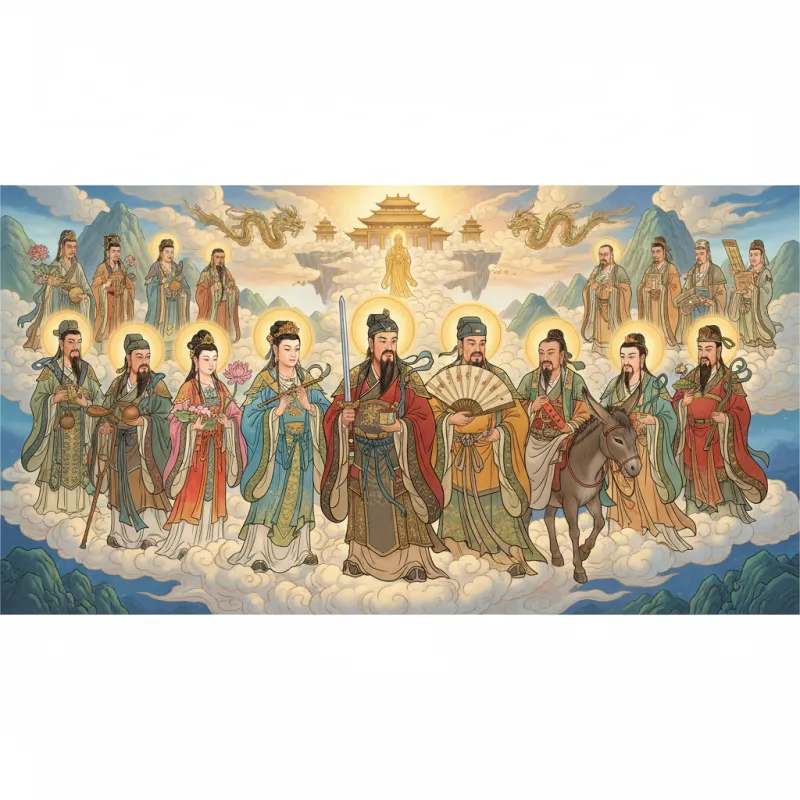
Picture this: a crippled beggar with an iron crutch, a flamboyant cross-dresser with castanets, and a woman who achieved immortality by eating powdered mica for breakfast. These aren't characters from a fever dream—they're three of the Eight Immortals, the most beloved misfits in Chinese mythology. Unlike the stern Jade Emperor or the austere Buddha, the Ba Xian (八仙) are immortals you'd actually want to grab a drink with. They're flawed, funny, and refreshingly human despite their supernatural powers.
Who Are the Eight Immortals?
The Eight Immortals aren't ancient deities from the dawn of time—they're actually a relatively modern invention. Most scholars trace their collective appearance to the Ming Dynasty (1368-1644), though individual immortals had been floating around Chinese folklore for centuries before someone had the brilliant idea to assemble them into a super-group. Think of them as the Avengers of Daoist mythology, except instead of fighting Thanos, they're mostly getting drunk and playing pranks on corrupt officials.
What makes them special isn't just their powers—it's their diversity. The group includes men and women, young and old, rich and poor, scholars and soldiers. This democratic approach to immortality was revolutionary. While traditional Daoist immortals often required decades of meditation and alchemical practice, the Eight Immortals proved that enlightenment could come through many paths, including some pretty unconventional ones.
The Magnificent Eight: Meet the Crew
Lü Dongbin (吕洞宾) is the unofficial leader and the most popular of the bunch. A Tang Dynasty scholar who failed the imperial examinations, he met Zhongli Quan in a wine shop and achieved immortality after a series of ten temptations. He's typically shown with a sword on his back—not for fighting demons, but for slaying ignorance and desire. Women particularly worship him, though ironically, his path to immortality required resisting female seduction. The contradiction isn't lost on anyone.
He Xiangu (何仙姑), the sole woman in the group, ate powdered mica (yes, the mineral) and swore off grain, which apparently was the Tang Dynasty equivalent of a keto diet. She's often depicted with a lotus flower, and her story is frustratingly vague compared to the men—a common problem in Chinese mythology. But she's fiercely popular among women seeking protection during childbirth and those hoping for longevity.
Li Tieguai (李铁拐), whose name literally means "Iron Crutch Li," has the most metal origin story. While his soul was off visiting Laozi in heaven, his disciples cremated his body thinking he'd died. When he returned, he had to possess the corpse of a lame beggar. Rather than complain, he embraced his new disabled body and became a champion of the poor and sick. His gourd contains magical medicines, and he's proof that immortality doesn't require a perfect body.
Lan Caihe (蓝采和) is delightfully ambiguous—sometimes depicted as male, sometimes female, sometimes as a young person of indeterminate gender. They wander around in tattered blue robes, wearing only one shoe, singing songs about life's impermanence. Lan Caihe is basically the Eight Immortals' resident performance artist, and their flower basket symbolizes the fleeting nature of earthly pleasures.
Zhang Guolao (张果老) rides a white donkey backward—because why face forward when you can watch where you've been? This elderly immortal could fold his donkey like paper and rehydrate it with water when needed (the ultimate portable transportation). He's associated with fertility despite his advanced age, and his fish drum represents the harmony of yin and yang.
Han Xiangzi (韩湘子) was supposedly the nephew of the famous Tang Dynasty poet Han Yu. He could make flowers bloom instantly and predict the future through his flute music. His story represents the tension between Confucian duty and Daoist freedom—his uncle wanted him to pursue an official career, but Han Xiangzi chose immortality instead. Every Chinese parent's nightmare, basically.
Cao Guojiu (曹国舅), the brother of an empress, gave up his royal privileges after his brother committed murder. He's the group's aristocrat, always depicted in court robes and holding jade tablets. His presence proves that even the privileged can achieve enlightenment, though they have to abandon their privilege first. His castanets symbolize the rhythm of the Dao.
Zhongli Quan (钟离权), often called "Han Zhongli," is the group's elder statesman. A former general who became an alchemist, he's depicted as a rotund, bare-bellied man with a fan that can revive the dead or kill the living. He taught Lü Dongbin, making him the grandfather of the group's most popular member. His fan represents the ability to stir up or calm the winds of change.
The Eight Immortals Cross the Sea
The most famous story about the Eight Immortals is "Ba Xian Guo Hai" (八仙过海)—"The Eight Immortals Cross the Sea." Challenged to cross the ocean without flying, each immortal used their magical object as a vessel. Lü Dongbin rode his sword, He Xiangu floated on her lotus, Li Tieguai bobbed along in his gourd. The phrase "Eight Immortals cross the sea, each displaying their divine powers" (八仙过海,各显神通) became a Chinese idiom meaning everyone contributes their unique talents to achieve a common goal.
But the story gets better. The Dragon King's son, being a typical entitled deity, tried to kidnap He Xiangu. Bad move. The Eight Immortals declared war on the underwater palace, and the resulting battle nearly drained the ocean. Eventually, cooler heads prevailed, but the story illustrates an important point: these immortals aren't pacifists. They'll throw down when necessary, especially when defending their own.
Cultural Impact and Modern Relevance
Walk into any Chinese restaurant, temple, or grandmother's house, and you'll likely spot the Eight Immortals somewhere—on paintings, porcelain, embroidery, or carved into furniture. They're especially popular during birthday celebrations, since they represent longevity and good fortune. The number eight itself is lucky in Chinese culture (it sounds like "prosper" in Chinese), making the Eight Immortals a double dose of auspiciousness.
Their influence extends beyond decoration. The Eight Immortals appear in countless novels, operas, films, and TV shows. They've been reimagined as everything from kung fu masters to modern-day superheroes. Video games love them—they're basically pre-made character classes with distinct abilities and personalities. Even the famous "drunken boxing" martial arts style draws inspiration from their carefree, unpredictable nature.
Why These Immortals Still Matter
In an age of polished Instagram influencers and carefully curated personal brands, the Eight Immortals feel refreshingly authentic. They're not perfect enlightened beings floating on clouds—they're weird, flawed individuals who found their own paths to transcendence. Li Tieguai is disabled. Lan Caihe is gender-nonconforming. Cao Guojiu is a reformed aristocrat. He Xiangu is a woman in a male-dominated pantheon.
Their message is subversive: you don't need to be born special, follow a rigid path, or conform to society's expectations to achieve greatness. You can be a failed scholar, a beggar, or an eccentric artist and still become immortal. In a culture that often emphasizes conformity and hierarchy, the Eight Immortals celebrate individuality and unconventional wisdom.
They also represent the Daoist ideal of "wu wei" (无为)—effortless action, going with the flow. Unlike the Jade Emperor with his bureaucratic heaven or the bodhisattvas with their vows to save all beings, the Eight Immortals just... exist. They help people when they feel like it, play tricks when they're bored, and generally live their best immortal lives without taking themselves too seriously.
Finding Your Inner Immortal
The beauty of the Eight Immortals is that everyone can identify with at least one of them. Are you a perpetual student who keeps seeking knowledge? You're Lü Dongbin. A healer who helps others despite your own struggles? That's Li Tieguai. An artist who sees the world differently? Hello, Lan Caihe. Someone who gave up material success for spiritual fulfillment? Meet Han Xiangzi.
Their stories remind us that immortality—whether literal or metaphorical—isn't about achieving perfection. It's about embracing who you are, developing your unique talents, and finding your own way across the sea. Each of us has our own magical object, our own special power. The trick is figuring out what it is and having the courage to ride it across the waves, even when dragons try to stop us.
Related Reading
- He Xiangu: The Only Female Among the Eight
- Lü Dongbin: The Sword Immortal
- Exploring the Enigmatic World of Chinese Immortals and Deities
- How to Pray at a Chinese Temple: A Respectful Visitor's Guide
- Unveiling the Rich Tapestry of Chinese Deities and Immortals
- Ancient Chinese Underworld Deities: Guardians of Death and Afterlife Realms