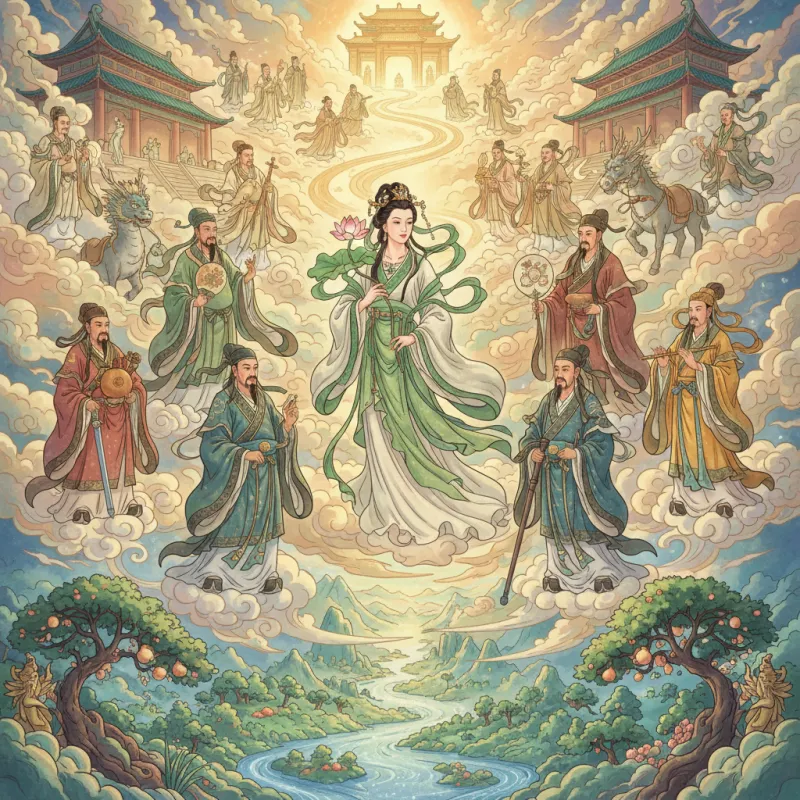
Among the pantheon of Chinese immortals, where bearded sages and eccentric wanderers dominate the landscape, one figure stands alone—literally. He Xiangu (何仙姑, Hé Xiāngū) is the sole woman among the Eight Immortals, that legendary band of Daoist transcendents who've captured Chinese imagination for over a millennium. But here's what makes her story fascinating: she didn't earn her place through some watered-down "feminine virtue" narrative. She achieved immortality the hard way—through alchemical practice, supernatural encounters, and a stubborn refusal to conform to Tang dynasty expectations of what a woman should be.
The Girl Who Ate Mica for Breakfast
The most reliable accounts place He Xiangu's origins in Zengcheng (增城), Guangdong province, during the Tang dynasty (618-907 CE). Her father, He Tai, ran a tofu shop—a detail that grounds her story in working-class reality rather than aristocratic fantasy. At fourteen, she had a dream that would change everything. A divine being appeared and instructed her to grind mica stone (云母, yúnmǔ) into powder and consume it. The promise? She would become as light as air and achieve immortality.
Most teenagers would've ignored such a bizarre dream. He Xiangu took it seriously. She began her daily regimen of mica consumption, and according to the texts, she gradually stopped needing regular food. The Lüshi Chunqiu and later Daoist compilations describe how she could traverse mountains with supernatural speed, gathering herbs and fruits for her mother while floating across peaks that would take ordinary mortals days to cross. This wasn't metaphorical—the texts are quite specific about her ability to cover hundreds of li in a single day.
The mica detail is crucial. In Daoist alchemical practice, certain minerals were believed to contain concentrated qi (氣) that could transform the physical body. Mica, with its layered, crystalline structure, symbolized the refinement of gross matter into subtle essence. He Xiangu wasn't just following a diet fad—she was engaging in serious neidan (內丹, internal alchemy), the same practice that male immortals like Lü Dongbin pursued through meditation and breath control.
The Empress Wu Connection
Here's where the story gets politically interesting. During the reign of Empress Wu Zetian (690-705 CE)—China's only female emperor—He Xiangu was supposedly summoned to the imperial court. Wu Zetian, who'd clawed her way to absolute power in a system designed to exclude women entirely, would naturally be intrigued by reports of a woman achieving transcendence through her own efforts.
The historical records are frustratingly vague about what happened at court, but the symbolism is potent. Some versions claim He Xiangu simply vanished before reaching the capital, ascending to immortality in broad daylight. Others suggest she appeared briefly, demonstrated her powers, then departed on her own terms. Either way, the message is clear: she answered to no earthly authority, not even an empress.
This timing matters. Wu Zetian's reign represented a brief crack in Confucian patriarchy, a moment when female power became thinkable. That He Xiangu's legend crystallized during this period isn't coincidence—it's cultural negotiation happening in real time, working out what female transcendence might look like.
The Lotus and the Ladle
He Xiangu's iconography is instantly recognizable: she carries a lotus flower (荷花, héhuā) or sometimes a lotus-shaped ladle. This isn't random decoration. The lotus is Buddhism and Daoism's favorite symbol—a flower that grows from mud yet remains unstained, representing spiritual purity achieved through worldly existence. But there's a linguistic pun at work too: "he" (荷) for lotus sounds identical to her surname "He" (何). Chinese religious art loves this kind of wordplay.
The ladle version of her attribute connects to more domestic imagery—she's sometimes depicted with a bamboo ladle used for serving food or wine. Some scholars read this as a concession to gender norms, tying her back to feminine domestic roles. I think that's too simple. In Daoist symbolism, the ladle represents the Big Dipper, which governs fate and longevity. She's not serving soup; she's ladling out destiny itself.
Compare this to the attributes of her male counterparts: Zhang Guolao rides a donkey backward, Han Xiangzi plays a flute, Cao Guojiu holds court tablets. Each object encodes their path to immortality and their particular powers. He Xiangu's lotus marks her as someone who achieved purity through transformation, not by avoiding the world but by transcending it while remaining rooted in it.
The Eight Immortals and the Token Woman Problem
Let's address the elephant in the room: is He Xiangu just tokenism, the obligatory female member added to an otherwise all-male club? The question matters because the Eight Immortals (八仙, Bā Xiān) weren't always eight, and they weren't always these eight. Earlier versions of the immortal band included different figures, and the roster only stabilized during the Ming dynasty (1368-1644 CE).
He Xiangu appears consistently in these lineups, but her role in group narratives often feels supplementary. In the famous story "The Eight Immortals Cross the Sea" (八仙過海, Bā Xiān Guò Hǎi), each immortal uses their magical implement to traverse the water—except He Xiangu, who sometimes just rides along on someone else's object. In opera and popular tales, she's frequently the one who needs rescuing or who provides healing support rather than direct confrontation.
But here's the counterargument: her consistent inclusion across centuries of retellings suggests she filled a necessary role. Chinese cosmology runs on balance—yin and yang, heaven and earth, male and female. An all-male group of immortals would be spiritually incomplete, lacking the yin principle necessary for cosmic harmony. He Xiangu isn't there despite being female; she's there because the group requires feminine energy to function properly.
Moreover, her specific powers—healing, nurturing, and the ability to predict fortunes—weren't considered lesser in Daoist thought. These are manifestations of yin power, which is receptive, preserving, and sustaining rather than aggressive and transformative. The Daodejing explicitly argues that yin qualities are superior to yang ones, that the valley outlasts the mountain, that water defeats stone through persistence.
Worship and Popular Religion
He Xiangu's cult never reached the heights of major deities like Guanyin or the Jade Emperor, but she maintained steady devotion, particularly among women. Temples dedicated to the Eight Immortals collectively would include her image, and she received special attention from women seeking fertility, safe childbirth, or family harmony.
In Guangdong province, where her legend originated, specific shrines marked locations associated with her story—the well where she drew water, the mountain where she gathered herbs. These sites became pilgrimage destinations, especially during the Qixi Festival (七夕, Qīxī), the "Double Seventh" celebration associated with female crafts and romantic love.
What's interesting is how her worship adapted across different communities. In some regions, she became associated with matchmaking and romantic success. In others, she was invoked for healing, particularly women's health issues. This flexibility suggests her legend served as a vessel for various forms of female aspiration and agency that had limited expression in Confucian orthodoxy.
The Modern Xiangu
He Xiangu's story continues to evolve. In contemporary Chinese popular culture—films, television series, comics—she often gets reimagined with more agency and complexity. The 2014 series "The Eight Immortals" gave her a backstory involving martial arts training and a romance subplot, while various fantasy novels have positioned her as a powerful cultivator in her own right, not merely the group's token female.
These modern retellings sometimes overcorrect, turning her into a warrior goddess who kicks as much ass as her male counterparts. That's not necessarily more authentic, but it reflects ongoing cultural negotiation about female power and representation. The fact that her story remains malleable, still being rewritten and reinterpreted, suggests it continues to serve a living function rather than being a dead relic.
What She Represents
Ultimately, He Xiangu embodies a particular kind of female transcendence—one achieved through discipline, alchemical practice, and personal transformation rather than through relationship to male power or conventional feminine virtue. She didn't become immortal by being a dutiful daughter, a faithful wife, or a devoted mother, though some later versions tried to emphasize her filial piety.
She ate rocks. She floated across mountains. She refused an imperial summons. She achieved immortality on her own terms, through her own efforts, following instructions from her own vision. In a culture that severely restricted female autonomy, that's a radical story, even if it's wrapped in the acceptable package of religious mythology.
The fact that she remains the only woman among the Eight Immortals is both a limitation and a statement. It acknowledges that female transcendence was thinkable in Chinese religious imagination while simultaneously marking it as exceptional, singular, not the norm. She's the exception that proves the rule—but exceptions, once established, create possibilities. Every woman who heard her story learned that immortality wasn't exclusively male territory, that transformation was possible, that the path existed even if the gate was narrow.
Related Reading
- The Eight Immortals: A Complete Guide
- Exploring the Enigmatic World of Chinese Immortals and Deities
- Lü Dongbin: The Sword Immortal
- The Quest for the Elixir of Life: From Emperor Qin to Modern Fiction
- The Complete Guide to Chinese Gods and Immortals
- Sun Wukong as a Real Deity: Temples and Worship of the Monkey God