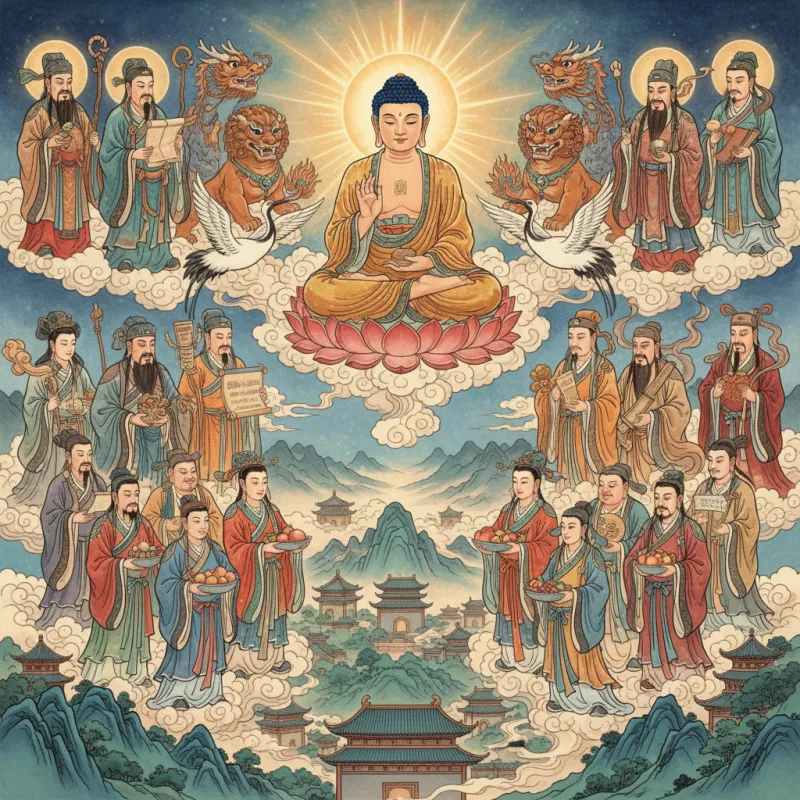
When the first Buddhist monks arrived in China carrying Sanskrit sutras and strange ideas about reincarnation, the Chinese looked at them with the same bewilderment you might feel if someone told you the solution to all your problems was to abandon your family and sit under a tree. The very foundation of Buddhism — renouncing worldly attachments, leaving home, rejecting family obligations — contradicted everything Chinese civilization held sacred. Yet within a few centuries, Buddhism had become so thoroughly Chinese that most people forgot it ever came from anywhere else.
The Collision of Two Worlds
Buddhism entered China sometime in the 1st century CE, probably through Central Asian trade routes, and immediately faced a civilization that had no conceptual framework for understanding it. The Chinese had spent two thousand years perfecting a social system built on family loyalty, ancestor veneration, and maintaining the cosmic order through proper ritual. Buddhism said: leave your family, stop worrying about ancestors, and focus on escaping the cycle of rebirth entirely.
The early Chinese response ranged from confusion to outright hostility. How could a teaching that encouraged men to abandon their parents and refuse to produce heirs be anything but barbaric? The Confucian scholar Yu Huan wrote in the 3rd century that Buddhism was "nothing more than a cult of barbarians." The fundamental problem was filial piety (孝 xiào) — the cornerstone of Chinese ethics. Buddhism's monastic ideal directly violated the Confucian mandate to serve one's parents and continue the family line.
But China has always been pragmatic about foreign ideas. If Buddhism was going to survive, it would have to become Chinese.
The Great Translation Project
The transformation began with language. Sanskrit Buddhist texts were dense, abstract, and filled with concepts that had no Chinese equivalents. Early translators like An Shigao (2nd century CE) and Kumarajiva (344-413 CE) faced an impossible task: how do you translate "dharma" when Chinese has no word for cosmic law? How do you explain "nirvana" to people who believe the highest good is harmonious family relationships?
The solution was creative mistranslation. Translators borrowed Daoist terminology, creating a hybrid vocabulary that made Buddhism comprehensible but fundamentally altered its meaning. The Sanskrit word "bodhi" (awakening) became "dao" (道 dào) — the same word Daoists used for the ultimate reality. "Nirvana" was translated as "wu wei" (無為 wúwéi), the Daoist concept of effortless action. This wasn't just translation — it was transformation.
Kumarajiva, a Central Asian monk who was essentially kidnapped and brought to China, spent his final years in Chang'an directing a massive translation bureau. He understood that literal accuracy would produce incomprehensible texts, so he prioritized meaning and readability. His translations of the Lotus Sutra and Diamond Sutra became foundational texts for Chinese Buddhism, but they were already Chinese in ways the Indian originals never were.
Making Buddha Chinese
The most visible transformation was physical. Indian Buddhist art depicted the Buddha with specific features: elongated earlobes, a topknot, South Asian facial features. Chinese artists gradually gave him Chinese characteristics — rounder face, different robes, a more serene expression that matched Chinese aesthetic ideals. By the Tang Dynasty (618-907 CE), Buddha statues in Chinese temples looked distinctly Chinese.
But the deeper transformation was theological. Chinese Buddhism developed the concept of "expedient means" (方便 fāngbiàn) — the idea that Buddhist teachings could be adapted to local circumstances. This wasn't seen as corruption but as wisdom. If Chinese people needed to honor their ancestors, then Buddhism would incorporate ancestor veneration. If they valued family loyalty, then Buddhism would reinterpret filial piety as compatible with Buddhist practice.
The Ullambana Sutra, probably composed in China despite claims of Indian origin, tells the story of Mulian (目連 Mùlián), a monk who rescues his mother from hell through Buddhist rituals. This story became wildly popular because it solved the filial piety problem: you could be a good Buddhist and a good son simultaneously. The Ghost Festival (中元節 Zhōngyuán Jié), celebrated on the 15th day of the seventh lunar month, emerged from this synthesis — a Buddhist ritual for feeding hungry ghosts that incorporated Chinese ancestor worship.
The Rise of Pure Land and Chan
Two distinctly Chinese forms of Buddhism emerged that would dominate East Asian practice: Pure Land (淨土宗 Jìngtǔ Zōng) and Chan (禪宗 Chán Zōng, known as Zen in Japan).
Pure Land Buddhism offered salvation through faith rather than monastic discipline. By simply reciting the name of Amitabha Buddha (阿彌陀佛 Āmítuófó), anyone — illiterate peasant, busy merchant, elderly grandmother — could be reborn in the Pure Land, a paradise where enlightenment was guaranteed. This was revolutionary. Indian Buddhism had been largely monastic and elite; Chinese Pure Land Buddhism was democratic and accessible. The monk Tanluan (476-542 CE) systematized Pure Land teachings, arguing that in this degenerate age, self-power was insufficient — only the compassionate power of Amitabha could save us.
Chan Buddhism took a different approach, claiming that enlightenment was sudden and immediate, available through direct insight rather than gradual cultivation. The legendary Bodhidharma (達摩 Dámó), who supposedly arrived in China in the 6th century, taught that Buddha-nature was inherent in everyone and could be realized through meditation and paradoxical teaching methods. Chan masters developed the "public case" (公案 gōng'àn, koan in Japanese) — puzzling questions like "What is the sound of one hand clapping?" — designed to short-circuit logical thinking and trigger sudden awakening.
Both schools reflected Chinese pragmatism. Pure Land said: you're busy, you're not a monk, you can't spend decades meditating — just recite the Buddha's name with sincere faith. Chan said: forget the scriptures, forget the rituals, just look directly at your own mind. These were Chinese solutions to Chinese problems.
Buddhism and Imperial Power
Chinese emperors quickly recognized Buddhism's political utility. A religion that taught people to accept suffering, respect authority, and seek salvation in the next life was useful for maintaining social order. The Northern Wei Dynasty (386-534 CE) sponsored massive Buddhist projects, including the Yungang Grottoes, where colossal Buddha statues were carved into cliffsides. These weren't just religious monuments — they were statements of imperial power.
But the relationship was always complicated. Buddhism's wealth and influence periodically threatened imperial authority, leading to devastating persecutions. The most severe occurred in 845 CE under Emperor Wuzong of Tang, who ordered the destruction of thousands of monasteries, forced hundreds of thousands of monks and nuns to return to lay life, and confiscated vast amounts of Buddhist property. The official justification was Confucian and Daoist — Buddhism was a foreign religion that undermined Chinese values — but the real motivation was economic and political.
Buddhism survived by becoming even more Chinese. After the persecution, the schools that thrived were those most integrated into Chinese culture: Pure Land with its accessibility, and Chan with its anti-institutional rhetoric and emphasis on working meditation (農禪 nóng chán) — monks supporting themselves through farming rather than depending on donations.
The Bodhisattva Goes Chinese
Perhaps nothing illustrates Buddhism's Chinese transformation better than Guanyin (觀音 Guānyīn), the Bodhisattva of Compassion. In Indian Buddhism, Avalokiteshvara was male. In China, Guanyin gradually became female, or at least androgynous, eventually settling into a distinctly feminine form by the Song Dynasty (960-1279 CE).
This transformation reflected Chinese needs. People wanted a compassionate, maternal figure who would respond to prayers for children, safe childbirth, and family protection — concerns that had little to do with Indian Buddhism's focus on individual liberation. Guanyin became the "Goddess of Mercy," absorbing characteristics from Chinese folk deities and Daoist immortals. The story of Miaoshan (妙善 Miàoshàn), a Chinese princess who became Guanyin through filial sacrifice, further sinicized the bodhisattva by embedding her in a narrative of family loyalty.
Today, Guanyin is probably the most popular deity in Chinese religion, worshipped in Buddhist temples, Daoist shrines, and folk religion altars. She appears in countless forms: holding a child, standing on a lotus, riding a dragon, with a thousand arms. This proliferation of forms and functions would have been unthinkable in Indian Buddhism, but it's perfectly Chinese — pragmatic, syncretic, responsive to popular needs.
What China Gave Buddhism
The standard narrative says China changed Buddhism, which is true. But Buddhism also changed China in ways that are easy to overlook. It introduced new art forms, architectural styles, and literary genres. The pagoda, now iconic in Chinese architecture, is a Buddhist import. Buddhist sutras influenced Chinese prose style, introducing new rhythms and vocabulary. The concept of karma (業 yè) became so thoroughly integrated into Chinese thought that most people don't realize it's Buddhist.
More profoundly, Buddhism gave China a vocabulary for discussing consciousness, psychology, and the nature of reality that Confucianism and Daoism lacked. Neo-Confucian philosophers in the Song Dynasty, even while criticizing Buddhism, borrowed heavily from Buddhist metaphysics and meditation practices. The great Neo-Confucian synthesis that dominated Chinese thought for centuries was unthinkable without Buddhism's influence.
Buddhism also provided an alternative to Confucian social hierarchy. In Buddhist temples, at least in theory, a peasant who achieved enlightenment outranked an unenlightened emperor. This radical egalitarianism was always more theoretical than real, but it offered a conceptual space outside the rigid Confucian social order.
The Legacy
When Buddhism spread from China to Korea, Japan, and Vietnam, it was Chinese Buddhism they received, not Indian. The forms that dominate East Asian Buddhism today — Pure Land, Chan/Zen, the feminine Guanyin — are Chinese creations. Even Tibetan Buddhism, which maintained closer ties to Indian traditions, was influenced by Chinese Buddhist texts and practices.
The transformation of Buddhism in China demonstrates something important about cultural exchange: great civilizations don't simply adopt foreign ideas wholesale. They digest them, transform them, and produce something new that bears the marks of both traditions. Chinese Buddhism is neither purely Indian nor purely Chinese — it's a genuine synthesis that couldn't have emerged anywhere else.
Walk into any Chinese Buddhist temple today, and you'll see this synthesis everywhere: Indian buddhas with Chinese faces, Sanskrit mantras in Chinese pronunciation, monks practicing meditation while maintaining ancestor altars, devotees seeking enlightenment and worldly blessings simultaneously. It's messy, contradictory, and thoroughly Chinese.
The Buddha who arrived in China two thousand years ago would barely recognize what his teaching became. But perhaps that's exactly as it should be. Buddhism always taught that attachment to fixed forms leads to suffering. The Chinese took that teaching seriously — they just applied it to Buddhism itself.
Related Reading
- The Four Heavenly Kings: Guardians at Every Temple Gate
- Buddhist Deities in Chinese Culture: How India's Gods Became Chinese
- Guanyin: The Goddess of Mercy Who Hears Every Cry
- Dizang Bodhisattva: The Buddha Who Chose Hell
- The Three Pure Ones: Supreme Deities of Taoism
- Dragon Boat Festival: The Poet, the River, and the Race
- Animal Deities in Chinese Religion: When Foxes, Snakes, and Turtles Become Gods