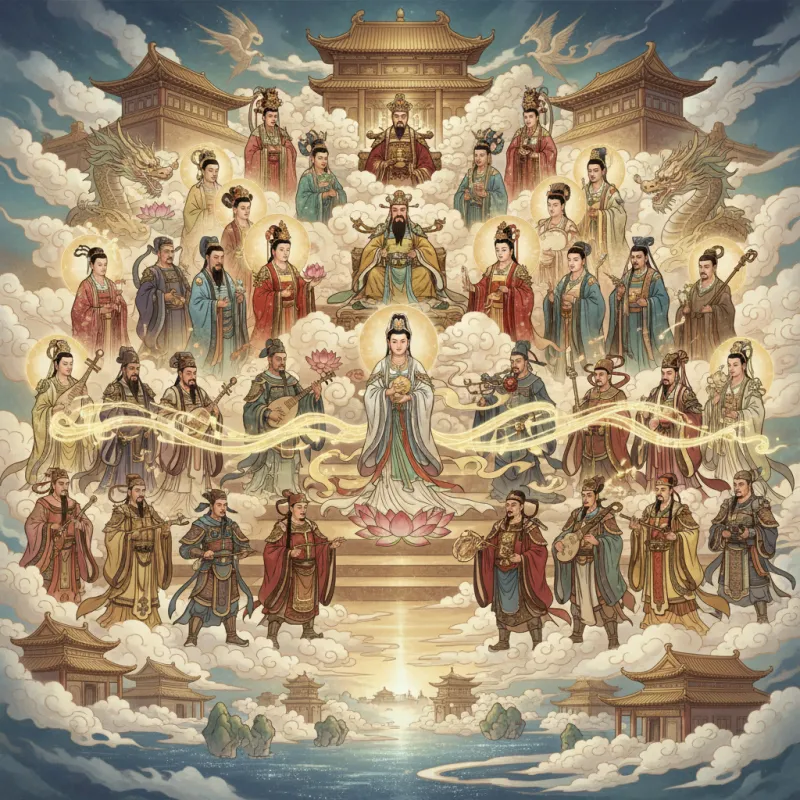
Picture this: A weathered Daoist master sits cross-legged on a misty mountaintop, his breath synchronized with the universe itself. After decades of meditation, alchemical practice, and moral cultivation, his body begins to shimmer—not with sweat, but with an otherworldly luminescence. He's on the verge of achieving what countless seekers have pursued for millennia: xian (仙), the state of immortality that transcends the mundane cycle of birth and death. This isn't just fantasy—it's the beating heart of Chinese spiritual imagination, a tradition so deeply woven into the culture that even today, millions visit temples to burn incense for these celestial beings.
The Daoist Path to Transcendence
The concept of immortality in Chinese thought isn't a gift bestowed by gods—it's earned through rigorous self-cultivation. Daoist texts like the Baopuzi (抱朴子), written by Ge Hong in the 4th century CE, outline specific practices: breathing exercises (qigong 气功), sexual techniques, dietary restrictions, and above all, the pursuit of the elixir of immortality through waidan (外丹, external alchemy) or neidan (内丹, internal alchemy). The former involved literal chemical experiments—mercury, cinnabar, lead—which ironically poisoned more seekers than it saved. The latter, which gained prominence during the Tang Dynasty, focused on transforming one's internal energies, a practice that survives in modern qigong and tai chi.
What's fascinating is how democratic this path theoretically was. Unlike the Buddhist bodhisattva ideal that required countless lifetimes of merit, Daoist immortality could be achieved in a single lifetime by anyone—peasant or emperor—willing to dedicate themselves to the practice. Of course, having the leisure time to meditate for decades helped, which is why so many immortals in folklore are depicted as eccentric hermits who abandoned worldly responsibilities.
The Eight Immortals: Personalities of Perfection
The Ba Xian (八仙, Eight Immortals) represent the most beloved immortal figures in Chinese culture, each embodying a different social class and life path. There's Lü Dongbin (吕洞宾), the scholarly swordsman who appears in countless wuxia novels; He Xiangu (何仙姑), the only female immortal who achieved transcendence after eating a magical peach; and Lan Caihe (蓝采和), whose gender ambiguity and perpetual drunkenness made them a patron of the marginalized. My personal favorite is Zhang Guolao (张果老), who rode a white donkey backward—a perfect metaphor for the Daoist principle of returning to the source.
These figures weren't always immortal. Most were historical or semi-historical people from the Tang and Song dynasties who became deified through popular legend. Their stories appear everywhere: in the 16th-century novel Journey to the East (Dong You Ji 东游记), on porcelain vases, in temple murals, and even in modern Hong Kong action films. They're not distant, austere gods but flawed, relatable characters who achieved the extraordinary through persistence. For more on individual immortal figures, explore our guide to legendary Daoist immortals.
The Celestial Bureaucracy: Heaven as Imperial Court
While Daoism offered a path to personal transcendence, Chinese folk religion organized the divine realm as a mirror of earthly government. The Jade Emperor (玉皇大帝, Yuhuang Dadi) sits atop this celestial bureaucracy, managing departments for everything from weather to justice. Below him are countless officials: the City God (城隍, Chenghuang) who governs local affairs, the Kitchen God (灶神, Zaoshen) who reports on household behavior, and the fearsome Yanluo Wang (阎罗王), who judges the dead.
This bureaucratic model reveals something profound about Chinese cosmology: the universe operates on principles of order, hierarchy, and moral accountability. Unlike the capricious gods of Greek mythology, Chinese deities follow rules, file reports, and can even be demoted for incompetence. During the Ming Dynasty, emperors would sometimes "punish" gods whose temples failed to deliver rain by removing their titles—a practice that seems absurd until you realize it reflects a worldview where even heaven must answer to cosmic law.
Buddhist Bodhisattvas: Compassion Incarnate
When Buddhism arrived in China during the Han Dynasty, it brought its own pantheon of enlightened beings. The most significant is Guanyin (观音, Avalokiteśvara), the Bodhisattva of Compassion, who underwent a remarkable transformation on Chinese soil. Originally male in Indian Buddhism, Guanyin became predominantly female in Chinese iconography by the Song Dynasty, absorbing characteristics of indigenous mother goddesses and the Daoist Queen Mother of the West (Xiwangmu 西王母).
Guanyin's popularity eclipsed nearly every other Buddhist figure in China. Her temples dot the landscape, her image appears in homes across Asia, and her thousand-armed form represents her infinite capacity to help suffering beings. The Lotus Sutra promises that anyone who calls her name in distress will be saved—a guarantee that made her accessible to illiterate peasants and sophisticated scholars alike. For deeper exploration of Buddhist influences, see our article on Buddhist deities in Chinese tradition.
The Blurred Lines: Syncretism in Practice
Here's where it gets interesting: most Chinese people don't distinguish sharply between Daoist immortals, Buddhist bodhisattvas, and folk deities. Walk into any traditional temple, and you'll find them sharing altar space. The Three Pure Ones (三清, Sanqing)—the highest Daoist deities—might occupy the central hall, while Guanyin has a side shrine, and Guan Yu (关羽), the deified general from the Romance of the Three Kingdoms, stands guard at the entrance.
This syncretism isn't theological confusion—it's practical wisdom. Chinese religious practice has always been more concerned with efficacy than orthodoxy. Need help with exams? Pray to Wenchang Wang (文昌王), the god of literature. Facing a sea voyage? Offer incense to Mazu (妈祖), the deified fisherman's daughter. Seeking enlightenment? Study Buddhist sutras. Pursuing immortality? Practice Daoist cultivation. The categories matter less than the results.
Immortals in Literature and Popular Culture
The immortals truly come alive in Chinese literature. The 16th-century novel Journey to the West (Xiyouji 西游记) features a riotous cast of celestial beings, from the mischievous Monkey King who steals the peaches of immortality to the Buddha himself. The Investiture of the Gods (Fengshen Yanyi 封神演义) narrates how historical figures became deified during the Shang-Zhou transition. These aren't dry religious texts—they're adventure stories filled with magic battles, political intrigue, and philosophical debates.
Modern adaptations continue this tradition. Hong Kong cinema has produced countless films featuring immortals, from the Chinese Ghost Story series to Tsui Hark's fantastical wuxia epics. Video games like Genshin Impact draw heavily on this mythology, introducing a new generation to figures like the Eight Immortals. The immortals remain culturally relevant because they represent timeless human aspirations: transcendence, justice, compassion, and the possibility of transformation.
The Living Tradition
Despite modernization, the worship of immortals and deities remains vibrant. During Chinese New Year, families still paste images of door gods on their entrances. Temples across Asia burn with incense offerings. Mediums channel deities during festivals, writing divine prescriptions in trance states. The Hungry Ghost Festival (中元节, Zhongyuan Jie) sees entire communities making offerings to wandering spirits.
What strikes me most about this tradition is its adaptability. These ancient figures have survived dynastic changes, communist suppression, and technological revolution because they fulfill enduring human needs: the desire for protection, the hope for transcendence, and the comfort of believing that compassionate beings watch over us. Whether you approach them as literal entities, psychological archetypes, or cultural metaphors, the immortals and deities of China offer a window into one of humanity's richest spiritual traditions—one that continues to evolve while maintaining connections to practices thousands of years old.
Related Reading
- The Eight Immortals: A Complete Guide
- He Xiangu: The Only Female Among the Eight
- Lü Dongbin: The Sword Immortal
- The Lantern Festival: When Gods Walk Among Mortals
- Unveiling the Mystique of Chinese Animal Spirits in Daoist and Buddhist Beliefs
- Exploring Chinese Deities and Immortals in Daoist and Buddhist Creation Myths