The incense smoke hits you first—thick, sweet, and so dense you can barely see the altar ten feet away. An elderly woman kneels on a cushion, forehead touching the ground three times, then nine times, then three times again. A businessman in an expensive suit lights a bundle of incense thicker than your wrist. A Daoist priest in blue robes chants something you can't understand while shaking a wooden block covered in indecipherable symbols. You're standing in a Daoist temple, phone in hand, wondering if it's okay to take photos. Spoiler: it's probably not.
These Are Not Museums (And the Gods Are Watching)
The first rule of visiting Daoist temples in China: you are entering someone's living room while they're having a conversation with the divine. This isn't the Louvre. There's no velvet rope between you and the sacred. The incense you're smelling? Someone paid for that as an offering to Guanyin or the Jade Emperor, hoping for a sick parent to recover or a business deal to close. The old woman prostrating herself isn't performing for tourists—she's negotiating with cosmic forces that, in her worldview, directly control her fate.
Western visitors often treat temples like architectural curiosities, snapping photos of every statue and altar. But imagine someone walking into a church during communion, loudly discussing the "aesthetic" of the chalice while the priest is mid-prayer. That's what you look like when you're posing for selfies in front of an active altar where someone is literally begging the gods for help.
The rules aren't arbitrary. They exist because these spaces are considered charged with spiritual power—what Daoists call ling (灵), a kind of numinous efficacy. Breaking the rules isn't just rude; it's believed to disturb the spiritual ecology of the place.
The Architecture: A Map of the Cosmos
Daoist temples aren't randomly organized. They're three-dimensional mandalas, physical representations of the Daoist cosmos. Understanding the layout helps you navigate both the space and the etiquette.
The Mountain Gate (山门, shānmén) is your first test. Most temples have three doors. The center door is reserved for the gods and the temple's abbot. You use the side doors—left door when entering (from your perspective), right door when leaving. Why? Because in Chinese cosmology, left is yang (active, entering) and right is yin (receptive, departing). Some temples are strict about this; others don't care. Watch what the locals do.
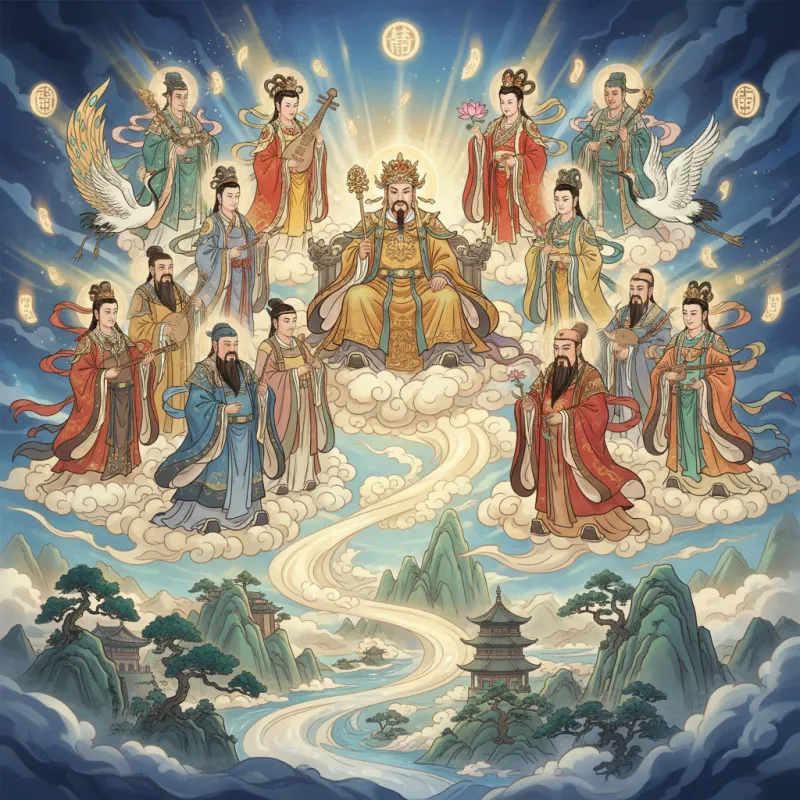
The Main Hall (大殿, dàdiàn) houses the primary deity. In a temple dedicated to the Eight Immortals, you'll find their statues here. In a temple to Laozi, you'll see the deified version of the philosopher, often depicted riding a water buffalo. The altar in front of the statues is where offerings are made—fruit, incense, sometimes whole roasted pigs during major festivals. Don't touch the offerings. Don't lean on the altar. Don't stick your head between the incense burners to get a better photo angle. (Yes, people do this.)
Side Halls contain secondary deities, often organized by function. One hall might be dedicated to wealth gods like Caishen (财神), another to healing deities, another to gods who govern specific aspects of fate. The Chinese approach to religion is refreshingly practical: you pray to the specialist god for your specific problem, like choosing the right doctor for your symptoms.
The Rear Hall often houses the temple's most esoteric deities or serves as a meditation space for priests. This is usually off-limits to casual visitors. If there's a sign or a closed door, respect it.
What to Do (And What Not to Do)
Dress code: Cover your shoulders and knees. This isn't Bali; you can't wander around in a tank top and shorts. Some temples provide wraps at the entrance, but don't count on it. Dark colors are safer than white, which is associated with funerals in Chinese culture.
Photography: Assume it's not allowed unless you see other people doing it. Never use flash. Never photograph people praying without permission—this should be obvious, but apparently it needs to be said. Some temples charge a photography fee; pay it or put your phone away.
Incense: If you want to make an offering, buy incense at the temple (don't bring your own—it's considered presumptuous). The standard is three sticks, representing the Three Pure Ones (三清, Sānqīng), the highest deities in the Daoist pantheon. Light them from the communal flame, hold them at forehead level with both hands, bow three times, then place them in the burner. Don't blow them out—wave your hand to extinguish the flame. Blowing is considered disrespectful, like spitting on the gods.
Bowing: Three bows is standard. Nine bows (three sets of three) is for serious requests or major festivals. Full prostrations—kneeling and touching your forehead to the ground—are for the deeply devout or those in desperate circumstances. You don't have to bow if you're just visiting, but if you're standing directly in front of an altar while someone is trying to pray, move.
Donations: There's usually a donation box. Contributing is appreciated but not required. Don't throw coins at statues or into decorative pools unless there's a clear indication it's meant for that. This isn't a wishing well.
The Priests: Not Monks, Not Exactly
Daoist priests (daoshi, 道士) are not Buddhist monks. Many are married. Some live in the temple; others have day jobs and show up for rituals. Their training involves years of studying classical Chinese texts, learning ritual procedures, and memorizing chants. The most skilled can perform elaborate ceremonies involving dance-like movements, mudras (hand gestures), and the manipulation of spiritual energy.
If a priest approaches you, they're probably not trying to scam you (though in tourist-heavy temples, be cautious). They might offer to perform a divination or blessing for a fee. This is legitimate—it's how many temples fund their operations. The fee is usually posted. If it's not, ask before agreeing to anything.
Some priests are happy to answer questions if you're respectful and they're not busy. Don't interrupt a ritual. Don't ask them to pose for photos like they're cosplayers. And for the love of the Jade Emperor, don't ask if they "really believe" in the gods. That's like asking a Catholic priest if he "really believes" in transubstantiation—it's not a question that makes sense within the framework of their practice.
Regional Variations: Not All Temples Are the Same
A Daoist temple in Beijing feels different from one in Sichuan or Guangdong. Northern temples tend to be more formal, with stricter adherence to classical ritual. Southern temples, especially in areas with strong folk religion traditions, often blend Daoist, Buddhist, and local deities into a syncretic mix that would make a religious studies professor's head spin.
In Taiwan, Daoist temples are often vibrant community centers with a carnival-like atmosphere during festivals. In mainland China, especially after decades of official atheism, some temples feel more like heritage sites than living religious spaces—though this is changing as younger Chinese rediscover traditional practices.
The most famous Daoist mountains—Wudang (武当山), Qingcheng (青城山), Longhu (龙虎山)—have temples that are pilgrimage destinations. Visiting these is a different experience from visiting a neighborhood temple in Shanghai. The mountain temples are larger, more formal, and often require hiking to reach. They're also more accustomed to foreign visitors, which means more English signage but also more tourist infrastructure (and higher prices).
Fortune Sticks and Divination: Should You Try It?
Many temples offer divination services using qiuqian (求签), bamboo fortune sticks. You kneel before the altar, ask your question silently, shake a container of numbered sticks until one falls out, then take the number to a priest or check a book of interpretations. The answers are usually classical Chinese poems that require interpretation—cryptic, poetic, and maddeningly vague.
Should you try it? If you're genuinely curious and approach it with respect, why not? But don't treat it like a fortune cookie. The system assumes you're asking about something serious—health, relationships, career decisions—not "Will I get Instagram likes?" The interpretations are meant to provide guidance, not predictions. They're Rorschach tests that reveal what you're already thinking about your situation.
Some temples also offer bǎobēi (杯珓) divination: two crescent-shaped wooden blocks that you drop after asking a yes/no question. The way they land—both flat, both curved, or one of each—indicates the gods' answer. It's simple, direct, and surprisingly addictive once you start.
When to Visit (And When to Avoid)
Weekday mornings are ideal—fewer crowds, more authentic atmosphere. Avoid major holidays unless you want to experience the full intensity of Chinese religious practice, which involves massive crowds, deafening firecrackers, and enough incense smoke to trigger every fire alarm in a five-mile radius.
The first and fifteenth of each lunar month are popular worship days. Temples are busier but also more active, with more rituals and offerings. If you want to see the temple in action rather than as a quiet museum-like space, these are good days to visit.
Major Daoist festivals—like the birthdays of popular deities—transform temples into something between a religious ceremony and a street fair. There's opera, food stalls, and ritual performances that can last for hours. It's overwhelming but fascinating if you can handle crowds.
The Real Reason to Visit
Forget the architecture and the exotic rituals for a moment. The real reason to visit a Daoist temple is to witness a worldview in action—one where the boundary between the material and spiritual is porous, where gods are not distant abstractions but active participants in daily life, where burning paper money and offering fruit are rational responses to life's uncertainties.
You don't have to believe any of it. But watching someone pray with absolute conviction, seeing the care with which offerings are arranged, feeling the weight of centuries of practice in a single gesture—that's worth more than any guidebook description of architectural features.
Just remember: you're a guest. Act like one.
Related Reading
- Sacred Mountain Pilgrimage: The Chinese Tradition of Climbing to Heaven
- The Most Sacred Temples in China You Can Visit
- Chinese Temple Architecture: What Every Symbol Means
- Exploring the Rich Tapestry of Chinese Deities and Immortals in Temples
- 10 Most Sacred Daoist Temples in China You Can Visit
- The Quest for Immortality: Why Chinese Mythology Is Obsessed With Living Forever
- Unveiling the Mystique of Chinese Animal Spirits in Daoist and Buddhist Beliefs
- Nezha: From Rebellious Child God to China's Biggest Animated Film