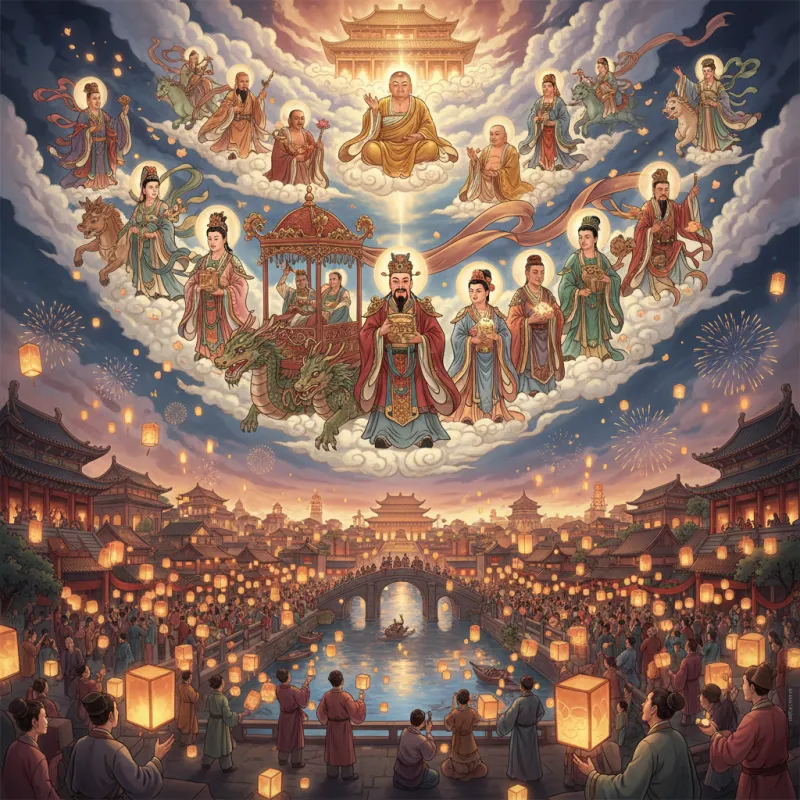
The sky above Chang'an blazed so bright on the fifteenth night of the first month that astronomers thought a second sun had risen. But it wasn't celestial fire — it was ten thousand lanterns, hung by terrified citizens who'd just learned that the Jade Emperor planned to burn their city to ash. One girl's quick thinking had bought them time, but now they had to convince heaven itself that Chang'an was already aflame. The lanterns worked. The city survived. And every year since, on the first full moon of the lunar calendar, China lights itself on fire with paper and silk, just in case the gods are watching.
This is the Lantern Festival (元宵节, Yuánxiāo Jié), and it's not what you think. Yes, it's beautiful — rivers of red lanterns flowing through streets, children chasing rabbit-shaped lights, lovers writing riddles on silk. But strip away the romance and you'll find something older and stranger: a night when the boundary between heaven and earth grows thin, when deities descend to walk among mortals, and when humans must prove they're worth keeping alive.
The Girl Who Tricked Heaven
The most famous origin story centers on a palace maid named Yuanxiao during the Han Dynasty. She served in the Jade Emperor's celestial court but desperately missed her family on earth. The problem? Celestial servants couldn't just take vacation days. So she enlisted the help of Dongfang Shuo (东方朔), a clever advisor known for his wit and his ability to talk his way out of anything.
Dongfang Shuo's plan was audacious: he spread rumors throughout Chang'an that the Fire God (火神, Huǒshén) planned to burn the city on the fifteenth day of the first month, on direct orders from the Jade Emperor. Panic spread. The emperor — the earthly one — summoned Dongfang Shuo for advice. The advisor suggested a counter-deception: if the city hung lanterns everywhere and set off fireworks, the Fire God would see the flames from heaven and assume his job was already done. He'd report back to the Jade Emperor that Chang'an had burned, and everyone could go about their business.
It worked. But here's the part most retellings skip: Yuanxiao got to go home that night, released by the Jade Emperor to help with the "fire emergency." She made tangyuan (汤圆) — sweet rice balls — for her family, the first meal she'd shared with them in years. The deception bought her one night of mortality, one evening of being human again instead of a celestial servant. The festival remembers both the trick and the longing behind it.
When Gods Descend
But the Lantern Festival isn't just about fooling deities — it's about inviting them down. The fifteenth day of the first lunar month marks Tianguan's birthday, one of the Three Officials (三官, Sānguān) who govern heaven, earth, and water. Tianguan (天官), the Heavenly Official, holds the specific job of bestowing blessings, and his birthday is one of the few nights when he personally descends to inspect the mortal realm.
This is why Daoist temples blaze with light on Lantern Festival night. The lanterns aren't just decorative — they're beacons, guiding Tianguan through the darkness so he can see which households deserve blessings and which need correction. Families hang lanterns outside their doors as both welcome and advertisement: we're here, we're pious, we're worth blessing. Inside, they prepare offerings of tangyuan, the round shape symbolizing completeness and family unity, exactly the kind of harmony that impresses celestial bureaucrats.
The connection between lanterns and divine inspection runs deeper than Tianguan. In Chinese cosmology, light represents yang energy, consciousness, and the presence of shen (神) — spiritual awareness. The first full moon of the year marks the peak of yang's return after winter's darkness. It's the moment when heaven's attention naturally turns earthward, when the veil thins, when gods can see clearly into human affairs. The lanterns amplify this connection, turning every street into a runway for descending deities.
The Festival of Riddles and Romance
Somewhere between religious obligation and celestial deception, the Lantern Festival became China's Valentine's Day — though calling it that undersells how subversive it actually was. In traditional Chinese society, unmarried women rarely left their homes, especially at night. But Lantern Festival was the exception. Everyone went out to see the lights, including young women, which meant it was one of the few nights when young people could actually meet potential partners without a matchmaker hovering nearby.
The lantern riddles (灯谜, dēngmí) added an extra layer of flirtation. Riddles would be written on lanterns, and anyone who solved one could claim a small prize — but more importantly, solving a difficult riddle demonstrated wit and education, exactly the qualities that made someone marriageable. Young men would linger near lanterns with particularly clever riddles, hoping to impress watching women. Young women would pretend to struggle with easy riddles, creating opportunities for helpful strangers to approach.
This tradition shows up constantly in Chinese literature. In Dream of the Red Chamber (红楼梦), the Lantern Festival scenes crackle with romantic tension and foreshadowing. In The Investiture of the Gods (封神演义), the festival provides cover for secret meetings between characters who shouldn't be meeting at all. The lanterns create a liminal space where normal social rules bend, where a girl can talk to a stranger, where fate might intervene in the form of a clever riddle and a shared laugh.
Lions, Dragons, and Walking on Stilts
The Lantern Festival performances aren't just entertainment — they're exorcisms. The lion dance (舞狮, wǔshī) that winds through streets, accompanied by drums and cymbals, doesn't just look impressive. It's chasing away evil spirits, the lion being a Buddhist symbol of protection and a creature fierce enough to scare demons. The dragon dance (舞龙, wǔlóng) does something similar, invoking the power of the dragon kings who control weather and water, asking for their blessing on the coming agricultural year.
Then there's the yangge (秧歌), a folk dance that looks deceptively simple — people in bright costumes, waving fans and handkerchiefs, moving in patterns that seem almost random. But yangge has roots in agricultural rituals, the movements mimicking planting and harvesting, the dancers' energy meant to transfer to the earth itself. It's sympathetic magic dressed up as folk art, performed on the night when heaven is watching and might be persuaded to grant a good harvest.
The stilt walkers (踩高跷, cǎi gāoqiāo) take this further. Walking on stilts elevates performers closer to heaven, making them more visible to descending gods. In some regions, stilt walkers dress as specific deities or legendary figures, essentially becoming temporary vessels for divine presence. It's street theater and religious ritual simultaneously, the line between performance and possession deliberately blurred.
Floating Lights and River Gods
In southern China, the Lantern Festival includes a practice that's both beautiful and slightly ominous: floating lanterns on rivers. Paper lanterns, often shaped like lotus flowers, are set on the water with candles inside, then released to drift downstream. The official explanation is that they carry away bad luck and misfortune from the previous year. The older explanation is that they're offerings to river gods and water spirits, payment for safe passage and good fishing in the coming months.
This connects to a broader pattern in Chinese festivals: water as a boundary between worlds. Rivers don't just flow through geography — they flow between realms. The floating lanterns mark that boundary, making it visible, acknowledging the spirits who live in the liminal space between earth and the underworld. Some families write wishes or prayers on the lanterns before releasing them, essentially sending mail to the spirit world via express water delivery.
The practice also serves as divination. If your lantern floats far and stays lit, it's a good omen. If it capsizes or the candle goes out quickly, you might want to make additional offerings. If it gets caught in reeds or circles back toward shore, the spirits are trying to tell you something — though what exactly requires interpretation by someone who knows the local water gods' preferences.
The Food That Holds Families Together
Tangyuan (汤圆) — glutinous rice balls served in sweet soup — are the mandatory food of Lantern Festival, and their symbolism is almost aggressively obvious. They're round, representing completeness and reunion. They're sweet, representing harmony. They're served in a bowl that everyone shares, representing family unity. Eating them on the first full moon of the year is supposed to ensure your family stays together for the next twelve months.
But there's a darker edge to this tradition. In some regions, the number of tangyuan you eat matters. An even number is lucky; an odd number invites loneliness. Some families count carefully, making sure everyone gets the same amount, because inequality at the Lantern Festival table might predict inequality in the coming year. It's a small thing, but small things matter when gods are watching.
The filling varies by region — black sesame paste in the north, sweet red bean in the south, peanut and sugar in some areas, even savory meat fillings in others. But the shape stays constant. Round. Complete. Whole. It's edible prayer, a way of telling heaven: we're together, we're harmonious, we deserve your blessings. And if you're eating tangyuan alone on Lantern Festival night, you're not just missing a meal — you're missing the chance to demonstrate to celestial bureaucrats that you're part of a functional family unit worth preserving.
The Festival Today
Modern Lantern Festivals have gone electric. LED lanterns, laser shows, massive installations that look more like art exhibitions than religious observances. Some traditionalists complain that the festival has lost its meaning, become just another tourist attraction. But maybe that's always been part of the Lantern Festival's nature — the tension between genuine religious observance and elaborate performance, between fooling the gods and inviting them in, between ancient terror and modern celebration.
The lanterns still go up on the fifteenth day of the first lunar month. Families still eat tangyuan. Young people still solve riddles, though now they're more likely to meet on dating apps than under paper lanterns. And somewhere, in temples that still follow the old calendar, Daoist priests still light incense for Tianguan's birthday, still perform the rituals that welcome the Heavenly Official down to inspect the mortal realm.
The question the Lantern Festival asks hasn't changed in two thousand years: when the gods look down on the first full moon of the year, what will they see? A city worth saving? A family worth blessing? A civilization that remembers why it lights lanterns in the first place? The answer depends on whether you believe the lanterns are signals or decorations, whether the festival is performance or prayer, whether the gods are watching or whether we're just telling ourselves stories in the dark.
Either way, the lanterns go up. Just in case.
Related Reading
- Exploring Chinese Deities and Immortals: Traditions of the Daoist and Buddhist Pantheon
- Chinese Festivals and Their Gods: The Calendar of Divine Celebrations
- The Mythology of the Mid-Autumn Festival: Chang'e, Hou Yi, and the Moon Rabbit
- Dragon Boat Festival: The Poet, the River, and the Race
- Gods of Chinese New Year: The Deities Behind the Festival
- Guardians of the Night Sky: The Star Gods in Chinese Daoist and Buddhist Traditions
- Unveiling the Rich Tapestry of Chinese Deities and Immortals
- Guanyin: The Goddess of Mercy